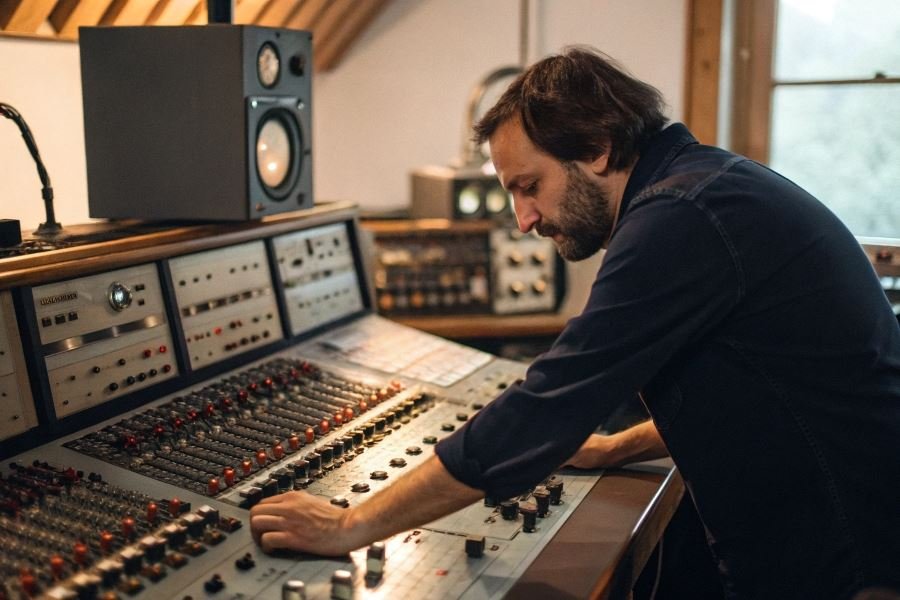
Ever wondered why some Grammy-winning engineers still lug around vintage hardware compressors worth thousands of dollars when plugin versions cost a fraction of the price? The answer lies in the fascinating intersection of technology, physics, and human perception.
At their core, hardware and software compressors serve identical purposes—controlling dynamic range by attenuating signals that exceed a threshold. Yet their approaches couldn’t be more different. Hardware units process audio through physical components—transformers, tubes, and transistors that impart subtle harmonic distortion and character. Software emulations, meanwhile, use mathematical algorithms to replicate these processes, offering unprecedented flexibility and recall capabilities.
The evolution of compression technology tells a compelling story. The legendary LA-2A compressor, introduced in 1962, remains coveted for its musical “glue” despite modern alternatives. Digital compression began as clinical and sterile, but advanced modeling techniques have narrowed the gap dramatically. Today’s premium plugins can capture the essence of classic hardware with astonishing accuracy.
When building your studio’s compression toolkit, consider three critical factors:
- Workflow requirements – Do you need instant recall for multiple projects?
- Sound character – Are you seeking transparent control or colorful saturation?
-
Budget constraints – Can you justify $3,000 for a single hardware unit versus $200 for a suite of software options?
The most successful studios typically employ a hybrid approach, using hardware on critical elements while leveraging software for flexibility and experimentation.
The Technical Showdown: Software vs Hardware Compressors
When building a professional studio, few decisions impact your sound signature as profoundly as choosing between software and hardware compressors. The debate between digital plugins and physical units isn’t just about preference—it’s about specific technical advantages that shape your production workflow. Let’s dive into the specifications that truly matter.
Analog warmth vs digital precision
The fundamental difference between hardware and software compressors begins at the circuit level. Hardware compressors process audio through physical components—transformers, tubes, and transistors—that impart subtle harmonic distortion. This creates what engineers call “analog warmth,” a pleasant coloration that adds character to vocals and instruments. The Universal Audio 1176 hardware compressor, for instance, delivers a distinctive FET-based compression that adds punch to drums that’s difficult to replicate digitally.
Software compressors, on the other hand, excel at mathematical precision. When deciding between software vs hardware compressors for your studio setup, consider that digital algorithms can achieve perfect parameter recall, ultra-precise attack times down to microseconds, and completely transparent operation when needed. The FabFilter Pro-C2 offers visualization tools showing exactly how compression affects your signal—something impossible with hardware.
Technical comparison:
| Specification | Hardware Compressors | Software Compressors |
|---|---|---|
| Harmonic distortion | 0.1-5% (desirable) | 0.001-0.1% (or simulated) |
| Attack time range | 20μs-100ms (component-limited) | 0.01μs-500ms (algorithm-limited) |
| Recall precision | Manual/approximate | Perfect/automatable |
| Frequency response | Often colored (20Hz-20kHz ±3dB) | Potentially flat (20Hz-20kHz ±0.1dB) |
Workflow integration and operational flexibility
Hardware compressors demand a physical signal path. Each unit requires dedicated inputs, outputs, and potentially insert points on your console or interface. The Empirical Labs Distressor needs rack space, power, and physical patching—creating a tactile workflow that many engineers find intuitive and satisfying.
“The ability to reach out and adjust a physical knob creates a different relationship with the sound,” notes many veteran producers. However, this physicality comes with limitations: you can only use as many hardware compressors as you physically own.
Software plugins offer virtually unlimited instances, automated parameter changes, and A/B comparison capabilities. The Waves CLA-76 can be instantiated across dozens of tracks simultaneously, with different settings saved within your project. This scalability represents a fundamental workflow advantage:
Operational advantages:
- Hardware: Tactile control, zero latency, dedicated signal path
- Software: Unlimited instances, automation, preset management, visual feedback
Cost-benefit analysis over time
Initial investment versus long-term value presents perhaps the starkest contrast. A professional hardware compressor like the Manley Variable Mu commands approximately $4,800—a significant studio investment. However, properly maintained hardware often retains or even increases in value over decades.
Software subscriptions from companies like Slate Digital offer dozens of compressor emulations for around $15/month, while perpetual licenses for individual plugins typically range from $50-300. The digital approach provides vastly more variety per dollar but comes with potential obsolescence as operating systems evolve.
Investment comparison:
| Factor | Hardware | Software |
|---|---|---|
| Initial cost | $1,000-6,000 per unit | $0-300 per plugin |
| Maintenance | Periodic servicing ($100-300/year) | Updates included or subscription |
| Resale value | 70-120% of purchase price | Minimal to none |
| Longevity | 20+ years with maintenance | 5-10 years before potential compatibility issues |
The technical decision between hardware and software compression ultimately depends on your specific production needs, budget constraints, and the sonic character you’re pursuing. Many professional studios employ a hybrid approach—hardware compressors on critical signal paths like lead vocals and bass, with software handling the bulk of mixing duties where convenience and recall are paramount.
Making the Final Decision: Your Ultimate Compression Strategy
Embracing the Hybrid Approach
The most successful modern studios aren’t choosing between software and hardware compressors—they’re strategically combining both. This hybrid approach leverages the strengths of each technology while minimizing their limitations.
Complementary workflows emerge when you pair hardware and software compression. For example, tracking through an API 2500 hardware compressor to capture that immediate analog character, then fine-tuning with FabFilter Pro-C 2 during mixing provides exceptional control and sonic options.
Many engineers apply this strategy by category:
- Hardware compression on critical elements (vocals, bass, drums)
- Software compression for auxiliary buses and subtle dynamic control
- Hardware for “character” and software for “precision”
The hybrid studio isn’t about having everything—it’s about having the right tools that complement each other in your specific workflow.
This approach also allows for gradual investment, starting with quality plugins and adding hardware pieces as budget permits.
Matching Tools to Production Scale
Your studio’s physical size and production requirements dramatically influence compression choices.
| Studio Type | Recommended Compression Approach |
|---|---|
| Bedroom/Home | Software-focused with 1-2 hardware units for character |
| Project Studio | Balanced hybrid approach with 4-6 hardware compressors |
| Commercial Facility | Extensive hardware collection with software for efficiency |
For smaller spaces, consider compact hardware like the Warm Audio WA-76 or DBX 560A that deliver professional results without consuming precious real estate.
Production volume matters too. If you’re handling multiple sessions daily, software compression offers workflow advantages through recall capabilities and session portability. Studios focusing on specific genres might prioritize differently—electronic music producers often prefer software flexibility, while vintage rock productions might benefit from hardware character.
Budget reality check: A single Manley Variable Mu hardware compressor costs approximately $4,800, while the entire Waves Gold Bundle with dozens of compressor emulations runs about $799. The value equation differs dramatically based on your production needs.
Future-Proofing Your Compression Arsenal
The audio technology landscape evolves constantly, requiring strategic thinking about long-term investments.
Hardware compressors from respected manufacturers like Neve, SSL, and Universal Audio typically maintain their value—and sometimes appreciate—over decades. They represent both sonic tools and financial assets.
Software, while more ephemeral, offers continuous improvement through updates. The UAD Luna recording system exemplifies this evolution, blurring the line between hardware and software with its integrated approach to compression processing.
Expandability considerations should include:
- Rack space and power requirements for hardware expansion
- Computer processing headroom for additional plugins
- Integration capabilities between analog and digital domains
- Learning curve associated with new tools
The most adaptable studios maintain a core set of versatile compressors while experimenting with rental or subscription options before committing to permanent additions.
Remember that compression technology continues advancing in both domains—neither hardware nor software represents a technological dead end. The wisest approach focuses on building a toolkit that serves your creative vision while remaining flexible enough to incorporate future innovations.
Discover the essential differences between hardware and software compressors for professional audio production. Learn how to choose the perfect compression solution based on sound character, workflow, and budget for your studio setup.
Discover the essential differences between hardware and software compressors for professional audio production. Learn how to choose the perfect compression solution based on sound character, workflow, and budget for your studio setup.