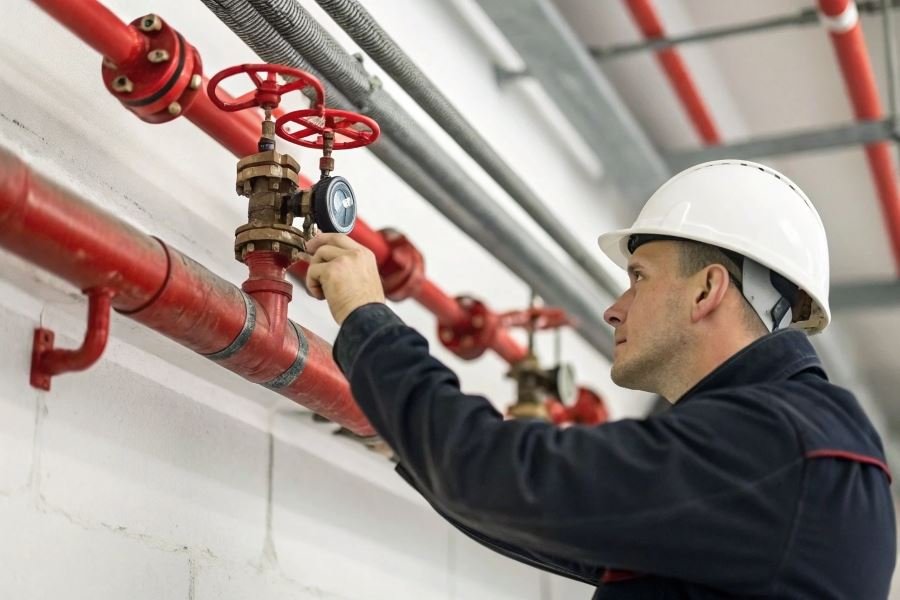
When was the last time you looked up at those small, unassuming devices mounted on your ceiling? Fire sprinklers—these silent sentinels have saved countless lives and billions in property, yet most of us barely notice them until they’re needed.
The journey of temperature-activated fire sprinklers began in 1874 when Henry S. Parmelee, a piano manufacturer concerned about protecting his factory, invented the first automatic sprinkler head. His innovation used a heat-sensitive solder that would melt at specific temperatures, releasing water to douse flames. This fundamental principle—that different fires require different activation temperatures—remains at the core of modern sprinkler technology.
Today’s temperature-activated sprinklers operate on a brilliantly simple premise: they remain dormant until heat triggers them. At the heart of each sprinkler is a glass bulb filled with a temperature-sensitive liquid or a fusible link designed to break at specific temperatures. When a fire generates enough heat, the liquid expands, shattering the bulb, or the link melts, allowing the water to flow precisely where it’s needed.
The science of precision activation
Understanding these activation modes isn’t just technical trivia—it’s critical knowledge that determines whether a system responds appropriately to a fire event. Too sensitive, and you risk unnecessary water damage from false activations. Too high a temperature rating, and the fire might grow beyond containment before sprinklers engage.
This delicate balance between sensitivity and reliability has made modern fire sprinkler systems one of the most effective life safety technologies ever developed, reducing fire deaths by approximately 80% when properly installed.
Fire Sprinkler Temperature Activation: The Science That Saves Lives
Fire protection systems operate silently in the background until that critical moment when every second counts. At the heart of these systems lies a fascinating mechanism that determines when sprinklers activate. Understanding the temperature activation modes of fire sprinklers is essential knowledge for anyone responsible for building safety or fire protection systems.
The engineering behind fire sprinkler activation represents one of the most elegant solutions in safety design. Temperature activation modes of fire sprinklers: what is important to know revolves around three primary mechanisms, each with specific applications and temperature thresholds designed to respond appropriately to different fire scenarios and environments.
Fusible Link Mechanisms: The Original Innovation
The fusible link or solder element activation mechanism remains one of the most widely deployed solutions in commercial and residential settings. These sprinklers feature a metal link held together by a specially formulated solder designed to melt at precise temperatures.
How they work: Two metal pieces are joined by a solder engineered to melt at a specific temperature (typically between 135°F and 170°F). When ambient heat reaches the threshold, the solder melts, the link separates, and water flows.
The beauty of this design lies in its simplicity and reliability—no power source required, just fundamental physics.
Common applications include:
- Residential properties
- Office buildings
- Retail spaces
- Standard commercial environments
Glass Bulb Systems: Color-Coded Protection
Perhaps the most visually recognizable sprinkler type features a small glass bulb containing temperature-sensitive liquid.
The color code system provides instant visual identification of temperature ratings:
| Bulb Color | Temperature Rating | Typical Applications |
|---|---|---|
| Orange | 135°F (57°C) | Residential, offices |
| Red | 155°F (68°C) | Commercial, standard settings |
| Yellow | 175°F (79°C) | Manufacturing, kitchens |
| Green | 200°F (93°C) | Bakeries, industrial |
| Blue | 286°F (141°C) | High-heat industrial processes |
These bulbs contain a precise mixture of glycerin and alcohol that expands when heated. As temperatures rise, the liquid expands until the pressure shatters the glass, releasing the sprinkler’s water flow mechanism.
The engineering precision required to manufacture these bulbs to activate within 3°F of their rated temperature is remarkable.
Chemical Pellet Activation: Specialized Solutions
For environments with unique challenges, chemical pellet activation methods offer specialized protection.
Key advantages include:
- Resistance to corrosive environments
- Exceptional reliability in extreme conditions
- Precise activation in specialized settings
These systems utilize a chemical compound that changes state at specific temperatures. Unlike fusible links or glass bulbs, these pellets can be engineered for environments where standard activation methods might be compromised by corrosion, vibration, or other challenging conditions.
Applications include:
- Chemical processing facilities
- Marine environments
- Freezers and cold storage
- Areas with significant temperature fluctuations
The selection of the appropriate temperature activation mechanism isn’t merely a technical decision—it’s a critical safety calculation based on occupancy, potential fire characteristics, ambient conditions, and response time requirements. Each system represents decades of engineering refinement aimed at one goal: protecting lives and property when seconds matter most.
Choosing the Right Temperature Activation for Fire Sprinklers
Fire sprinkler systems represent the first line of defense against catastrophic fire damage, but their effectiveness hinges on one critical factor: selecting the appropriate temperature activation mode. This decision isn’t merely technical—it’s the difference between optimal protection and potential system failure when you need it most.
Environmental Factors That Drive Selection
The environment where sprinklers operate fundamentally dictates their temperature rating requirements. Consider this: a standard commercial kitchen regularly experiences ceiling temperatures of 150-175°F during peak operation, while a typical office space maintains a steady 70-75°F.
Temperature differential matters enormously. Sprinklers must activate quickly during fires but remain dormant during normal operations. This balance requires careful consideration of:
- Ambient temperature fluctuations
- Ceiling height (heat stratification)
- Proximity to heat-generating equipment
- Exposure to direct sunlight
- HVAC system patterns
In manufacturing facilities with heat-producing machinery, higher-rated sprinklers (212°F/100°C or above) prevent false activations. Conversely, residential settings typically benefit from lower-rated sprinklers (135-165°F/57-74°C) for faster response during emergencies.
The temperature rating of a sprinkler should exceed the highest expected ceiling temperature by at least 25-50°F to prevent accidental discharge while ensuring timely activation during actual fires.
Building Codes and Compliance Requirements
Building codes don’t leave temperature selection to chance. The National Fire Protection Association (NFPA) standards—particularly NFPA 13—provide comprehensive guidelines that must be followed.
Temperature selection compliance includes:
| Building Type | Typical Temperature Rating | Code Reference |
|---|---|---|
| Residential | 135-165°F (57-74°C) | NFPA 13R/13D |
| Commercial | 155-200°F (68-93°C) | NFPA 13 |
| Industrial | 200-286°F (93-141°C) | NFPA 13 |
| Special Hazard | 286-500°F (141-260°C) | NFPA 13 |
Local jurisdiction requirements may exceed national standards. Many municipalities have adopted enhanced requirements based on regional risks or historical fire data. Always verify local amendments to national codes before finalizing system design.
The International Building Code (IBC) further reinforces these requirements through its fire protection chapters, creating a comprehensive framework that designers and building owners must navigate.
Maintenance Protocols Across Temperature Ranges
Different temperature ratings demand tailored maintenance approaches. Higher-temperature sprinklers often utilize more robust heat-sensitive elements that require specific testing protocols.
Maintenance considerations include:
- Quarterly visual inspections to check for corrosion, paint, or physical damage
- Annual testing of water flow alarms and control valves
- Five-year internal inspection of piping systems
- Testing representative samples from sprinkler lots older than 50 years
For specialized environments like freezers or furnace areas, maintenance frequency typically increases due to the extreme conditions. Documentation becomes particularly critical—temperature-rated systems require meticulous record-keeping to demonstrate ongoing compliance.
The American Fire Sprinkler Association (AFSA) recommends creating environment-specific maintenance schedules that account for the unique challenges posed by different temperature activation modes.
By aligning temperature activation modes with environmental conditions, code requirements, and appropriate maintenance protocols, building owners ensure their sprinkler systems deliver reliable protection when it matters most.
Discover how fire sprinkler temperature activation systems work, from fusible links to color-coded glass bulbs. Learn to select the right activation mode based on environmental factors and building codes for optimal fire protection.
Discover how fire sprinkler temperature activation systems work, from fusible links to color-coded glass bulbs. Learn to select the right activation mode based on environmental factors and building codes for optimal fire protection.