
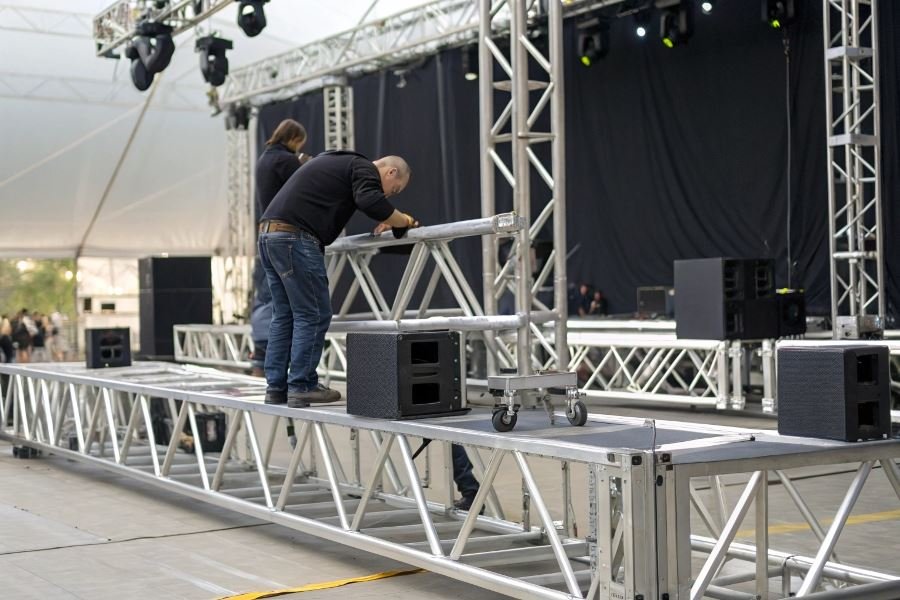
Ever watched a headline act at Coachella and wondered what’s keeping that massive video wall suspended 40 feet above the stage? Or how presidential debate podiums stay rock-solid despite the heated exchanges happening atop them? The unsung heroes of these moments are stage trusses and podiums—the literal foundation upon which unforgettable events are built.
When planning events, from intimate corporate gatherings to stadium-sized productions, the structural elements often take a backseat to lighting and sound in the planning process. Yet, these frameworks determine not just what’s possible for your event, but what’s safe. The collapse of a temporary stage structure at the Indiana State Fair in 2011 resulted in seven fatalities—a stark reminder that structural integrity isn’t just about aesthetics.
Today’s event infrastructure must balance three critical factors: structural integrity, compliance with safety standards, and adaptability to venue specifications. Professional-grade aluminum trusses can support anywhere from 500 to 3,000 pounds depending on their configuration, while modular podium systems offer customizable heights from 8 inches to 6 feet.
“The right truss system isn’t just about holding weight—it’s about creating possibilities while eliminating risks.”
Industry standards like TUV certification and ANSI E1.2-2012 guidelines aren’t just bureaucratic hurdles; they’re the difference between a flawless event and a potential disaster. Matching your equipment to both your creative vision and venue requirements isn’t just good planning—it’s essential engineering that transforms ambitious concepts into breathtaking realities.
Scaling Your Stage: Choosing the Right Trusses and Podiums
Event production is a game of precision engineering where the right staging infrastructure can make or break your show. Whether you’re hosting an intimate corporate gathering or a stadium-filling concert, understanding how to choose stage trusses and podiums for events of different scales is crucial for both safety and spectacle. Let’s break down the selection process based on event size and requirements.
Small-scale events: Lightweight champions
For intimate gatherings of 50-200 attendees, portable solutions reign supreme. These events demand equipment that’s:
- Quick to deploy (typically under 2 hours)
- Manageable by 1-3 crew members
- Transportable in standard vehicles
Triangle Truss Systems offer excellent small-venue solutions with their F23-F34 series, weighing just 7-12 lbs per linear foot. These aluminum structures provide surprising strength-to-weight ratios while maintaining a professional appearance.
For podiums, consider modular deck systems with heights between 12-24 inches. The Intellistage portable staging system deserves attention with its tool-free assembly and 125 lbs/sq ft load capacity.
Key advantage: These systems typically pack into cases that fit standard doorways and elevators, eliminating logistical headaches at venues with limited access.
Medium-scale events: The balancing act
When your audience grows to 200-1,000 people, your staging requirements enter a critical transition zone where:
- Setup time extends to 4-8 hours
- Crew requirements increase to 4-8 people
- Load capacities must accommodate more equipment
Medium events require truss systems that balance durability with reasonable setup times. The Global Truss F34 series hits this sweet spot with its 12-inch square design and 3,500 lb center load capacity.
For podiums, adjustable-height systems with 24-48 inch ranges provide versatility. Look for platforms with integrated guardrails and stairs that meet local safety codes.
| Truss Type | Load Capacity | Typical Span | Setup Complexity |
|---|---|---|---|
| 12″ Box | 2,500-3,500 lbs | 20-40 ft | Moderate |
| 12″ Triangle | 1,800-2,200 lbs | 15-30 ft | Low-Moderate |
| 16″ Box | 4,000-5,000 lbs | 30-50 ft | Moderate-High |
Large-scale events: No compromises
For major productions with 1,000+ attendees, your staging infrastructure requires:
- Professional installation teams (8+ crew members)
- Heavy machinery for assembly (forklifts, chain motors)
- Engineering sign-offs and load calculations
Large events demand heavy-duty truss systems like the Tomcat GP series or James Thomas Engineering SuperTruss. These systems feature 20-24 inch profiles with load capacities exceeding 10,000 lbs over 60-foot spans.
Podium systems for large events should be engineered with:
- Multiple access points for talent and crew
- Integrated cable management
- Modular design allowing custom configurations
Safety considerations become paramount at this scale. Always factor in:
- Wind loads for outdoor installations
- Point load distribution on venue floors
- Proper ballasting for ground-supported structures
Remember that large-scale installations often require 1-3 days for setup and specialized transport logistics. Budget accordingly for both time and equipment.
The investment in professional-grade staging pays dividends in both safety and production value, especially when your event is in the spotlight.
The Backbone of Your Event: Selecting Quality Stage Infrastructure
Material Quality and Load Capacity: The Foundation of Safety
When evaluating stage trusses and podiums, material composition is non-negotiable. Aluminum trusses dominate the market for good reason—they offer an exceptional strength-to-weight ratio. Professional-grade trusses typically use 6082-T6 aluminum alloy, which delivers superior structural integrity while remaining lightweight enough for efficient transport.
Load-bearing capacity should be your north star in this decision. A standard 12-inch box truss can support between 1,500-3,000 pounds distributed load, but these specifications vary dramatically between manufacturers. Always request detailed load charts that specify:
- Maximum point load (weight at a single point)
- Distributed load (weight spread across the truss)
- Span capabilities (maximum distance between supports)
Never accept vague specifications when lives and equipment literally hang in the balance.
For podiums, look beyond the surface finish to the core construction. Steel-reinforced platforms with birch plywood tops offer the ideal balance of durability and acoustic performance. Premium systems like those from Staging Concepts feature load ratings exceeding 150 pounds per square foot—essential when hosting multiple performers or heavy equipment.
Equipment Compatibility: Creating a Seamless Technical Ecosystem
Your trussing system must integrate flawlessly with lighting, sound, and visual equipment. Consider these critical compatibility factors:
Mounting options determine what can be attached and how quickly. Look for trusses with pre-drilled mounting points and compatible clamp systems that allow for rapid deployment of:
- Moving lights (requiring secure mounting and power/data access)
- Line array speakers (demanding precise load distribution)
- LED walls (requiring perfect alignment capabilities)
Cable management pathways are frequently overlooked until you’re wrestling with hundreds of feet of cabling during setup. Premium truss systems include integrated channels for clean, safe cable routing.
Control system integration becomes crucial for larger events. Modern stage infrastructure should accommodate DMX, Ethernet, and power distribution systems without requiring makeshift solutions.
| Equipment Type | Required Truss Features | Common Compatibility Issues |
|---|---|---|
| Moving Lights | Half-coupler compatibility, load rating | Insufficient power distribution |
| LED Screens | Precise alignment capability, high load rating | Inadequate support for processors |
| Sound Arrays | Vibration resistance, distributed load capacity | Cable interference with audio signals |
Long-term Investment: Beyond the First Event
The true cost of stage infrastructure extends far beyond the initial purchase price. Transportation logistics can quickly become your largest recurring expense. Modular systems from manufacturers like Global Truss offer significant advantages through:
- Nested design for compact transport
- Quick-connect mechanisms reducing labor costs
- Standardized components enabling gradual system expansion
Storage considerations directly impact longevity. Aluminum trusses are corrosion-resistant but not corrosion-proof. Invest in proper storage cases and climate-controlled facilities to extend equipment life by years.
The most expensive truss is the one you have to replace prematurely due to preventable damage.
For podiums, look for systems with replaceable components. When a single damaged deck can render an entire system unusable, the ability to replace individual elements becomes a significant cost advantage over time.
The most successful event companies view their stage infrastructure as a decade-long investment. Premium systems from established manufacturers maintain compatibility across generations of products, allowing you to expand your inventory without rendering existing components obsolete.
Discover expert strategies for selecting the right stage trusses and podiums for events of any size. Learn about load capacity, material quality, and compatibility with equipment to ensure safe, professional staging solutions for your next event.
Discover expert strategies for selecting the right stage trusses and podiums for events of any size. Learn about load capacity, material quality, and compatibility with equipment to ensure safe, professional staging solutions for your next event.