Ever wondered why some packages arrive wrapped tight like a drum while others seem shrink-wrapped like they’ve been through a heat wave? Behind this packaging mystery lies a strategic decision that impacts billions of dollars in shipping costs annually.
When it comes to securing products for transport, two titans dominate the industrial packaging arena: stretch film and shrink film. Though they might look similar to the untrained eye, these materials represent fundamentally different approaches to the same challenge.
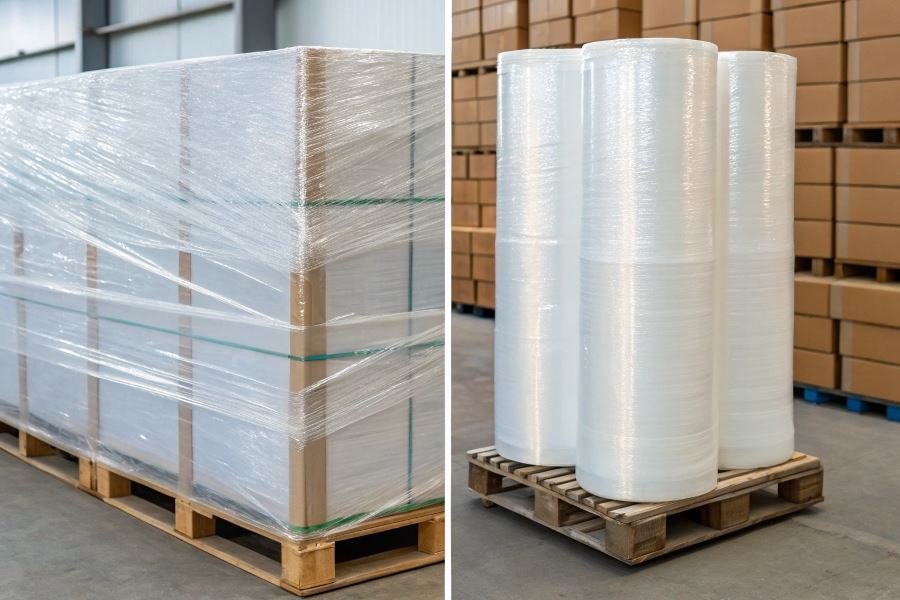
Stretch film is a highly elastic plastic material, typically made from linear low-density polyethylene (LLDPE). Its defining characteristic is the ability to elongate when pulled—often stretching 500% or more from its original length—creating tension that secures loads without heat application. This “memory” effect causes the film to constantly try returning to its original state, creating a secure hold around pallets and products.
Shrink film, by contrast, is manufactured from polyolefin, PVC, or polyethylene materials designed to contract when heat is applied. The molecular structure of shrink film is “frozen” during manufacturing, then releases and contracts when heated, creating a tight, custom-fit package.
“The difference between these films isn’t just technical—it’s economic. The right choice can reduce material costs by up to 40% while improving load stability.” — Packaging Industry Report
Market landscape and applications
The global industrial film market exceeds $25 billion, with stretch film claiming approximately 60% of applications. Manufacturing, food and beverage, and e-commerce sectors drive demand, with sustainability concerns reshaping material formulations.
Stretch film dominates in:
- Pallet stabilization
- Bundling multiple items
- Warehouse storage
Shrink film excels in:
- Retail-ready packaging
- Tamper-evident applications
- High-clarity product display
Effectiveness factors
Three critical elements determine which film delivers superior results:
- Load characteristics: Weight, shape uniformity, and stability requirements
- Environmental conditions: Temperature fluctuations during transport and storage
- Operational efficiency: Equipment costs, labor requirements, and application speed
The most effective solution balances protection with material efficiency—the ideal film uses the minimum amount of material while providing maximum load security and product protection.
The Technical Showdown: Stretch vs. Shrink Film
Material Composition and Performance
Stretch film and shrink film represent two distinct approaches to packaging technology, each with unique material properties that determine their effectiveness in different scenarios. Stretch film typically consists of linear low-density polyethylene (LLDPE), while shrink film commonly uses polyolefin, PVC, or polyethylene.
When examining the comparison of stretch film and shrink film to determine which is more effective, material composition emerges as the fundamental differentiator. Stretch film’s elasticity allows it to conform to irregular shapes without heat application, creating tension that secures loads through its “memory” property. This elasticity provides 25-300% elongation capability, with premium films reaching up to 400% stretch.
Shrink film, by contrast, offers superior clarity and rigidity. With tensile strengths ranging from 3,000-12,000 PSI depending on the formulation, shrink film creates a drum-tight seal when heat is applied, making it particularly effective for retail packaging where presentation matters. The material thickness typically ranges from 45-150 gauge (0.45-1.5 mil), with specialized films available for extreme temperature conditions (-60°F to 250°F).
Application Process and Equipment Requirements
The application methods for these films create significant operational differences:
| Feature | Stretch Film | Shrink Film |
|---|---|---|
| Application Method | Mechanical stretching | Heat application |
| Equipment Needed | Stretch wrapper (2, 000−50,000) | Heat tunnel (5, 000−100,000) |
| Energy Requirements | Low (mechanical only) | High (constant heat source) |
| Setup Complexity | Minimal | Moderate to complex |
| Throughput Speed | 30-60 pallets/hour | 10-30 packages/minute |
Stretch film application requires minimal equipment—often just a stretch wrapper like those from Lantech or manual application tools. The process is straightforward: the film is stretched around the load, creating tension that secures items together.
Shrink film demands more sophisticated equipment, including heat tunnels, sealing bars, and sometimes shrink chambers. Systems from manufacturers like Shanklin require careful calibration of temperature settings (typically 300-400°F) and conveyor speeds to achieve optimal results without film degradation or product damage.
Cost Analysis: Initial vs. Long-term Value
The financial equation extends beyond material costs:
Initial Investment:
- Stretch film systems: Lower entry point (2, 000−10,000 for basic wrappers)
- Shrink systems: Higher initial cost (15, 000−100,000 for complete systems)
Operational Costs:
- Stretch film: 0.01−0.03 per square foot, minimal energy costs
- Shrink film: 0.02−0.05 per square foot, plus significant energy consumption (15-40 kWh per operational day)
When calculating total cost of ownership over a 5-year period, stretch film systems typically demonstrate 15-30% lower operational costs, despite potentially higher material usage in some applications. However, shrink film’s superior product protection can reduce damage rates by up to 40% for fragile items, potentially offsetting the higher operational expenses.
Environmental Impact and Sustainability
The sustainability profile of these materials has evolved significantly:
-
Material Reduction: Modern stretch films have achieved up to 50% material reduction through nano-layer technology while maintaining load stability.
-
Recycling Compatibility: Both films are technically recyclable, but stretch film’s single-polymer composition makes it more readily accepted in recycling streams (resin identification code #4).
-
Energy Footprint: Shrink film’s heat requirements create a larger carbon footprint—approximately 0.5-1.2 kg CO2 per 1,000 packages compared to stretch film’s 0.2-0.4 kg CO2 equivalent.
-
Biodegradable Alternatives: New bio-based stretch films incorporating plant starches can decompose in 2-5 years versus 500+ years for traditional films, though with a 20-30% cost premium.
The environmental calculation increasingly favors stretch film, particularly as manufacturers like Berry Global introduce PCR (post-consumer recycled) content options with up to 30% recycled material without compromising performance specifications.
The technical differences between these films ultimately create distinct value propositions: stretch film offers operational simplicity and cost efficiency, while shrink film provides superior product presentation and protection for certain applications. The effectiveness question isn’t which is better—but rather which aligns with your specific packaging requirements.
Making the Right Choice: Stretch vs Shrink Film
Where Stretch Film Shines Brightest
Stretch film has carved out its dominance in specific applications where flexibility and cost-efficiency are paramount. The material excels in warehouse environments where pallets need frequent access or reconfiguration. Its primary advantage lies in its application simplicity—no heat required means lower equipment investment and reduced energy costs.
For businesses handling temperature-sensitive products like pharmaceuticals or certain foods, stretch film provides protection without the thermal stress that heat-shrinking methods introduce. The film’s elasticity creates a tight hold through tension alone, making it ideal for irregularly shaped items that would challenge shrink film’s uniform contraction.
The ability to apply varying tension levels makes stretch film particularly versatile when securing mixed loads or products with protruding edges.
Stretch film also dominates in high-volume operations where throughput speed matters. A skilled operator can wrap a pallet in under a minute, while automated stretch wrappers can process 30-100+ loads per hour depending on the model.
Shrink Film’s Sweet Spots
Shrink film transforms into a packaging powerhouse when product presentation and tamper-evidence take priority. The material creates a skin-tight barrier that conforms perfectly to product contours, making it the go-to choice for retail-ready packaging where aesthetics matter.
The film’s ability to create hermetic seals makes it exceptional for moisture-sensitive products requiring maximum protection from environmental factors. This characteristic has made shrink film standard in industries like:
| Industry | Application | Key Benefit |
|---|---|---|
| Food & Beverage | Multipacks, bottle bundling | Tamper-evidence, display clarity |
| Publishing | Books, magazines | Dust protection, presentation |
| Electronics | Components, accessories | Moisture barrier, anti-static options |
| Consumer Goods | Boxed products | Theft deterrence, brand enhancement |
Shrink film’s superior clarity after application makes it unmatched for products where visibility drives sales. The glossy, transparent finish enhances product appearance while providing substantial protection.
Your Decision Framework
Selecting between these packaging solutions requires evaluating several critical factors:
-
Product characteristics: Fragile items with sharp edges often fare better with stretch film’s gentler application, while products benefiting from display enhancement typically justify shrink film.
-
Operational capacity: Consider your throughput requirements against equipment investment. Stretch wrapping requires minimal startup costs, while shrink systems demand higher initial investment but may deliver superior results for certain applications.
-
Environmental conditions: If your products move through varying temperature zones during distribution, stretch film typically handles these transitions with less risk of loosening or tearing.
-
Total cost analysis: Look beyond material costs to include:
- Equipment maintenance
- Energy consumption
- Labor requirements
- Material waste percentage
The most effective packaging solution isn’t necessarily the cheapest per linear foot—it’s the one that delivers your product undamaged while optimizing your total operational efficiency.
For businesses seeking maximum flexibility with minimal investment, stretch film typically provides the better entry point. However, companies focused on brand perception and retail-ready packaging often find shrink film’s superior aesthetics worth the additional processing requirements.
The ultimate decision should align with your specific product protection needs, operational capabilities, and customer expectations rather than following industry trends alone.
Discover the key differences between stretch and shrink film packaging solutions to make the right choice for your business. Compare material properties, application processes, cost efficiency, and environmental impact to maximize your packaging effectiveness.
Discover the key differences between stretch and shrink film packaging solutions to make the right choice for your business. Compare material properties, application processes, cost efficiency, and environmental impact to maximize your packaging effectiveness.