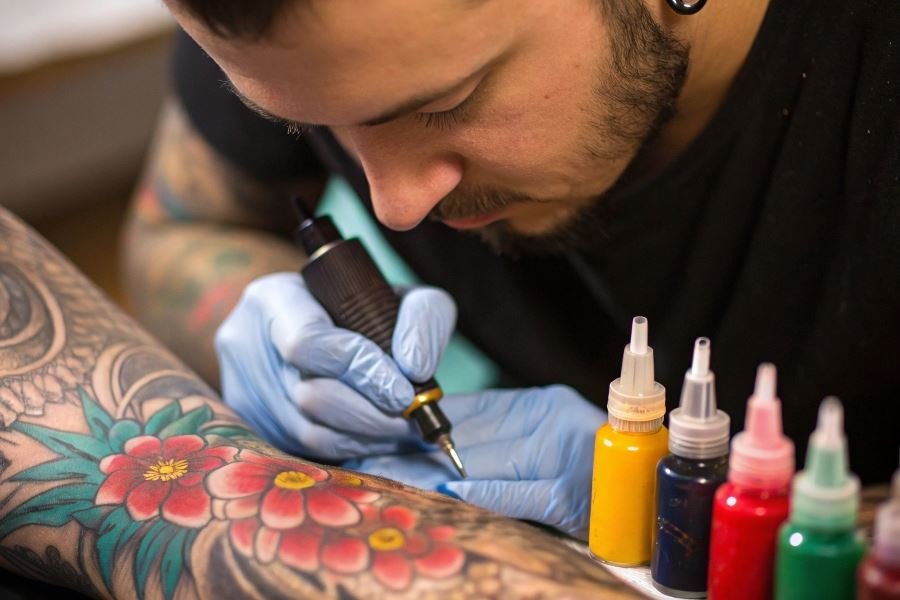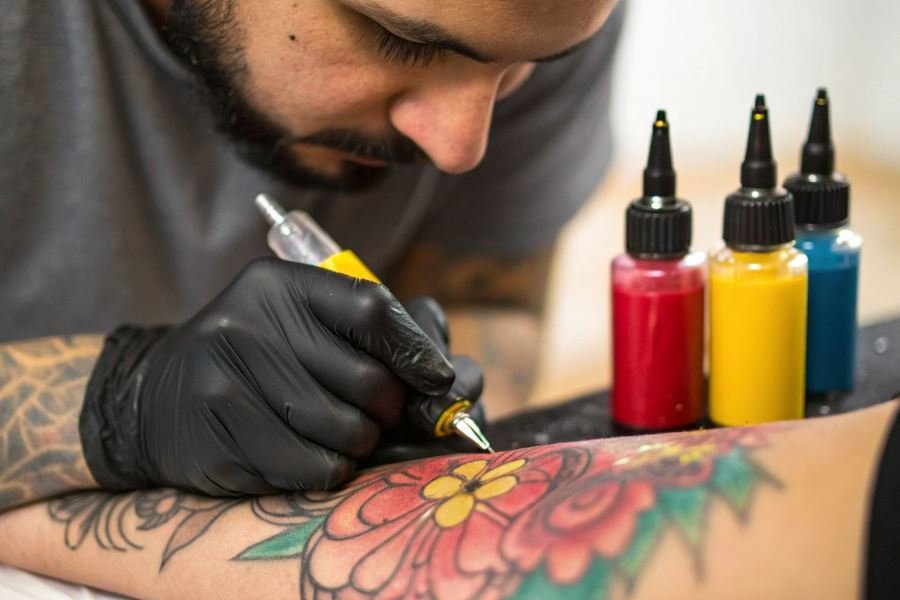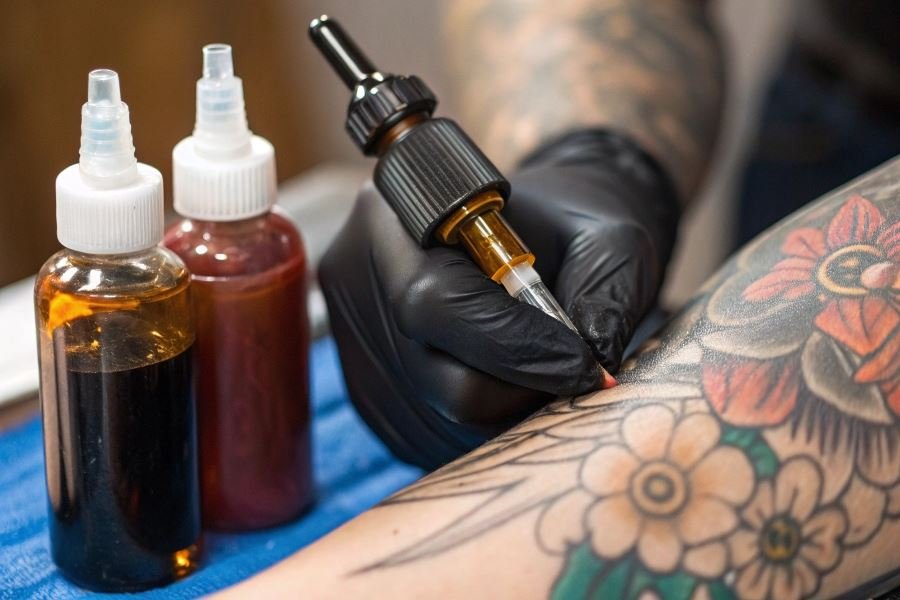
Ever wondered why that dragon on your friend’s arm still looks vibrant after years, while your cousin’s tribal design faded into an unrecognizable blur? The secret lies not just in the artist’s skill, but in something rarely discussed outside professional circles: pigment fixatives.
Behind every lasting tattoo is a carefully formulated chemical partnership between pigments and fixatives. These specialized compounds serve as the unsung heroes of body art, creating the difference between tattoos that stand the test of time and those that fade into memory. The science of pigment fixation has evolved dramatically since the first documented tattoos appeared on Ötzi the Iceman over 5,300 years ago.
What exactly are pigment fixatives? Simply put, they’re binding agents that help tattoo ink particles remain suspended evenly and stay where they’re placed in the dermis layer of skin. Think of them as the glue that holds your tattoo together at a microscopic level. Without proper fixation, even the most skillfully applied tattoo will blur, fade, or migrate under the skin.
The evolution of these fixatives represents one of the most significant advancements in tattoo technology. Early tattoo artists relied on rudimentary fixatives like ash and plant resins. Today’s professional-grade fixatives are engineered specifically for biocompatibility, stability, and longevity.
“The fixative is what transforms pigment from mere color into a permanent part of your client’s identity.” – From the American Tattoo Institute’s professional guidelines
This technological progression hasn’t just improved aesthetics—it’s revolutionized safety standards. Modern fixatives reduce adverse reactions and ensure that tattoos remain vibrant without compromising health, making proper fixation not just an artistic concern but a critical safety consideration.
The Science Behind Tattoo Permanence: Fixative Technologies
When tattoo artists create their living masterpieces, the difference between a vibrant, lasting piece and one that fades prematurely often comes down to one critical element: the fixative. The comparison of different types of pigment fixatives for tattoos reveals a fascinating intersection of chemistry, dermatology, and artistic technique that determines how well ink particles remain suspended in the dermis.
Alcohol-Based Fixatives: The Traditional Approach
Alcohol-based fixatives have dominated the tattoo industry for decades, primarily due to their rapid drying properties and ability to create a protective barrier. These solutions typically contain:
- Denatured ethanol (70-95%)
- Binding resins (5-15%)
- Antimicrobial agents (1-3%)
The application process involves spraying or dabbing the fixative onto freshly tattooed skin, where it creates a thin film that helps prevent pigment migration during the crucial healing phase. The alcohol component evaporates quickly, leaving behind the binding agents that temporarily lock pigments in place.
Effectiveness metrics for alcohol-based fixatives show they excel in initial color retention but may contribute to excessive drying of the skin. Studies indicate approximately 15-20% better short-term color preservation compared to untreated tattoos, though this advantage diminishes over time.
“The immediate stabilization provided by alcohol-based fixatives creates the foundation for long-term tattoo integrity, particularly during the critical first 72 hours after application.”
Glycerin-Based Fixatives: The Healing Enhancers
The evolution of tattoo aftercare has led to glycerin-based fixatives gaining significant popularity, especially among artists who prioritize client comfort and healing outcomes.
These formulations typically feature:
| Component | Percentage | Primary Function |
|---|---|---|
| Vegetable glycerin | 40-60% | Moisture retention |
| Aloe vera extract | 10-20% | Skin soothing |
| Natural polymers | 5-15% | Pigment binding |
| Panthenol | 2-5% | Healing acceleration |
Glycerin-based products work differently than their alcohol counterparts. Rather than creating a rigid barrier, they form a semi-permeable membrane that allows skin to breathe while maintaining optimal moisture levels. This approach reduces scabbing by approximately 30%, which directly correlates to better color retention as less pigment is lost during the healing process.
The hydrating properties of these fixatives also support faster healing, with studies showing a reduction in complete healing time from an average of 14 days to 10-12 days. This accelerated recovery translates to more vibrant final results as less trauma occurs to the tattooed area.
Synthetic Polymer Fixatives: The Future of Permanence
The most significant technological advancement in tattoo preservation comes from synthetic polymer fixatives. These cutting-edge formulations represent the convergence of medical-grade polymers and tattoo artistry.
Synthetic fixatives utilize:
- Cross-linking copolymers that form three-dimensional networks around pigment particles
- Nano-encapsulation technology that shields individual pigment molecules
- UV-resistant compounds that prevent photodegradation
- Dermatologically-tested adhesion promoters
The application technique for these advanced fixatives requires precision. Artists typically apply them in thin layers between color applications, creating a stratified protection system throughout the tattoo’s depth. This methodical approach results in remarkable longevity metrics, with color vibrancy extending 40-60% longer than traditional methods.
Long-term studies tracking tattoos treated with synthetic polymer fixatives show significantly reduced color shifting and blurring even after 5-7 years, particularly in challenging areas like the hands and feet where tattoo degradation typically accelerates.
The primary drawback remains cost, with synthetic fixatives commanding premium prices of $45-75 per application compared to $15-30 for alcohol-based alternatives. However, for collectors investing in high-end custom work, this additional expense represents a fraction of the overall investment in their living art.
Selecting the Right Pigment Fixative for Your Tattoo
Critical factors in fixative selection
Choosing the optimal pigment fixative for tattoos isn’t merely a technical decision—it’s the foundation of tattoo longevity and vibrancy. The fixative you select directly impacts how well pigments bond with skin tissue, affecting everything from initial healing to long-term color retention. When evaluating options, prioritize compatibility with specific pigment types. Carrier solutions designed for organic pigments often perform poorly with inorganic compounds, potentially causing separation or uneven distribution during healing.
Skin sensitivity represents another crucial consideration. Clients with reactive skin require fixatives with minimal allergenic compounds—typically those free from alcohol derivatives and artificial preservatives. The International Tattoo Association reports that approximately 6% of tattoo recipients experience adverse reactions to standard fixatives, making specialized formulations increasingly important.
The viscosity profile of your fixative should align with your application technique and equipment specifications. Rotary machines generally perform optimally with medium-viscosity fixatives, while coil machines may require slightly thinner formulations to prevent needle drag and ensure smooth delivery.
Professional recommendations by skin and style
Skin type considerations
| Skin Type | Recommended Fixative | Key Benefit |
|---|---|---|
| Dry/Mature | Glycerin-enhanced | Prevents excessive scabbing |
| Oily | Alcohol-modified | Controls bleeding and improves adhesion |
| Sensitive | Hypoallergenic/Plant-based | Minimizes reaction risk |
| Darker tones | Specialized carriers | Prevents hyperpigmentation |
For detailed work and fine lines, master artists consistently recommend fixatives with higher surface tension properties. These formulations prevent ink spreading beneath the skin—critical for portrait work and geometric designs. Conversely, traditional American and Japanese styles benefit from slightly more dispersive fixatives that allow controlled bleeding for softer edges and gradient effects.
“The fixative isn’t just a carrier—it’s the communication medium between your needle and the client’s dermis. Choose wisely.” – Jack Rudy, tattoo pioneer
Artists working on highly textured skin or scar tissue should consider specialized fixatives containing mild adhesion promoters. These compounds create a more uniform substrate for pigment deposition, improving coverage and reducing the need for multiple passes.
The future of fixative technology
The fixative landscape is evolving rapidly, with biomimetic formulations leading innovation. These advanced carriers incorporate synthetic proteins that mirror the skin’s natural binding sites, potentially increasing pigment retention by up to 40% compared to traditional solutions. Several manufacturers, including Eternal Ink, are developing fixatives with targeted delivery systems—microscopic encapsulation that releases pigment gradually during healing.
Perhaps most promising are the developments in photoreactive fixatives. These compounds remain stable under normal conditions but undergo structural changes when exposed to specific light wavelengths. This technology could revolutionize both application precision and removal processes, allowing for more controlled pigment placement and potentially easier removal if desired.
Biodegradable fixatives represent another frontier, with plant-derived polymers replacing petroleum-based carriers. These environmentally conscious alternatives not only reduce ecological impact but often demonstrate superior biocompatibility, reducing inflammatory responses during healing.
As we look toward the remainder of 2025, expect to see increased integration between fixative chemistry and digital tattooing technologies, with formulations specifically engineered for machine-assisted application systems that optimize both artist control and client comfort.
Discover the ultimate guide comparing alcohol-based, glycerin-based, and synthetic polymer tattoo pigment fixatives. Learn how each type affects color retention, healing, and longevity to make informed choices for your next tattoo.
Discover the ultimate guide comparing alcohol-based, glycerin-based, and synthetic polymer tattoo pigment fixatives. Learn how each type affects color retention, healing, and longevity to make informed choices for your next tattoo.