Ever wondered why professional facials feel so different from at-home attempts? The secret often lies in specialized tools that elevate treatments from basic to transformative. Among these game-changers is the humble yet mighty Uno spoon.
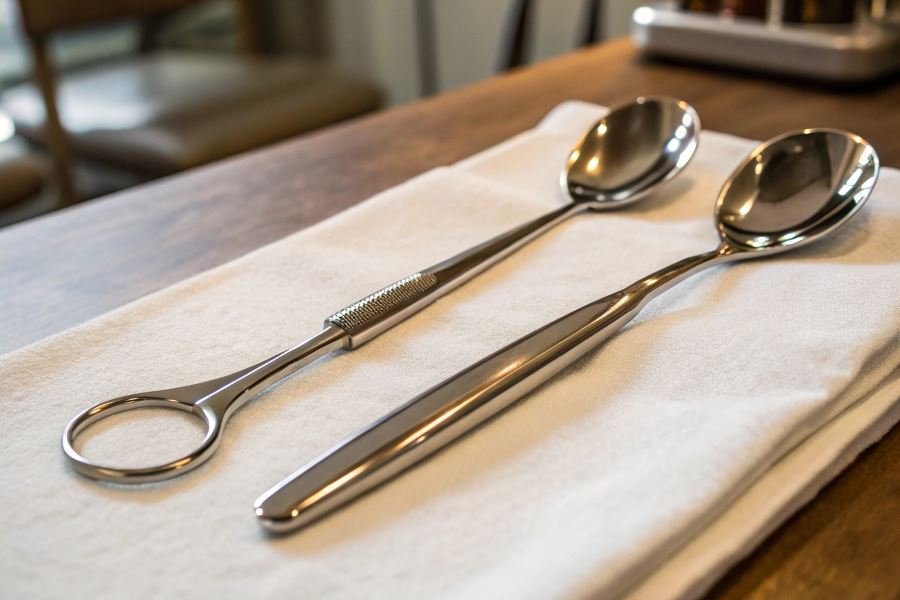
For beginner cosmetologists stepping into the world of facial treatments, mastering the Uno spoon technique can dramatically enhance client results and satisfaction. This double-ended stainless steel tool—featuring a flat end and a looped end—serves as an extension of your skilled hands, allowing for precise extraction, product application, and skin manipulation that fingers simply cannot achieve.
What exactly is a Uno spoon?
A Uno spoon (sometimes called a “comedone extractor”) is a professional-grade tool designed specifically for safe blemish extraction and facial treatments. Unlike improvised household items that can damage skin, the Uno spoon’s carefully engineered edges and pressure distribution make it the gold standard for:
- Blackhead and whitehead extraction without traumatizing surrounding tissue
- Precise product application in targeted treatment areas
- Gentle lymphatic drainage during facial massage sequences
Before you begin: Essential preparation
Proper preparation transforms your Uno spoon from mere metal to magic wand:
- Sterilization is non-negotiable – Autoclave your tools or use a medical-grade disinfectant solution
- Prepare the client’s skin – Thorough cleansing followed by steam or warm towel application softens pores
- Position lighting correctly – Angled, bright illumination reveals what needs attention
Safety first: Protecting your clients
The difference between amateur and professional treatments often comes down to safety protocols:
“The most skilled hands are worthless without proper hygiene practices.” – Industry wisdom that stands the test of time
Always wear gloves, maintain separate clean and used tool containers, and know when not to extract—including active infections, severe inflammation, or when clients are using certain medications that thin the skin.
Mastering the Uno Spoon: Essential Techniques for Facial Treatments
The Uno spoon—that elegant, dual-ended stainless steel tool—has revolutionized extraction procedures in modern esthetics. Its precision design allows for targeted treatment without the tissue damage often caused by fingertip extraction. Learning how to use a Uno spoon effectively requires understanding proper technique, directional awareness, and specific applications that make this tool indispensable for beginner cosmetologists entering the field.
Proper Hand Positioning: The Foundation of Control
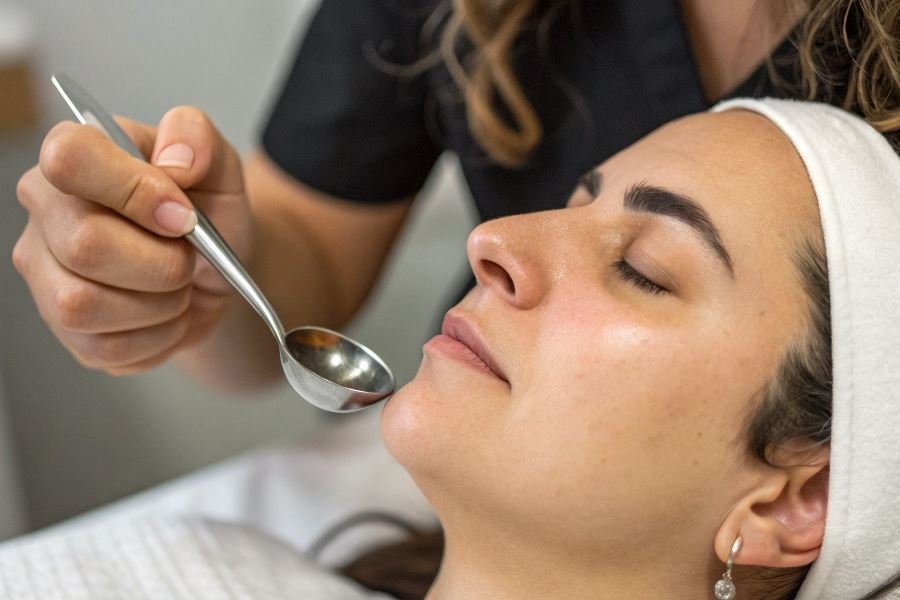
Success with the Uno spoon begins with your grip. Hold the tool like a pencil, approximately 1-2 inches from the working end. This provides the perfect balance between stability and flexibility. Your ring finger should rest lightly against the client’s face as an anchor point, creating what professionals call the “triangle of control.” How to use a Uno spoon: tips for beginner cosmetologists often emphasize this foundational positioning because it prevents slippage and allows for the micro-adjustments needed during delicate extractions.
Never grip the spoon with your entire fist—this removes the sensitivity needed for precise work and increases the risk of applying excessive pressure.
Pressure Control Fundamentals
Pressure application with the Uno spoon follows a simple principle: start light, then adjust as needed. The ideal pressure typically falls between 2-4 ounces—just enough to create effective compression without causing trauma. Consider this pressure scale:
| Pressure Level | Application | Best For |
|---|---|---|
| Light (1-2 oz) | Surface comedones | Sensitive skin, rosacea-prone areas |
| Medium (2-4 oz) | Standard extractions | T-zone, normal skin types |
| Firm (4-6 oz) | Deep impactions | Stubborn blackheads, oily skin |
Remember that pressure should always be distributed evenly across the loop end of the tool, never concentrated at a single point.
Directional Movements That Deliver Results
The effectiveness of your Uno spoon technique depends significantly on directional awareness. Always work with the natural topography of the face:
Glide, Don’t Drag: Move the spoon in the direction of hair growth, using smooth, continuous motions rather than short, jerky movements.
The 360° Approach: For stubborn extractions, position the loop around the comedone and apply gentle pressure in a circular motion, gradually working inward. This creates a controlled “expression zone” that guides content upward.
Pro tip: When working around the delicate eye area, always move from the inner corner outward to prevent pulling delicate tissues against their natural tension lines.
Three Essential Uno Spoon Applications
-
Blackhead Extraction
The loop end of the Uno spoon excels at removing blackheads, particularly in oily zones like the nose and chin. Position the loop directly over the comedone with the opening aligned with the direction you want the content to express. -
Whitehead Release
For closed comedones, the angled flat end becomes your precision tool. Place it at a 45° angle adjacent to the whitehead and apply gentle, rolling pressure to create an opening before switching to the loop end for extraction. -
Post-Extraction Compression
Often overlooked, the flat end serves as an excellent compression tool after extraction. Apply cool pressure for 3-5 seconds to reduce inflammation and help close the pore, significantly reducing post-treatment redness.
Mastering these techniques transforms the Uno spoon from a simple tool into an extension of your professional expertise. With practice, your movements will become fluid and intuitive, allowing you to focus entirely on delivering exceptional results for your clients.
Troubleshooting and Mastering the Uno Spoon
The Uno spoon has revolutionized facial treatments, but even the most promising cosmetology tools require finesse. As you build your practice, understanding how to overcome common obstacles and advance your technique will set you apart in this competitive field.
Avoiding the rookie mistakes
The path to Uno spoon mastery is paved with common missteps that can easily be avoided:
Excessive pressure application tops the list of beginner errors. The Uno spoon isn’t meant to be pressed firmly against the skin—it should glide with gentle, consistent contact. Remember: you’re not scraping, you’re stimulating.
“The tool should do the work, not your arm muscles,” as veteran esthetician Maria Gonzalez often reminds her students.
Another frequent mistake is improper angle positioning. Maintain a 15-30° angle between the spoon and skin surface for optimal results. When the angle exceeds 45°, you risk creating unnecessary friction and potential irritation.
Inconsistent stroke patterns can significantly diminish treatment effectiveness. Develop a systematic approach—whether working in upward strokes, outward from center, or following lymphatic drainage pathways—and maintain that pattern throughout each facial zone.
Product overload frequently sabotages treatments. A dime-sized amount of serum or oil is typically sufficient for the entire face. Excess product creates slip that reduces the tool’s effectiveness and wastes expensive products.
Post-treatment care essentials
Client aftercare determines whether your Uno spoon treatment delivers lasting results or temporary improvement. Provide these critical recommendations:
- Hydration protocol: Clients should increase water intake by at least 16oz on treatment day to support lymphatic drainage
- Sun protection: A broad-spectrum SPF 30+ is non-negotiable for 72 hours post-treatment
- Touch restriction: Advise against facial touching for 4-6 hours to prevent introducing bacteria
- Product pause: Recommend avoiding retinoids, AHAs, and BHAs for 24-48 hours post-treatment
Create a simple aftercare card with these guidelines, adding your contact information for any post-treatment questions. This professional touch builds client confidence and improves compliance.
From beginner to virtuoso
The progression from Uno spoon novice to expert follows a natural evolution:
- Master the basics: Perfect your pressure control and stroke patterns on different facial contours
- Incorporate product pairing: Learn which serums and oils enhance specific treatment goals
- Develop customized protocols: Create signature sequences for different skin concerns
- Add complementary modalities: Integrate with gua sha techniques or LED therapy for enhanced results
Advanced practitioners often develop combination techniques that maximize results. Try the “sandwich method”—beginning with manual lymphatic drainage, followed by Uno spoon work, and finishing with gentle fingertip pressure point stimulation.
Timing refinement marks the transition to advanced practice. Beginners typically spend 15-20 minutes on a full facial treatment. As your confidence grows, you’ll develop the ability to deliver equally effective results in 10-12 minutes—a valuable skill for busy practices.
The most sophisticated practitioners develop intuitive responsiveness to skin feedback. You’ll learn to “read” subtle tissue responses, adjusting pressure, angle, and stroke pattern in real-time based on what you feel beneath the tool.
Remember that mastery comes through deliberate practice. Document your techniques, collect before/after photos (with client permission), and continuously refine your approach. The Uno spoon may be simple in design, but its application offers endless opportunities for professional growth.
Discover essential Uno spoon techniques for facial treatments with our comprehensive guide for new cosmetologists. Learn proper hand positioning, extraction methods, and safety protocols to master this vital skincare tool.
Discover essential Uno spoon techniques for facial treatments with our comprehensive guide for new cosmetologists. Learn proper hand positioning, extraction methods, and safety protocols to master this vital skincare tool.