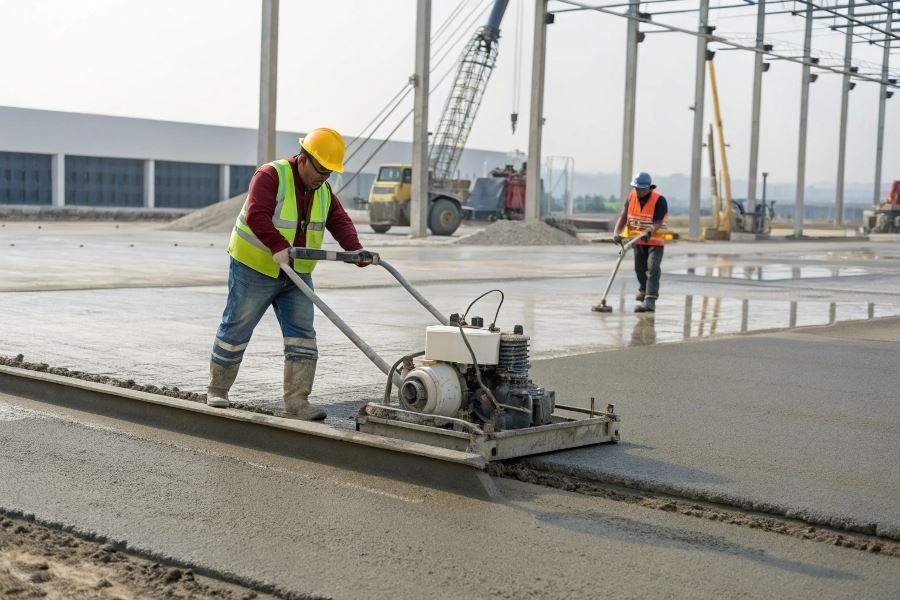
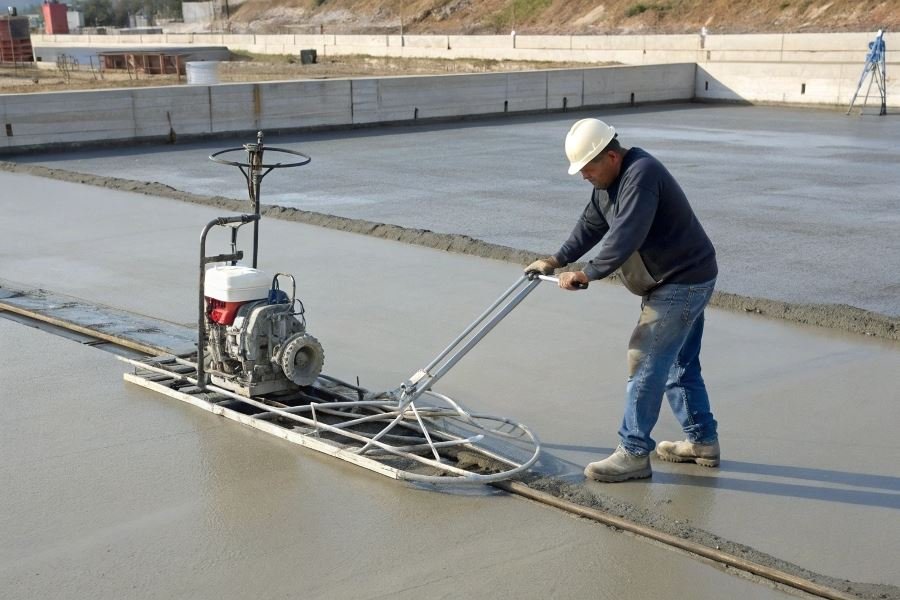
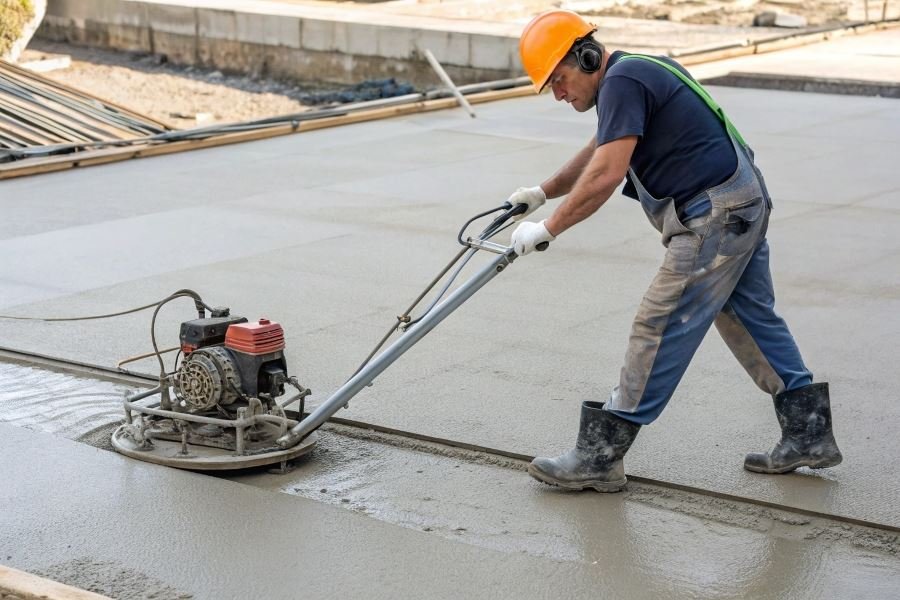
Ever watched a perfectly smooth concrete floor being created and wondered how they achieved that flawless finish? The secret weapon is likely a vibratory screed—a specialized tool that’s revolutionizing concrete work across America’s construction sites.
Vibratory screeds are powerful machines designed to level, compact, and smooth freshly poured concrete surfaces. By generating consistent vibrations, these tools eliminate air pockets and excess water while creating remarkably even surfaces—essential for everything from residential driveways to massive industrial floors. The difference between amateur-looking concrete work and professional results often comes down to this single piece of equipment.
The $50,000 question: Rent or buy?
For contractors and construction professionals, the decision between renting or purchasing a vibratory screed represents a significant financial crossroads. With quality models ranging from $3,000 for basic walk-behind units to over $50,000 for advanced laser-guided systems, the investment isn’t trivial.
The profitability equation hinges on several critical factors:
- Project frequency: How often will you actually use the equipment?
- Job specifications: Do you need specialized features for particular projects?
- Cash flow considerations: Can your business absorb a major equipment purchase?
- Maintenance capabilities: Do you have the resources to maintain complex machinery?
Making the wrong choice can either tie up precious capital unnecessarily or create costly rental dependencies that eat into profit margins. The most successful contractors approach this decision with careful analysis rather than gut feeling.
The Dollars and Sense of Vibratory Screed Ownership
Let’s dive into the financial chess match between renting and purchasing a vibratory screed. When contractors face this decision, they’re essentially gambling on future project volume—and the stakes can be thousands of dollars. Making the wrong choice doesn’t just impact your current project; it ripples through your business’s financial health for years.
For construction professionals weighing rental vs purchase of a vibratory screed, profitability hinges on understanding both immediate costs and long-term financial implications. The decision matrix involves more variables than most realize, including project frequency, storage capabilities, and maintenance expertise.
Initial Investment: The Upfront Price Tag
Purchasing a new vibratory screed represents a significant capital expenditure. Quality models from manufacturers like Wacker Neuson or Allen Engineering typically range from $3,000 for basic walk-behind models to $15,000+ for advanced ride-on systems. Mid-range contractor-grade units hover around 7, 000−9,000.
Key purchase considerations:
- Equipment lifespan (typically 5-7 years with proper maintenance)
- Warranty terms (usually 1-3 years depending on manufacturer)
- Financing options (potentially 0% for 12-24 months through dealers)
The Hidden Costs of Ownership
Ownership extends far beyond the purchase price. Annual maintenance costs typically run 10-15% of the purchase price, breaking down as follows:
| Expense Category | Annual Cost | Notes |
|---|---|---|
| Regular maintenance | 500−1,200 | Oil changes, filters, belts |
| Repairs | 300−900 | Increases with age and usage |
| Storage | 600−1,800 | Climate-controlled space recommended |
| Transportation | 200−800 | Fuel, trailer maintenance, insurance |
These recurring expenses often surprise first-time buyers who focus solely on purchase price versus rental rates.
Rental Economics: Pay As You Go
Rental rates for vibratory screeds typically follow this structure:
| Rental Period | Average Cost | Typical Deposit |
|---|---|---|
| Daily | 150−250 | 500−1,000 |
| Weekly | 450−750 | 500−1,000 |
| Monthly | 1, 200−2,000 | 1, 000−2,000 |
Rental advantages:
- Zero maintenance responsibility
- No storage requirements
- Access to newer models
- Flexibility to choose different sizes for different projects
Breaking Even: The Magic Number
The break-even calculation reveals when ownership becomes more economical than renting. This formula provides clarity:
Break-even point (in days) = (Purchase price + Lifetime maintenance costs) ÷ Daily rental rate
For a concrete example, consider a $8,000 screed with estimated lifetime maintenance of $4,000:
Break-even = ($8,000 + $4,000) ÷ $200 = 60 days
This means if you’ll use the screed for more than 60 days over its lifetime (approximately 12 days per year over 5 years), purchasing makes financial sense.
Decision factors beyond numbers:
- Project predictability (consistent vs. sporadic needs)
- Cash flow considerations
- Tax implications (depreciation benefits)
- Equipment control and availability during peak seasons
The financial analysis ultimately reveals that high-volume contractors typically benefit from purchasing, while occasional users find greater value in renting. The middle ground—contractors using screeds for 8-15 days annually—requires the most careful analysis, as their break-even point hovers near the threshold where either option could prove optimal.
Strategic Considerations for Vibratory Screed Ownership
Project Frequency Drives Profitability
The rent-or-buy decision for a vibratory screed hinges primarily on your project pipeline. Contractors completing more than 15-20 concrete pours annually typically cross the financial threshold where ownership becomes advantageous. With quality vibratory screeds ranging from 2, 000−7,500, frequent renters face a sobering reality: weekly rental rates of 250−400 quickly accumulate.
A concrete contractor in Colorado shared: “After renting for 18 months at $300/week, I realized I’d already paid for the equipment twice over.” His experience reflects a common industry calculation—if you’re using the equipment more than 25-30 days annually, purchasing generally wins the financial battle.
The breakeven formula: Annual rental costs ÷ Purchase price = Years to ownership equivalence
For seasonal contractors, however, rental remains compelling. Why tie up capital in equipment that hibernates half the year?
Depreciation and Resale Considerations
Vibratory screeds retain value remarkably well compared to other construction equipment. Quality models from manufacturers like Wacker Neuson and Allen Engineering typically depreciate just 15-20% in the first year, then 10-12% annually thereafter.
This depreciation pattern creates interesting ownership dynamics:
| Ownership Period | Typical Depreciation | Resale Value (% of purchase) |
|---|---|---|
| 1 year | 15-20% | 80-85% |
| 3 years | 35-40% | 60-65% |
| 5 years | 50-55% | 45-50% |
Maintenance costs remain relatively modest, with annual service expenses averaging 200−400 for professional-grade equipment. The key value retention factor? Proper maintenance and cleaning after each use.
Tax Implications That Boost Your Bottom Line
Equipment ownership unlocks significant tax advantages unavailable to renters. Under Section 179 of the tax code, businesses can deduct the full purchase price of qualifying equipment in the year it’s put into service, rather than depreciating it over several years.
For a contractor in the 24% tax bracket purchasing a $5,000 screed, this could mean $1,200 in immediate tax savings—effectively reducing the actual cost to $3,800. Additionally, ongoing maintenance expenses remain fully deductible.
Rental payments, while fully deductible as business expenses, don’t offer the same potential for accelerated deductions or building business equity.
Smart Recommendations Based on Business Profile
For small contractors (1-3 employees):
- Rental makes sense unless you’re pouring concrete weekly
- Consider equipment sharing arrangements with trusted colleagues
- Look for rent-to-own programs that convert payments toward ownership
For mid-sized operations (4-15 employees):
- Purchase becomes compelling with 2+ concrete projects monthly
- Consider financing options with current interest rates
- Maintenance capabilities become a deciding factor
For large contractors:
- Fleet ownership with multiple units optimizes crew efficiency
- Depreciation benefits significantly impact tax strategy
- Consider newer models with enhanced features for productivity gains
The final decision extends beyond simple math—factor in storage capabilities, maintenance expertise, and cash flow realities. The most profitable choice aligns with your specific business rhythm and growth trajectory.
Discover whether renting or buying a vibratory screed makes more financial sense for your construction business. Compare initial costs, maintenance expenses, and calculate the break-even point to maximize profitability on concrete projects.
Discover whether renting or buying a vibratory screed makes more financial sense for your construction business. Compare initial costs, maintenance expenses, and calculate the break-even point to maximize profitability on concrete projects.