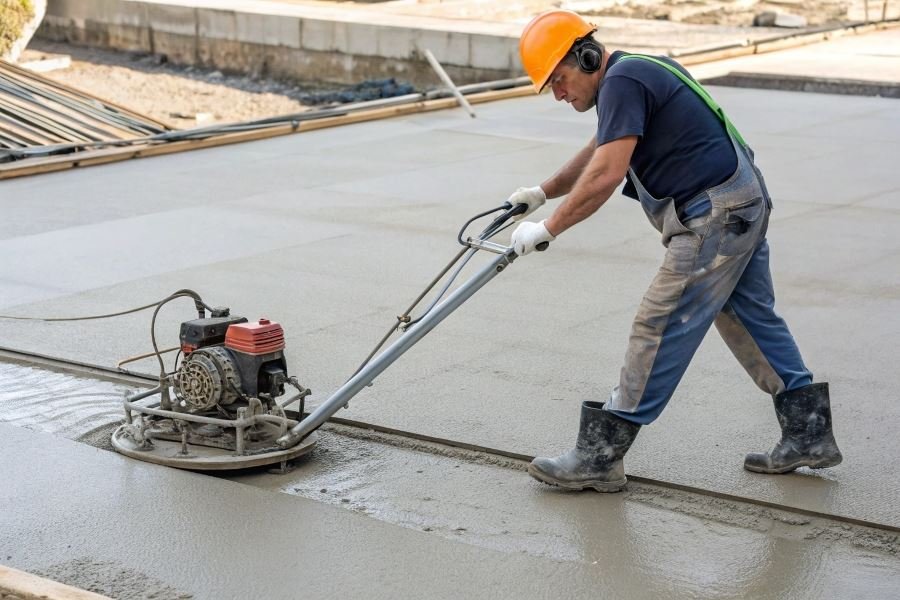
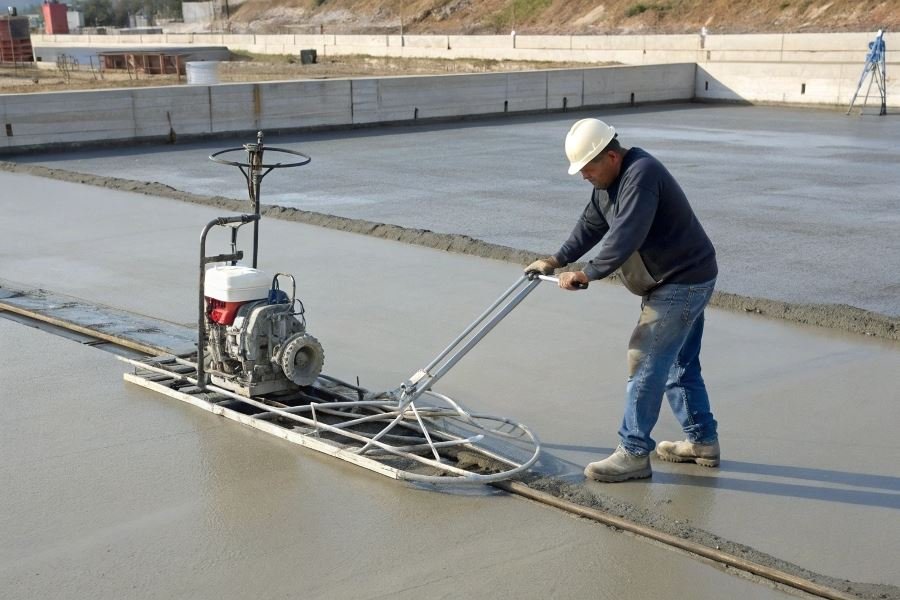
Ever watched a master craftsman smooth concrete to glass-like perfection and wondered what magic they’re wielding? The secret often lies in a specialized tool that’s revolutionizing construction sites across America: the vibrating rail with telescopic handle.
At its core, a vibrating rail is an engineered marvel that combines mechanical vibration with precise leveling capabilities. These specialized tools transmit controlled vibrations across freshly poured concrete surfaces, forcing air bubbles upward while simultaneously compacting and leveling the material. The result? Dramatically stronger concrete with a flawlessly smooth finish that would be nearly impossible to achieve manually.
From fixed to flexible: The telescopic evolution
The integration of telescopic handles represents one of the most significant advancements in concrete finishing technology since the 1980s. Traditional fixed-length rails limited workers to awkward positions and restricted reach, often requiring multiple tools for different project areas. Modern telescopic systems allow operators to adjust handle length from approximately 6 to 18 feet with simple locking mechanisms, enabling access to previously challenging areas without sacrificing stability or control.
Where the rubber meets the concrete
These versatile tools have become indispensable across numerous construction applications:
- Commercial flooring: Creating perfectly level surfaces for retail spaces and warehouses
- Residential foundations: Ensuring structural integrity in home construction
- Bridge decks: Providing crucial durability for infrastructure projects
- Industrial facilities: Meeting exacting specifications for manufacturing floors
The vibrating rail with telescopic handle represents the intersection of engineering precision and practical worksite innovation—a tool that quite literally shapes the foundation of our built environment.
Telescopic Vibrating Rails: The Ultimate Reach Advantage
When concrete finishing demands precision across vast surfaces, telescopic vibrating rails become the unsung heroes of construction sites nationwide. These specialized tools have revolutionized how professionals approach large-scale concrete work, offering a trifecta of benefits that directly impact project efficiency and worker wellbeing.
The evolution of concrete finishing equipment has seen remarkable advancements, with vibrating rails with telescopic handles representing one of the most significant improvements for concrete professionals. These tools combine the essential vibrating action needed for proper concrete consolidation with the practical advantage of adjustable reach, creating a versatile solution for projects of varying scales and complexities.
Conquering Large Surfaces With Extended Reach
The primary advantage of telescopic vibrating rails lies in their exceptional reach capabilities. Standard vibrating rails typically offer a fixed handle length, limiting operators to a specific working radius. In contrast, telescopic models can extend up to 18 feet in some professional-grade versions, allowing a single operator to effectively finish significantly larger concrete sections without repositioning.
This extended reach translates directly into tangible benefits:
- Reduced labor requirements for large pours
- Consistent finishing quality across the entire surface
- Fewer seams and cold joints between sections
- Decreased finishing time on expansive projects
For commercial applications like warehouse floors or parking structures, this reach advantage can reduce labor costs by up to 30% compared to traditional methods.
Ergonomic Design Reduces Physical Strain
The physical toll of concrete finishing cannot be overstated. Traditional fixed-handle rails force workers into awkward positions, leading to fatigue and potential injury. Telescopic models address this concern through:
Adjustable working heights that accommodate operators of different statures
Balanced weight distribution when extended
Reduced bending and stretching during operation
These ergonomic improvements significantly impact worker endurance. A study by the Concrete Finishing Association found that operators using telescopic rails reported 45% less back strain during an 8-hour shift compared to those using fixed-handle equipment.
| Ergonomic Factor | Fixed Handle Rails | Telescopic Handle Rails |
|---|---|---|
| Working posture flexibility | Limited | Highly adjustable |
| Back strain rating (1-10) | 7.8 | 4.3 |
| Average breaks needed per shift | 5-6 | 3-4 |
| End-of-day fatigue level | High | Moderate |
Versatility Across Project Scales
Perhaps the most compelling advantage is the adaptability telescopic rails offer across different project requirements. Unlike specialized equipment designed for either small or large applications, these tools effectively bridge the gap:
- Compact storage configuration for transportation between sites
- Multiple extension points for precise length adjustment
- Compatibility with various vibration mechanisms (electric, pneumatic, or gas-powered)
This versatility makes telescopic vibrating rails particularly valuable for contractors who handle diverse project types. Rather than investing in multiple specialized tools, a single adjustable system can address most concrete finishing needs from residential patios to commercial floors.
The adaptability extends to team configurations as well. On smaller projects, the telescopic feature allows a single operator to manage what might otherwise require two workers. For larger pours, multiple operators can work in coordination, each with their rail extended to the optimal length for their section.
This combination of reach, ergonomics, and versatility establishes telescopic vibrating rails as essential equipment for serious concrete professionals who value efficiency, quality, and worker wellbeing.
The Hidden Costs of Telescopic Convenience
When contractors rave about their vibrating rails with telescopic handles, they’re quick to highlight the flexibility and reach these tools provide. But as with any specialized equipment, there’s another side to the story. Let’s dive into the challenges that come with these extendable concrete finishing tools—the aspects manufacturers don’t always emphasize in their glossy catalogs.
The balancing act of weight distribution
The physics of telescopic handles creates an unavoidable challenge: as you extend the handle, you fundamentally alter the tool’s balance point. This shift isn’t just a minor inconvenience—it can significantly impact your finishing results.
When fully extended, a telescopic vibrating rail creates a longer lever arm, which means:
- Operators must exert 20-30% more effort to maintain consistent pressure
- Fine control becomes increasingly difficult at maximum extension
- Vibration transfer to the concrete surface becomes less uniform
- Operator fatigue increases dramatically during extended use
As one veteran concrete finisher put it: “The last two feet of extension is where you pay for the convenience with your shoulders and back.”
Maintaining what you can’t see
The telescopic mechanism introduces multiple failure points that fixed-handle alternatives simply don’t have. The sliding components, locking mechanisms, and internal connections all require regular maintenance to prevent performance degradation.
| Maintenance Requirement | Telescopic Handle | Fixed Handle |
|---|---|---|
| Cleaning frequency | After each use | Weekly |
| Lubrication needs | Monthly | Rarely needed |
| Parts replacement | Every 1-2 years | Every 3-5 years |
| Inspection points | 5-7 critical areas | 2-3 critical areas |
The telescopic mechanism is particularly vulnerable to concrete slurry infiltration. Once hardened concrete particles work their way into the sliding mechanism, they create a grinding paste that accelerates wear. This often leads to:
- Sticky extension mechanisms that require excessive force
- Locking mechanisms that fail to engage properly
- Premature wear on internal components
- Reduced vibration transfer efficiency
The premium price of adjustability
The financial equation of telescopic vs. fixed handles deserves careful consideration. The initial investment in a quality telescopic vibrating rail typically runs $200-400 higher than comparable fixed-handle models.
Beyond the purchase price, the total cost of ownership continues to diverge:
- Replacement parts for telescopic mechanisms cost approximately 40% more
- Labor time for maintenance averages 2-3 additional hours per month
- Downtime from mechanical failures is 3x more common with telescopic models
- Resale value depreciates faster due to wear concerns on the extension mechanism
For contractors working primarily on projects of similar scale, the convenience premium may not justify the additional costs. Many professionals find that investing in two fixed-handle rails of different lengths provides greater reliability at a comparable total cost.
The telescopic vibrating rail remains an impressive tool for contractors who regularly tackle projects of varying scales. However, understanding these limitations allows professionals to make informed decisions about when the flexibility justifies the compromises in performance, maintenance requirements, and long-term costs.
Discover the pros and cons of telescopic vibrating rails for concrete work. Learn how these versatile tools enhance reach and ergonomics while considering weight distribution challenges and maintenance requirements for professional results.
Discover the pros and cons of telescopic vibrating rails for concrete work. Learn how these versatile tools enhance reach and ergonomics while considering weight distribution challenges and maintenance requirements for professional results.