
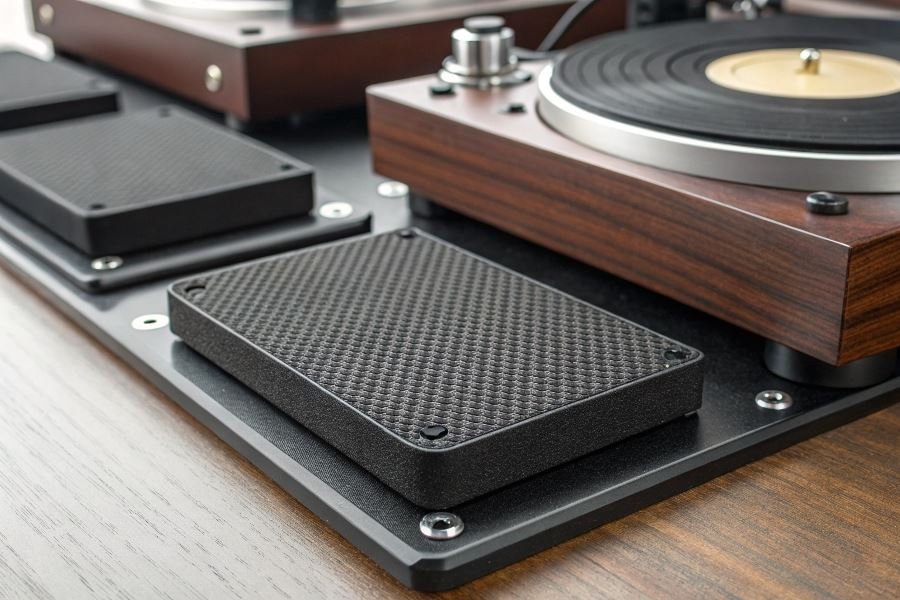
Ever wondered why some high-performance machinery runs whisper-quiet while identical equipment elsewhere rattles like it’s about to take flight? The difference often lies in what you can’t see—what’s underneath the machine.
Anti-vibration pads are engineered solutions designed to isolate unwanted vibrations from equipment, preventing them from transferring to surrounding structures. These unassuming heroes work continuously to extend equipment life, improve performance, and create safer working environments. Think of them as shock absorbers for your valuable machinery.
What exactly are anti-vibration pads?
At their core, anti-vibration pads are specialized cushioning devices that absorb and dissipate mechanical energy. They create a buffer zone between vibrating equipment and the surface it rests on, effectively “trapping” vibrations before they can travel further. This isolation prevents damage to both the equipment and surrounding structures while reducing noise pollution—a win-win solution for operational efficiency.
Material matters: The science of absorption
The effectiveness of anti-vibration pads largely depends on their composition. Common materials include:
- Rubber compounds: Offering excellent elasticity and durability, natural and synthetic rubber blends provide reliable performance across temperature ranges
- Cork-rubber composites: Combining natural resilience with enhanced stability
- Neoprene: Resistant to oils and chemicals, making it ideal for industrial applications
- High-density foams: Lightweight yet effective for specific applications
Each material offers unique vibration frequency absorption properties, with some excelling at dampening high-frequency vibrations while others better handle low-frequency oscillations.
How vibration isolation actually works
The science behind these pads involves principles of physics—specifically, mechanical impedance and resonance. When vibrations encounter materials with different density and elasticity properties, energy transfer is interrupted. The pad’s material deforms slightly, converting kinetic energy into heat through internal friction, effectively “catching” vibrations before they can propagate further.
This dampening effect is particularly crucial for precision equipment, where even minor vibrations can affect calibration, accuracy, and component longevity.
Key Applications for Anti-vibration Pads
Vibration is the silent productivity killer that plagues equipment across industries. Understanding when anti-vibration pads are necessary can dramatically extend equipment lifespan, improve performance, and create safer working environments. These unassuming components deliver outsized benefits in specific applications where controlling unwanted movement makes all the difference.
Heavy Machinery That Demands Stability
Industrial environments present the most compelling case for vibration isolation. Manufacturing floors, where massive equipment generates forces that can literally shake buildings, demonstrate why anti-vibration pads: when they are necessary becomes less a question and more an operational imperative.
CNC machines, hydraulic presses, and industrial compressors all benefit from proper isolation:
| Equipment Type | Vibration Concerns | Recommended Pad Type |
|---|---|---|
| CNC Machines | Precision errors, tool wear | High-density rubber/cork composite |
| Hydraulic Presses | Structural damage, noise | Steel-reinforced elastomer |
| Industrial Compressors | Component fatigue, noise pollution | Neoprene with load distribution plate |
A 100-ton hydraulic press can generate vibrations that travel through concrete foundations for hundreds of feet. Without proper isolation, these forces can compromise structural integrity and create workplace hazards that extend far beyond the equipment itself.
Home Appliances That Run Smoother
The residential setting offers equally compelling applications, though at a different scale. Washing machines represent the classic example—these 200+ pound devices can “walk” across floors during spin cycles without proper stabilization.
Residential applications where anti-vibration pads deliver noticeable benefits:
- Washing machines and dryers (especially stacked units)
- Refrigerators with compressors
- Home HVAC equipment
- Exercise equipment like treadmills and ellipticals
Modern LG washing machines incorporate advanced anti-vibration technology, but aftermarket pads still improve performance in many installations. The difference is particularly noticeable in older homes with wooden floors, where resonance can amplify vibrations throughout the structure.
Precision Instruments That Demand Perfection
Perhaps the most critical applications involve sensitive electronic equipment and precision instruments where even microscopic vibrations can compromise function.
Laboratory environments represent the gold standard for vibration control:
“In electron microscopy, vibrations measured in nanometers—smaller than a human hair is thick—can render a $2 million instrument effectively useless.”
Medical imaging equipment like MRI machines require specialized isolation systems that often incorporate multiple vibration control technologies. These systems protect not only the equipment but also ensure diagnostic accuracy that can impact patient outcomes.
Audio enthusiasts understand this principle well. High-end turntables from manufacturers like Pro-Ject often float on sophisticated suspension systems to isolate the stylus from environmental vibrations that would otherwise translate into audible distortion.
Computer server rooms present another critical application. Hard drives with spinning platters are particularly susceptible to vibration-induced errors. Data centers employ isolation strategies at multiple levels—from individual drive mounts to entire server rack systems—to protect mission-critical information.
The common thread across these applications is clear: wherever precision, performance, or longevity matters, proper vibration isolation isn’t just beneficial—it’s essential.
Your Ultimate Anti-vibration Pad Selection Guide
Choosing the right anti-vibration solution isn’t just about grabbing whatever’s on sale—it’s about protecting your valuable equipment and creating a more comfortable environment. Let’s dive into how to determine when these unsung heroes are necessary and how to select the perfect match for your specific needs.
Measuring vibration impact before damage occurs
Vibration issues often go unnoticed until they’ve already caused problems. The first step in determining whether you need anti-vibration pads is to assess current vibration levels.
Professional vibration meters can measure displacement in millimeters and frequency in hertz, but there are also practical observations that signal a need for intervention:
- Visible movement or “walking” of equipment
- Unusual noise levels during operation
- Premature wear on machine components
- Inconsistent performance or output quality
- Complaints about noise or vibration from adjacent spaces
Early intervention prevents costly repairs. For example, a commercial washing machine transmitting vibrations through a building’s structure can eventually damage both the machine and the building itself. Studies show that properly managed vibration can extend equipment lifespan by up to 40%.
Load calculations that prevent costly mistakes
Selecting the right pad thickness and material depends on precise load calculations:
- Determine the total weight of your equipment (in pounds)
- Identify the number of support points
- Calculate the load per support point
- Factor in dynamic loads during operation (typically 1.5-3× static load)
This calculation prevents the two most common mistakes: choosing pads that are too soft (causing bottoming out) or too firm (providing insufficient isolation).
| Equipment Type | Typical Static Load | Dynamic Load Factor | Recommended Pad Thickness |
|---|---|---|---|
| HVAC Units | 50-500 lbs per corner | 2× | 1-2 inches |
| Washing Machines | 100-300 lbs total | 3× | 0.75-1.5 inches |
| Generators | 500-5000+ lbs | 1.5× | 1-3 inches |
| CNC Machines | 1000-20000+ lbs | 1.3× | 0.5-2 inches |
The perfect pad strikes the balance between compression and resilience, absorbing vibration without collapsing under load.
Installation techniques that maximize performance
Even the highest quality anti-vibration pads will underperform if installed incorrectly. Follow these best practices:
-
Ensure level mounting surfaces before installation. Uneven surfaces create pressure points that compromise pad performance.
-
Position pads at load-bearing points, not arbitrarily under the equipment. For most rectangular equipment, this means placing pads at or near the corners.
-
Maintain equal load distribution across all pads. Uneven loading causes some pads to compress more than others, reducing isolation efficiency.
-
Consider stacking for extreme situations. For severe vibration problems, stacking compatible pads can increase isolation, though this requires careful calculation to prevent instability.
-
Implement regular inspection routines to check for pad compression, deterioration, or displacement. Most quality pads from manufacturers like Mason Industries or Vibration Mountings should maintain their properties for 5-10 years under normal conditions.
Remember that proper installation is not just about placing pads under equipment—it’s about creating an integrated system where the pads, equipment, and mounting surface work together to minimize vibration transmission.
Discover when anti-vibration pads are essential for equipment stability. Learn about materials, applications for machinery, home appliances, and electronics, plus how to select the right pads based on load requirements and vibration levels.
Discover when anti-vibration pads are essential for equipment stability. Learn about materials, applications for machinery, home appliances, and electronics, plus how to select the right pads based on load requirements and vibration levels.


