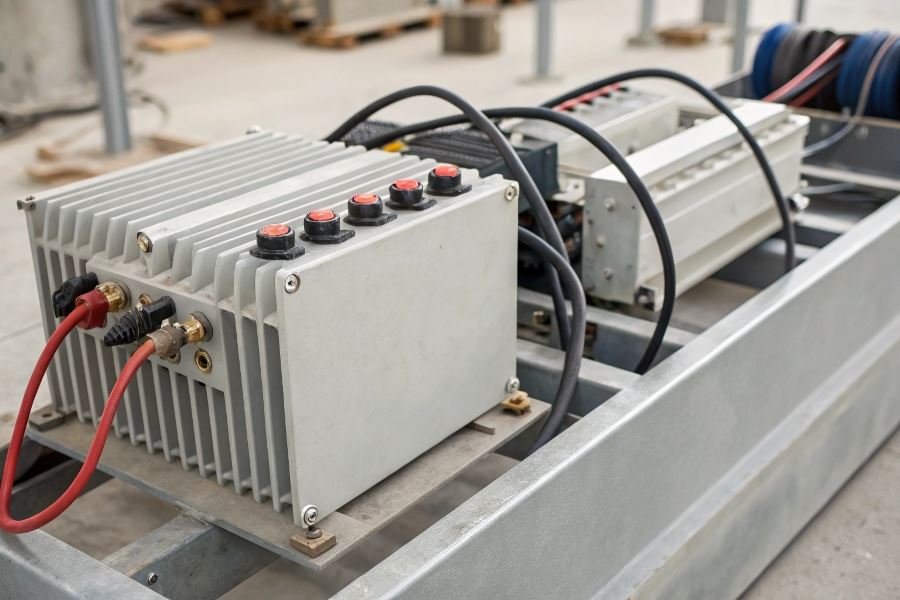
Ever wondered what makes a vibrator… vibrate? The answer lies in a critical component that transforms energy into motion: the converter. This unassuming device is the beating heart of every vibration tool, whether it’s used in industrial applications or personal devices.
At their core, electronic and mechanical converters serve the same purpose but take fundamentally different approaches. Mechanical converters utilize physical components—typically offset weights attached to a motor shaft—to generate vibration through rotational imbalance. When the motor spins, the uneven weight distribution creates the characteristic oscillating motion. Electronic converters, by contrast, employ circuit boards and sophisticated programming to precisely control electromagnetic coils, producing vibrations with remarkable precision.
The evolution of these technologies tells a fascinating story. Mechanical converters dominated the landscape since the first electric vibrators emerged in the early 1900s. Their simplicity and reliability made them the standard for decades. The electronic revolution began in earnest during the 1980s, when microprocessors became small enough and affordable enough to incorporate into consumer devices.
“The difference between mechanical and electronic converters is like comparing a hammer to a scalpel—both effective, but with vastly different levels of precision.” — Engineering Monthly
Key differences that matter
The distinction between these technologies extends beyond their internal workings:
| Feature | Mechanical Converters | Electronic Converters |
|---|---|---|
| Precision | Limited patterns | Highly programmable |
| Durability | Fewer components to fail | More complex circuitry |
| Energy efficiency | Higher power consumption | Optimized power usage |
| Noise level | Generally louder | Typically quieter |
| Cost | Usually less expensive | Premium pricing |
The choice between electronic and mechanical converters ultimately depends on specific needs, with each offering distinct advantages in different applications.
The Ultimate Converter Showdown
Performance That Powers Your Experience
When diving into the world of industrial vibrators, the converter technology becomes your make-or-break decision point. Electronic vs mechanical converters for vibrators: which is better often comes down to specific performance metrics that directly impact your operational efficiency.
Electronic converters dominate the efficiency landscape, typically converting 85-95% of input energy into vibration output. This translates to lower power consumption and reduced heat generation. Mechanical converters, while robust, generally achieve only 60-75% efficiency due to inherent friction losses in their moving parts.
Vibration intensity tells another compelling story. Electronic converters offer precision control, allowing adjustments in increments as small as 0.1mm of amplitude. Mechanical systems typically provide 3-5 preset intensity levels with less granular control.
The frequency range comparison is particularly striking:
| Converter Type | Frequency Range | Precision Control | Response Time |
|---|---|---|---|
| Electronic | 20-400 Hz | ±1 Hz | <10ms |
| Mechanical | 40-200 Hz | ±5 Hz | 50-100ms |
This expanded frequency range makes electronic converters from manufacturers like Vibco particularly valuable for applications requiring either very low or very high frequencies.
Durability That Defines Value
The durability equation isn’t as straightforward as many assume. Mechanical converters feature fewer sensitive components, making them remarkably resilient in harsh environments with extreme temperatures, dust, or moisture. Their typical lifespan ranges from 15,000-20,000 operating hours before major maintenance.
Electronic converters have historically been more vulnerable to environmental factors, but modern designs from companies like Martin Engineering incorporate robust protection systems. Today’s electronic units typically deliver 12,000-18,000 hours of operation, with the advantage of providing clear warning signs before failure.
Maintenance requirements create another significant distinction:
- Mechanical converters require regular lubrication (typically every 500 hours), bearing inspections, and occasional replacement of wear parts.
- Electronic converters generally need only periodic cleaning of heat sinks and visual inspection of connections, with maintenance intervals often extending to 2,000+ hours.
The True Cost Calculation
Initial investment presents the most visible difference between these technologies. Mechanical converters typically cost 15-30% less upfront, with basic models starting around $400. Electronic alternatives generally begin at $550, with advanced models reaching $1,200+.
However, the long-term value assessment reveals a more nuanced picture:
-
Energy consumption favors electronic converters, which can save $200-300 annually in electricity costs for continuous operation applications.
-
Maintenance expenses typically run 40-60% higher for mechanical systems over a five-year period.
-
Downtime costs often prove most significant, with mechanical systems averaging 30% more unplanned downtime than their electronic counterparts.
For operations running 8+ hours daily, electronic converters generally reach cost parity within 18-24 months, after which they deliver superior return on investment. Intermittent-use applications may find mechanical converters more economical over their entire lifecycle.
The decision ultimately hinges on your specific application requirements, operating environment, and long-term operational strategy. Both technologies continue to evolve, with manufacturers like Cleveland Vibrator developing hybrid systems that aim to capture the best attributes of both approaches.
Making the Right Choice: Electronic vs Mechanical Converters
Application-specific considerations for industrial use
When selecting between electronic and mechanical converters for vibrators in industrial settings, the application dictates the optimal choice. Manufacturing environments with precise frequency requirements typically benefit from electronic converters, which offer digital precision within 0.1 Hz. A concrete batching plant, for example, requires consistent vibration to eliminate air pockets—electronic converters maintain this consistency even during voltage fluctuations.
Mechanical converters shine in heavy-duty applications where durability trumps precision. Mining operations using vibrating screens to separate materials rely on mechanical converters that withstand extreme conditions without the sensitivity of electronic components. These robust systems have demonstrated 30% longer operational lifespans in high-dust environments compared to their electronic counterparts.
For food processing equipment, electronic converters provide the variable frequency control necessary to adjust vibration intensity based on product density. This adaptability allows a single piece of equipment to handle everything from powders to granules with appropriate force.
Environmental factors affecting performance
Temperature extremes dramatically impact converter efficiency and lifespan. Electronic converters typically operate optimally between 14°F and 104°F (-10°C to 40°C), while mechanical systems can function reliably in temperatures ranging from -4°F to 122°F (-20°C to 50°C).
The difference between electronic and mechanical converters becomes most apparent when environmental conditions deteriorate beyond design parameters.
Moisture presents another critical consideration. In high-humidity environments like paper mills or coastal facilities, mechanical converters with proper sealing maintain functionality where electronic systems risk condensation damage to circuit boards. However, Siemens and other manufacturers now offer IP67-rated electronic converters specifically designed for wash-down environments.
Vibration ironically affects vibrator converters themselves. Mechanical systems inherently withstand operational vibration, while electronic converters require isolation mounting to prevent premature component failure. Recent testing by ABB demonstrated that properly isolated electronic converters now achieve comparable vibration resistance to mechanical systems.
| Environmental Factor | Electronic Converters | Mechanical Converters |
|---|---|---|
| Temperature Range | 14°F to 104°F | -4°F to 122°F |
| Dust Tolerance | Moderate (requires filtration) | High (sealed systems) |
| Moisture Resistance | Low to Moderate (depends on enclosure) | High |
| Vibration Tolerance | Moderate (requires isolation) | High (inherent) |
Future trends in converter technology
The converter landscape is evolving rapidly with smart monitoring capabilities becoming standard in premium electronic models. These systems from Emerson and others provide predictive maintenance alerts by analyzing vibration patterns, potentially reducing downtime by up to 70%.
Energy efficiency improvements represent another significant advancement. The latest electronic converters achieve up to 96% efficiency compared to 75-80% for mechanical systems. This difference translates to substantial operational savings in continuous-use applications.
Perhaps most promising is the development of hybrid converter systems that combine electronic precision with mechanical durability. These systems use electronic controls for precise frequency management while employing mechanical components for power transmission, offering the best attributes of both technologies.
Miniaturization continues to advance, with new electronic converters requiring 40% less installation space than previous generations. This compact footprint makes retrofitting existing equipment significantly more feasible without sacrificing performance.
As industrial IoT integration becomes standard, electronic converters with network connectivity enable remote monitoring and adjustment—a capability mechanical systems simply cannot match without additional components. This connectivity is becoming increasingly valuable for facilities embracing data-driven optimization strategies.
Discover the key differences between electronic and mechanical vibrator converters in our comprehensive performance guide. Compare efficiency, durability, and cost-effectiveness to make the optimal choice for your industrial applications.
Discover the key differences between electronic and mechanical vibrator converters in our comprehensive performance guide. Compare efficiency, durability, and cost-effectiveness to make the optimal choice for your industrial applications.