Ever sat at your desk, frantically lunging for your speakers when a track suddenly blasts at ear-splitting levels? That moment of panic is exactly why volume controllers have become indispensable tools in home recording setups.
At their core, volume controllers are dedicated hardware interfaces that give you precise, immediate control over your monitoring levels. Think of them as the gatekeeper between your audio interface and studio monitors—allowing you to adjust volume without touching your software or interface settings. This seemingly simple function transforms your workflow in profound ways.
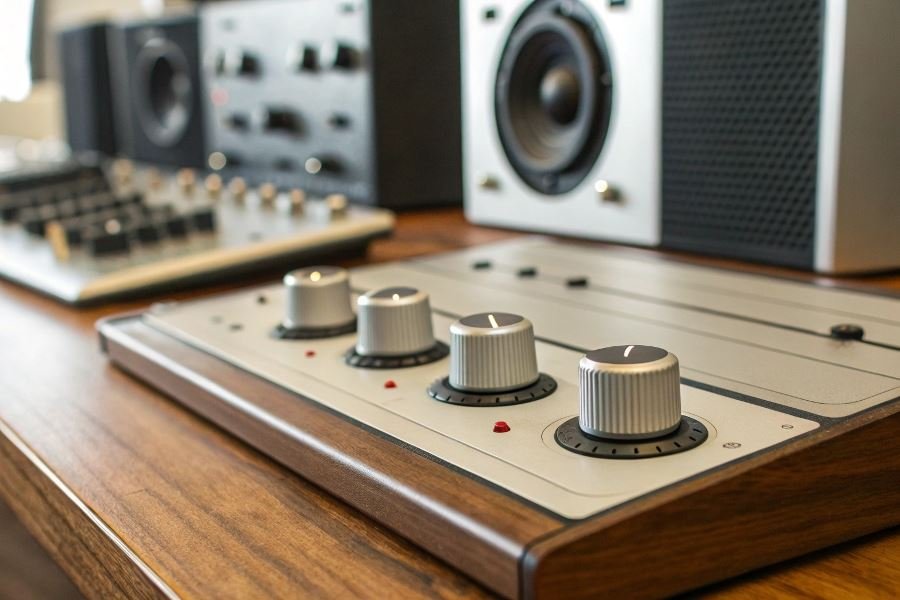
The magic of a dedicated volume controller lies in its tactile experience. There’s something deeply satisfying about adjusting your mix with a physical knob rather than clicking through software menus or adjusting digital sliders. This hands-on approach not only feels more natural but actually improves your decision-making during critical listening sessions.
Types of controllers for every studio
Volume controllers come in several varieties to match different studio setups:
- Passive controllers: Simple, affordable options with no power requirements—perfect for straightforward setups
- Active controllers: Powered units offering additional features like multiple inputs/outputs and headphone amplification
- Monitor controllers: Advanced systems with speaker switching, mono summing, and talkback capabilities
The benefits extend beyond mere convenience. A quality volume controller provides cleaner signal paths than many interface volume controls, preserving your audio fidelity. They also offer instant muting capabilities—crucial when feedback suddenly occurs or when you need to take a quick phone call without disrupting your session.
For professionals mixing at consistent reference levels, these controllers provide repeatable, calibrated volume settings that ensure mix decisions remain consistent across projects.
Essential Factors for Choosing the Perfect Volume Controller
When setting up a home recording studio, the volume controller becomes your command center—the interface between your creative vision and the actual sound output. Selecting the right one requires careful consideration of several critical factors that can make or break your recording experience.
The process of how to choose a volume controller for a home recording studio begins with understanding the fundamental differences between analog and digital options. Each approach offers distinct advantages depending on your workflow and sonic preferences.
Analog vs Digital: The Sound Philosophy Debate
Analog volume controllers operate using physical components like resistors and potentiometers to adjust signal levels. They’re prized for their warm, natural sound characteristics and immediate tactile feedback.
The passive analog controller’s simplicity offers reliability with zero coloration of your audio signal—what goes in comes out unchanged except for volume.
Digital controllers, conversely, convert your analog signal to digital, adjust the level mathematically, then convert back. This approach offers precision and additional features like remote control, presets, and digital metering.
| Controller Type | Sound Quality | Features | Latency | Price Range |
|---|---|---|---|---|
| Passive Analog | Transparent, no coloration | Limited, purely mechanical | None | $50-300 |
| Active Analog | Slightly colored, potential for gain | More I/O options, buffering | None | $100-500 |
| Digital | Depends on conversion quality | Extensive, programmable | Minimal to noticeable | $150-1000+ |
Connectivity: The Studio Ecosystem
Your volume controller must integrate seamlessly with your existing equipment. Consider these connectivity requirements:
- Input/output types: Balanced XLR, unbalanced RCA, TRS, or digital options like optical/coaxial
- Channel count: Stereo (2-channel) vs. multi-channel monitoring
- Integration points: Between interface and monitors or post-interface
The Mackie Big Knob series exemplifies versatile connectivity with multiple input sources and monitor outputs, while the Dangerous Music D-Box offers premium balanced connections for professional setups.
Build Quality: The Longevity Factor
Durability considerations should never be overlooked. A volume controller is a hands-on device you’ll interact with constantly.
Look for:
- Solid metal chassis rather than plastic
- Smooth, consistent potentiometer action without “scratchy” sounds
- Quality connectors that grip plugs firmly
- Weighted base that stays put on your desk
The feel of the main volume knob itself reveals much about overall quality—it should turn with satisfying resistance and absolute precision.
Precision and Control Range: The Technical Heart
The technical specifications determine how effectively you can dial in exact monitoring levels:
- Attenuation range: Typically 60-90dB total range
- Taper curve: Linear vs. logarithmic (logarithmic matches human hearing better)
- Channel matching: Deviation less than 0.5dB between left/right channels
- Step resolution: Continuous (analog) vs. stepped (digital, often 0.5-1dB increments)
The SPL Volume2 offers exceptional precision with 0.5dB steps across its entire range, while the Crane Song Avocet IIA provides reference-grade monitoring with exact 0.5dB increments and perfect channel matching.
Remember that the volume controller you select will influence every monitoring decision you make. Choose one that disappears between you and your music, allowing pure, uncolored evaluation of your work.
Top Volume Controllers That Elevate Your Home Studio Game
Budget-friendly options that punch above their weight
For those just setting up their first recording space, investing wisely in core equipment makes all the difference. Budget-friendly volume controllers deliver essential functionality without emptying your wallet.
The PreSonus Monitor Station V2 stands out at around $299, offering three stereo inputs, four headphone outputs, and dedicated talkback functionality. What makes this controller exceptional is its clean signal path and robust build quality that rivals controllers twice its price.
Another stellar option is the Mackie Big Knob Passive at just $69. Don’t let the price fool you—this compact passive controller handles two input sources and two monitor outputs with zero coloration to your audio signal. Its satisfyingly large volume knob provides precise level control that feels remarkably professional.
The JBL Active-1 rounds out the budget category at $129, featuring a clean preamp section, two monitor outputs, and a surprisingly accurate headphone amp. Its small footprint makes it perfect for space-constrained setups.
Mid-range controllers with features that matter
As your studio evolves, mid-range volume controllers offer expanded connectivity and refined audio quality that elevate your monitoring experience.
The Audient Nero ($499) delivers exceptional audio transparency with four stereo inputs and three stereo outputs. What sets it apart is its comprehensive monitor control section with mono summing, polarity reverse, and dim functions—tools that professional engineers rely on daily.
For those needing digital connectivity, the SPL Marc One ($699) integrates seamlessly with modern workflows. It features USB connectivity, a high-quality DAC, and pristine analog circuitry. The Marc One’s ability to switch between digital and analog sources without quality compromise makes it invaluable for hybrid setups.
The Heritage Audio RAM System 2000 ($599) brings vintage-inspired circuitry to the mid-range category. Its transformer-coupled design adds subtle warmth while maintaining exceptional clarity. The dedicated subwoofer output with adjustable crossover makes it perfect for studios with 2.1 monitoring systems.
Professional-grade controllers for serious production
When precision and flexibility become non-negotiable, these professional-grade controllers deliver studio-quality monitoring environments.
The Grace Design m905 ($3,495) represents the gold standard in monitoring control. Its reference-grade DAC, ultra-transparent analog path, and comprehensive I/O options (including AES, S/PDIF, and ADAT) make it the centerpiece of serious studios. The m905’s metering accuracy and customizable workflow options justify its investment for professionals who demand absolute precision.
For those seeking analog purity, the Dangerous Music Monitor ST ($1,899) delivers uncompromising signal integrity. Its passive switching design and relay-controlled volume ensure your mix decisions are based on what’s actually happening in your audio, not colorations from your controller. The dedicated engineer headphone section with independent source selection proves invaluable during client sessions.
The Crane Song Avocet IIA ($2,749) combines pristine analog performance with digital conversion that rivals dedicated high-end converters. Its proprietary Quantum DAC technology and discrete analog circuitry create a monitoring environment where subtle mix decisions become immediately apparent. The Avocet’s ability to store calibration settings for different monitor pairs streamlines workflow in multi-speaker setups.
When selecting your volume controller, consider not just your current needs but your studio’s growth trajectory. The right controller becomes the command center of your creative space, making the investment in quality and functionality one that pays dividends with every mix.
Discover how to select the ideal volume controller for your home recording studio. Learn about analog vs. digital options, connectivity requirements, and top recommendations for every budget level, from beginner to professional.
Discover how to select the ideal volume controller for your home recording studio. Learn about analog vs. digital options, connectivity requirements, and top recommendations for every budget level, from beginner to professional.