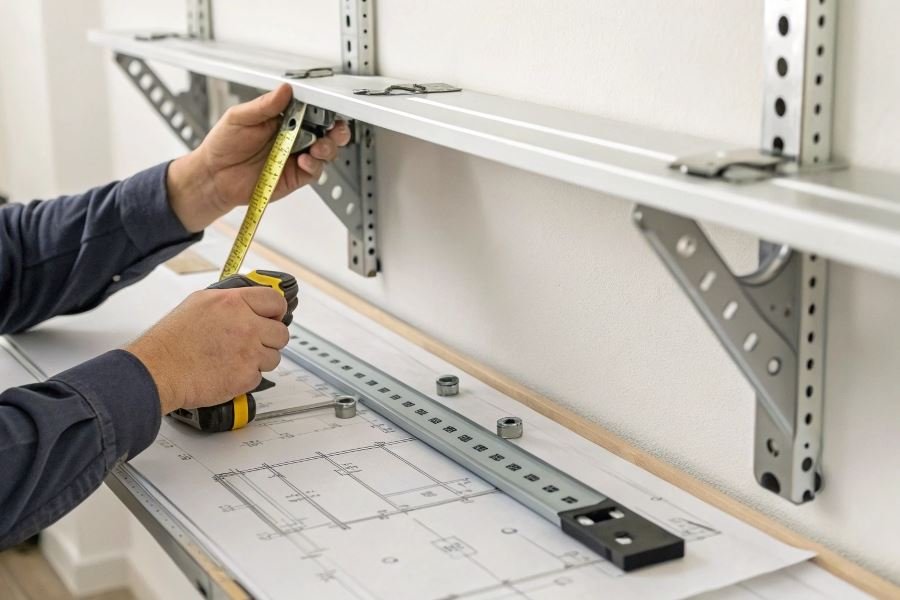
Ever watched $5,000 worth of inventory crash to the floor because someone underestimated a shelf’s capacity? That’s not just a mess—it’s a preventable business disaster happening in stockrooms and retail spaces across America every day.
When planning commercial storage solutions, load capacity isn’t just a technical specification—it’s the difference between efficient operations and costly catastrophe. The physics behind shelf strength directly impacts your bottom line, employee safety, and business continuity.
Three critical factors determine how much weight your wall shelves can safely hold:
- Mounting method – Toggle bolts can support 2-3 times more weight than standard drywall anchors
- Wall material – Solid wood studs provide approximately 80-100 pounds of support per screw compared to only 5-15 pounds in drywall
- Shelf design – The difference between a flat board and a properly braced shelf can multiply capacity by 400%
“The most expensive shelf is the one that fails when you need it most.” — Veteran retailer wisdom
Commercial settings demand more rigorous calculations than residential applications. While a home bookshelf might hold decorative items, your business shelves likely support inventory, equipment, or customer-facing displays—all requiring precise load management.
Calculation methods range from simple weight-per-bracket formulas to sophisticated distributed load analyses. The smartest approach combines manufacturer specifications with real-world testing and generous safety margins. Remember: theoretical capacity and practical safety are different considerations entirely.
Mastering Shelf Load Calculations for Business Success
When setting up retail displays, warehouse storage, or office organization systems, understanding the load capacity of wall shelves becomes critical to both safety and functionality. Calculating these capacities isn’t just about preventing catastrophic failures—it’s about optimizing your space for maximum efficiency while maintaining a professional appearance.
For business owners looking to maximize their vertical storage options, determining load capacity of wall shelves: how to calculate for your business becomes an essential skill that can prevent costly mistakes and potential liability issues. The difference between a properly mounted shelf that confidently holds your inventory and one that comes crashing down often comes down to simple mathematics and material knowledge.
Material Strength Fundamentals
Different shelf materials offer vastly different load-bearing capabilities:
| Material | Average Load Capacity | Best Applications |
|---|---|---|
| Solid Wood | 30-50 lbs per linear foot | Product displays, books, decorative items |
| Particleboard | 15-25 lbs per linear foot | Light merchandise, paperwork |
| Metal | 50-100+ lbs per linear foot | Heavy inventory, tools, equipment |
| Glass | 10-30 lbs per linear foot | Luxury displays, lightweight products |
Material thickness matters tremendously. A 3/4-inch solid maple shelf will support approximately twice the weight of its 1/2-inch counterpart. When selecting materials, consider not just immediate needs but future merchandising plans that might require additional capacity.
The span between supports dramatically affects capacity—a shelf’s maximum load decreases exponentially as its unsupported length increases. A 24-inch span typically supports about 40% less weight than a 12-inch span using identical materials.
Wall Structure and Hardware Assessment
Your calculations are only as good as your mounting system:
- Drywall anchors typically support 5-75 lbs depending on type
- Wood studs can handle 80-100 lbs per mounting point
- Concrete/masonry supports 100+ lbs with proper anchors
- Metal studs generally support 25-50 lbs per mounting point
Always factor in a safety margin of at least 20-30% below maximum rated capacity for long-term installations.
When mounting to drywall, locate studs whenever possible using a quality stud finder or use heavy-duty toggle bolts for substantial loads between studs.
Practical Calculation Methods
For most business applications, this simplified formula works well:
Total Shelf Capacity = (Material Capacity per Linear Foot × Shelf Length) ÷ (Span Between Supports × 1.5)
Example calculation: For a 48-inch solid oak shelf (rated at 40 lbs/linear foot) with supports every 16 inches:
(40 lbs × 4 ft) ÷ (16 in ÷ 12 × 1.5) = 160 ÷ 2 = 80 lbs total capacity
For retail displays, consider these specialized approaches:
- Point-load calculations for concentrated weight (like product displays)
- Distributed load planning for evenly spaced merchandise
- Dynamic load adjustments for frequently accessed inventory
When designing shelving for customer-facing areas, remember that aesthetics and function must balance. A beautifully designed shelf that sags under weight creates a poor impression, while overbuilt industrial shelving might clash with your brand image.
By mastering these calculation methods, you’ll create storage solutions that serve your business needs while maintaining both safety and professional appearance.
Turning Shelf Safety into Business Success
Documentation and Labeling That Works
Proper documentation isn’t just paperwork—it’s protection. Start by creating a comprehensive shelf inventory system that records each shelf’s specifications, including material, mounting hardware, and maximum load capacity. The most successful businesses maintain digital records with photos of proper installation alongside manufacturer specifications.
Clear labeling saves money and prevents accidents. Implement a standardized labeling system using high-visibility tags that display:
- Maximum weight capacity in pounds
- Date of installation
- Last inspection date
- Appropriate load types
A retail hardware chain in Colorado implemented QR code shelf labels that staff could scan to instantly access loading guidelines, reducing overloading incidents by 78% in just six months.
The most expensive shelf is the one that fails because someone didn’t know its limits.
Consider color-coding your shelving systems based on capacity ranges—red for light-duty (under 20 pounds), yellow for medium-duty (20-50 pounds), and green for heavy-duty (50+ pounds). This visual system creates an intuitive environment where even new employees can make smart loading decisions.
Staff Training Beyond the Basics
Knowledge transforms safety from theory to practice. Develop a training program that goes beyond simply sharing weight limits. Your staff should understand:
Weight distribution principles – Items should be centered, with heavier objects placed toward the bottom and back of shelving units.
Recognition of warning signs – Train employees to spot early indicators of shelf stress like bowing, loose fasteners, or wall damage.
Material density awareness – Help staff estimate item weights based on size and material (a small box of metal parts may outweigh a large box of fabric).
Interactive training yields better results than passive instruction. Create hands-on exercises where staff practice estimating weights and properly loading shelves. One manufacturing business reduced shelf-related incidents by 92% after implementing quarterly hands-on training sessions.
Maintenance That Prevents Failures
Even perfectly installed shelves require ongoing attention. Establish a maintenance schedule that includes:
| Timeframe | Inspection Type | Actions Required |
|---|---|---|
| Weekly | Visual check | Look for visible sagging, loose hardware |
| Monthly | Physical test | Gently test stability, tighten fasteners |
| Quarterly | Comprehensive | Unload shelves, inspect wall anchors, verify level |
| Annually | Professional | Have contractor verify structural integrity |
Document all inspections and repairs in your maintenance log. This creates accountability and provides crucial documentation should any issues arise.
Proactive replacement saves money. Establish clear criteria for shelf retirement—visible stress points, age thresholds, or changes in business needs. Many businesses find that replacing shelving systems every 5-7 years, even if they appear functional, prevents costly failures and inventory damage.
Remember that environmental factors like humidity and temperature fluctuations can affect load capacity over time. Businesses in regions with extreme seasonal changes should conduct additional inspections during transition periods.
By implementing these systematic approaches to documentation, training, and maintenance, you transform shelf safety from a potential liability into a business advantage that protects both your inventory and your people.
Learn how to accurately calculate wall shelf load capacity for your business storage needs. Our step-by-step guide covers material strength, mounting hardware, mathematical formulas, and safety protocols to maximize storage efficiency while ensuring workplace safety.
Learn how to accurately calculate wall shelf load capacity for your business storage needs. Our step-by-step guide covers material strength, mounting hardware, mathematical formulas, and safety protocols to maximize storage efficiency while ensuring workplace safety.