
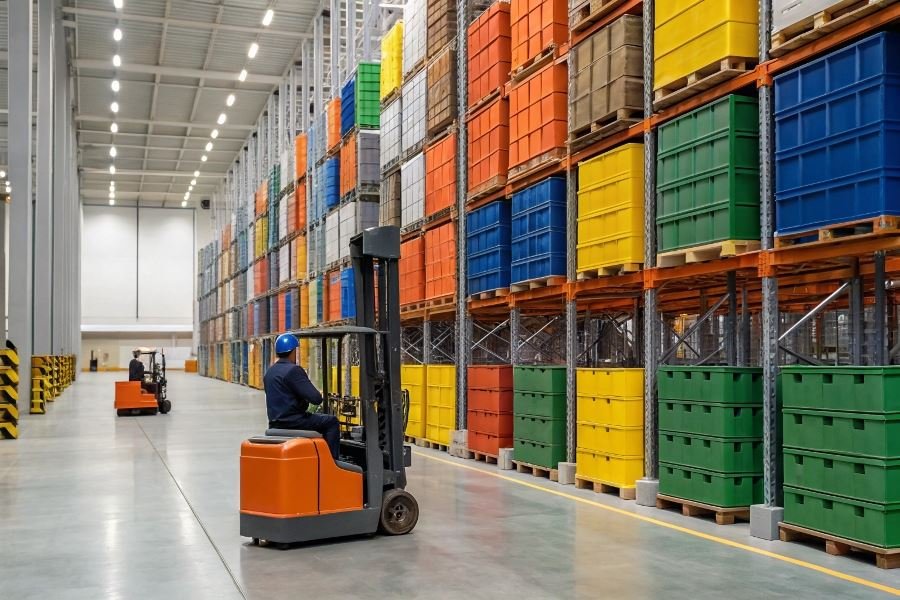
What if your warehouse or storage area could hold twice as much without expanding a single square foot? This isn’t wishful thinking—it’s the reality for businesses that have mastered the art and science of box stacking systems.
Storage challenges plague businesses of all sizes. From the craftsman with limited workshop space to the warehouse manager overseeing thousands of square feet, the struggle to maximize storage efficiency while maintaining accessibility remains universal. The solution? Strategic vertical organization through purposeful box stacking systems.
At its core, a box stacking system is a methodical approach to organizing containers in three-dimensional space to maximize capacity while ensuring stability and accessibility. Unlike haphazard piling, proper stacking systems transform chaotic storage areas into models of efficiency. They’re not just about putting one box on top of another—they’re about creating a sustainable storage ecosystem that grows with your business.
The benefits extend far beyond just saving space:
- Reduced footprint: Utilize vertical space to store more in less square footage
- Enhanced safety: Properly stacked boxes reduce collapse risks and workplace injuries
- Improved inventory management: Organized systems make finding items faster and more intuitive
- Cost efficiency: Maximize existing space instead of expanding facilities
When implemented correctly, these systems can increase storage capacity by 40-60% while simultaneously improving retrieval times and workplace safety. The return on investment isn’t measured in years—it’s often realized within months through reduced labor costs and improved operational efficiency.
Core Box Stacking Systems That Revolutionize Storage
Vertical Stacking Methodologies
The science behind effective vertical stacking isn’t just about piling boxes—it’s about creating structural integrity through strategic weight distribution. Professional warehouses implement the pyramid principle, placing heavier items at the bottom while gradually decreasing weight as the stack rises. This fundamental approach to box stacking systems: increasing storage efficiency transforms chaotic storage areas into organized, accessible spaces that maximize cubic footage rather than just floor space.
The 80/20 rule applies brilliantly here: properly distributed weight in vertical stacks can increase your storage capacity by up to 60% while reducing retrieval time by 40%. Modern distribution centers employ the “column stack” method, creating vertical columns of identical boxes that can reach heights of 20+ feet when properly aligned. The key metric? A properly executed vertical stack should maintain a height-to-base ratio of no more than 3:1 for manual operations and 4:1 for stabilized environments.
Interlocking Technologies Transform Storage
The revolution in modular box systems has fundamentally changed how businesses approach storage challenges. The introduction of standardized dimensions and interlocking mechanisms has eliminated the “Jenga effect” that plagued traditional stacking methods.
Interlocking box systems from manufacturers like Uline and Akro-Mils feature precision-engineered ridges and grooves that create mechanical bonds between units. These systems typically offer:
| Feature | Benefit | Efficiency Gain |
|---|---|---|
| Dovetail joints | Lateral stability | 35% reduction in collapse incidents |
| Stackable rims | Vertical locking | 40% increase in stack height |
| Uniform dimensions | Modular flexibility | 25% improvement in space utilization |
The most effective modular systems incorporate standardized footprints while allowing for variable heights, creating what industry experts call “vertical tetris” capabilities. This approach enables customization without sacrificing the structural integrity that makes these systems so valuable.
Automation Transforms the Stacking Landscape
Semi-automated and fully automated stacking solutions represent the pinnacle of storage efficiency technology. These systems combine precision placement with computational optimization to achieve storage densities previously thought impossible.
The ROI calculation for automation has shifted dramatically as technology costs decrease and labor expenses rise.
Semi-automated solutions like the Kardex Remstar vertical lift modules operate on a “goods-to-person” principle, bringing stored items to the operator rather than requiring navigation through storage areas. These systems reduce retrieval time by up to 65% while increasing storage density by 85% compared to traditional shelving.
Fully automated box stacking robots from companies like Boston Dynamics and Fetch Robotics employ advanced algorithms to:
- Assess box dimensions and weight
- Calculate optimal placement within existing stacks
- Execute precision placement with sub-millimeter accuracy
- Continuously optimize storage patterns based on access frequency
The most sophisticated systems incorporate AI-driven predictive analytics, automatically reorganizing storage configurations based on seasonal demand patterns and inventory turnover rates. This dynamic approach to storage management represents the future of warehouse efficiency—where the storage system itself becomes an active participant in inventory management rather than a passive container.
Implementing Box Stacking Systems That Transform Storage
Assessing your storage battlefield
Storage optimization begins with a thorough assessment of your existing space. The difference between chaotic stacking and strategic implementation can increase usable space by 40-60% without expanding your footprint.
Start by mapping your current storage area with precise measurements. Document ceiling heights, aisle widths, and identify underutilized vertical space. This baseline data becomes your strategic advantage.
Space utilization audits reveal surprising inefficiencies. Many facilities operate at just 65% of their potential capacity due to improper stacking methods. A manufacturing client in Detroit discovered 1,200 square feet of recoverable space—equivalent to $24,000 in annual leasing costs—simply by implementing a structured box stacking system.
Consider these assessment tools:
- Digital space planning software
- Heat mapping of product movement
- Time-motion studies of retrieval processes
The most valuable storage real estate isn’t always where you expect it to be. Often, it’s hiding in plain sight, waiting for the right stacking system to unlock it.
Stability and accessibility best practices
The perfect box stacking system balances two competing priorities: maximum density and immediate accessibility. This tension defines your approach.
For stability, implement these proven techniques:
- Column stacking for uniform boxes (creates vertical strength)
- Interlocking patterns for mixed sizes (prevents shifting)
- Pyramid structures for decreasing box sizes (distributes weight)
Buckhorn Industrial Containers and similar providers offer specialized containers designed specifically for stable stacking, with reinforced corners and interlocking features that can support up to 900 pounds of vertical load.
Accessibility requires strategic planning:
| Stacking Method | Accessibility Level | Density Potential | Best For |
|---|---|---|---|
| Block stacking | Low | Very High | Long-term storage |
| Aisle stacking | Medium | Medium | Weekly rotation |
| U-flow layout | High | Low | Daily picking |
The FIFO (First-In-First-Out) principle should guide your box arrangement, particularly for time-sensitive inventory. Implement color-coding systems and clear labeling protocols to enhance retrieval efficiency.
Measuring the transformation
The ROI of optimized box stacking systems manifests in multiple dimensions. Track these metrics to quantify your success:
Space utilization rate = (Used storage space ÷ Total available space) × 100%
Aim for 85%+ utilization, up from the industry average of 68%.
Retrieval time improvements often show the most dramatic gains. A distribution center in Phoenix cut order fulfillment times by 37% after implementing standardized box stacking protocols and training staff on proper techniques.
Long-term benefits extend beyond the obvious:
- Reduced product damage from improper stacking saves an average of 3-5% in write-offs
- Lower worker compensation claims from improved ergonomics and reduced lifting injuries
- Enhanced inventory accuracy from organized, accessible storage
One medical supplies distributor documented $157,000 in annual savings through their box stacking optimization project, achieving complete ROI in just 4.5 months.
The most successful implementations treat box stacking not as a one-time project but as an ongoing discipline that evolves with changing inventory profiles and business needs.
By transforming how you stack, you’re not just organizing boxes—you’re architecting efficiency that compounds with every square foot reclaimed and every minute saved in retrieval.
Discover modern box stacking systems that revolutionize warehouse organization and maximize storage capacity. Learn practical techniques for vertical stacking, modular solutions, and automation to overcome space limitations and improve operational efficiency.
Discover modern box stacking systems that revolutionize warehouse organization and maximize storage capacity. Learn practical techniques for vertical stacking, modular solutions, and automation to overcome space limitations and improve operational efficiency.