
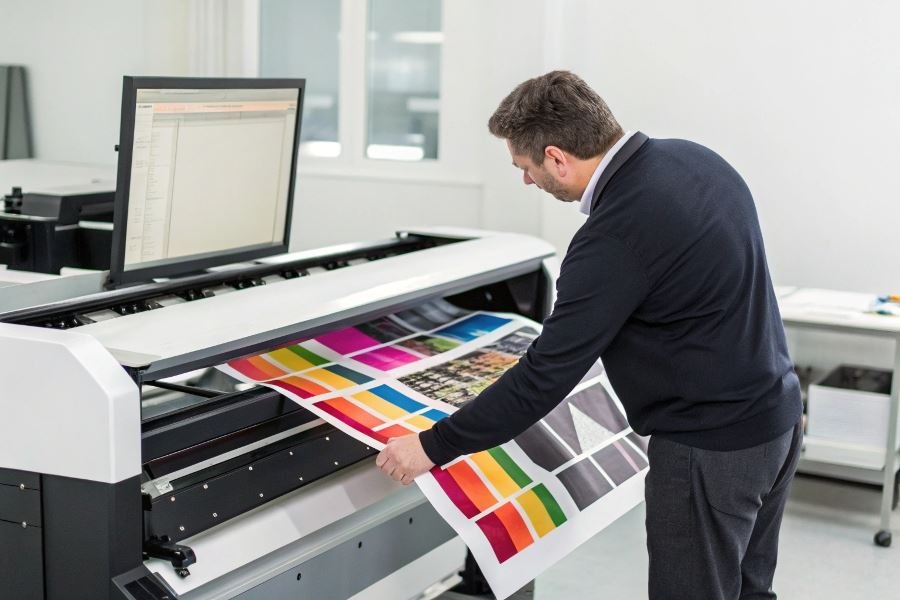
Ever seen a billboard that stopped you in your tracks? Or a vehicle wrap so striking you nearly missed your exit? That’s the power of wide-format printing—and for advertising agencies, selecting the right printer isn’t just a purchase, it’s a strategic investment that directly impacts creative capabilities and client satisfaction.
Wide-format printing has revolutionized how brands communicate visually. From trade show displays that command attention to outdoor signage that withstands the elements, these specialized printers transform creative concepts into tangible marketing assets that drive results. The criteria for choosing the right wide-format printer extend far beyond price tags—they determine whether your agency delivers jaw-dropping visuals or merely acceptable output.
“The difference between good and exceptional print quality isn’t just visible to the trained eye—it’s felt by every consumer who encounters your client’s brand.”
The technology landscape has evolved dramatically, with eco-solvent, UV, latex, and dye-sublimation options each offering distinct advantages. Resolution capabilities now reach photographic quality at 1440dpi and beyond, while production speeds have increased by over 40% since 2020. Modern systems also offer sophisticated color management tools that ensure brand consistency across multiple substrates—from rigid boards to flexible fabrics.
Your printer selection influences everything from turnaround times and material versatility to maintenance costs and environmental impact. The right equipment doesn’t just produce prints; it becomes the backbone of your creative offerings, enabling your team to say “yes” to projects that would otherwise require outsourcing.
Technical Essentials for Wide-Format Excellence
When evaluating wide-format printers for your advertising agency, the technical specifications become your roadmap to success or failure. The difference between a mediocre print and one that stops traffic often comes down to the hardware you’ve invested in. Establishing clear criteria for choosing a wide-format printer for an advertising agency requires understanding three critical technical components that will determine your output quality, production capacity, and versatility.
Resolution that commands attention
Print resolution remains the cornerstone of visual impact. Today’s premium wide-format printers deliver resolutions ranging from 720 dpi for basic signage to an impressive 2400 dpi for fine art reproduction.
The viewing distance equation is essential: a billboard viewed from 100 feet requires significantly lower resolution (around 720 dpi) than a retail display examined at arm’s length (1200+ dpi). Understanding this relationship prevents overspending on unnecessary resolution or underwhelming clients with pixelated imagery.
For advertising agencies handling diverse projects, consider these resolution benchmarks:
| Application | Minimum Resolution | Optimal Resolution |
|---|---|---|
| Billboards | 720 dpi | 1200 dpi |
| Retail POP Displays | 1200 dpi | 1440 dpi |
| Vehicle Wraps | 1440 dpi | 1800 dpi |
| Fine Art/Photography | 1800 dpi | 2400+ dpi |
The Canon Colorado 1650 exemplifies this balance with its FLXfinish technology, allowing both matte and gloss finishes at resolutions that maintain clarity even under scrutiny.
Production speed that meets deadlines
Nothing kills profitability faster than missed deadlines. Modern wide-format printers balance speed with quality through variable droplet technology and multi-pass printing modes.
The speed-quality relationship isn’t linear—doubling print speed typically reduces quality by more than half. Leading models like the HP Latex 800 W offer production modes that intelligently adjust this balance based on project requirements.
Consider these production metrics when evaluating options:
- Square feet per hour: The true measure of productivity
- Warm-up time: Often overlooked but critical for rush jobs
- Multi-roll capability: Can increase throughput by 40-100%
- Automated maintenance cycles: Reduces downtime between jobs
For high-volume advertising environments, look for printers capable of at least 800 sq ft/hr in production mode while maintaining acceptable quality for the intended viewing distance.
Media versatility for unlimited creativity
The most powerful printer becomes worthless if it can’t handle your clients’ preferred substrates. Today’s advertising landscape demands flexibility across rigid boards, textiles, vinyl, and specialty materials.
The most valuable wide-format printers aren’t necessarily those with the highest specs, but those that say “yes” to the widest range of client requests.
The Epson SureColor S80600 demonstrates this versatility with its ability to print on substrates ranging from traditional vinyl to specialized textiles, backlit films, and even leather.
When evaluating media compatibility, consider:
- Maximum media thickness (typically 0.08″ to 2.0″)
- Roll weight capacity (standard 40-100 lbs)
- Ink adhesion across substrates without specialized coatings
- White ink capability for transparent and colored media
The technical specifications of your wide-format printer will ultimately determine which projects you can accept, how quickly you can deliver them, and whether the final product will exceed client expectations or leave them underwhelmed. Choose wisely—your agency’s reputation prints with every job.
The Business Blueprint for Wide-Format Printer Selection
Beyond sticker price thinking
When evaluating wide-format printers for your advertising agency, the purchase price is merely the tip of the financial iceberg. Smart business owners analyze the Total Cost of Ownership (TCO) over a 3-5 year period. A Canon Colorado might command $25,000 upfront while an HP Latex runs $18,000, but ink consumption can dramatically reverse the cost equation.
Premium printers often deliver superior ink efficiency that compounds with every print job.
Consider this breakdown for a medium-volume agency:
| Cost Factor | Economy Model | Premium Model |
|---|---|---|
| Purchase Price | $18,000 | $25,000 |
| Annual Ink Costs | $9,600 | $6,200 |
| Yearly Maintenance | $2,400 | $1,800 |
| 3-Year TCO | $47,400 | $43,600 |
Maintenance contracts vary wildly—from basic phone support to comprehensive on-site service with parts included. The Roland DG premium service package might seem expensive until your printer fails during a critical client deadline.
Physical realities of production power
Wide-format printers aren’t desktop devices—they’re production equipment requiring thoughtful installation planning. The average 64-inch printer needs approximately 80 square feet of operational space, including room for media loading, finished print handling, and technician access.
Environmental factors demand equal attention:
- Temperature stability (68-75°F ideal range)
- Humidity control (40-60% recommended)
- Dedicated electrical circuits (20-30 amp service typical)
- Ventilation requirements (especially for solvent printers)
The Epson SureColor series requires less ventilation than solvent-based alternatives, potentially saving thousands in HVAC modifications. Meanwhile, the Mimaki UCJV300 series offers a more compact footprint that can reduce your space requirements by up to 30%.
Downtime is the true business killer
Nothing devastates production schedules like equipment failure. The reliability difference between printer models can mean dozens of additional productive days annually. The EFI Pro series boasts a 99.8% uptime rate when properly maintained, compared to industry averages hovering around 97%.
The most expensive printer is the one that isn’t printing when you need it most.
Warranty terms reveal manufacturer confidence levels. Standard coverage ranges from 1-2 years, but premium models often include:
- Extended 3-5 year coverage options
- Next-business-day on-site service
- Printhead replacement provisions (potentially saving $2,000+ per incident)
- Loaner equipment during extended repairs
Support accessibility creates dramatic business impact. The Fujifilm Acuity platform offers 24/7 technical support with remote diagnostics, potentially resolving issues in minutes rather than days. Compare response times carefully—some manufacturers promise “same-day response” but deliver only a callback, not a solution.
When evaluating service contracts, prioritize providers with certified technicians within a 50-mile radius of your facility. Remote locations often face 48+ hour response times regardless of contract promises.
Discover the 7 essential criteria for selecting the perfect wide-format printer for your ad agency. From print resolution and speed to cost analysis and reliability, learn how to make a strategic investment that enhances your advertising capabilities.
Discover the 7 essential criteria for selecting the perfect wide-format printer for your ad agency. From print resolution and speed to cost analysis and reliability, learn how to make a strategic investment that enhances your advertising capabilities.