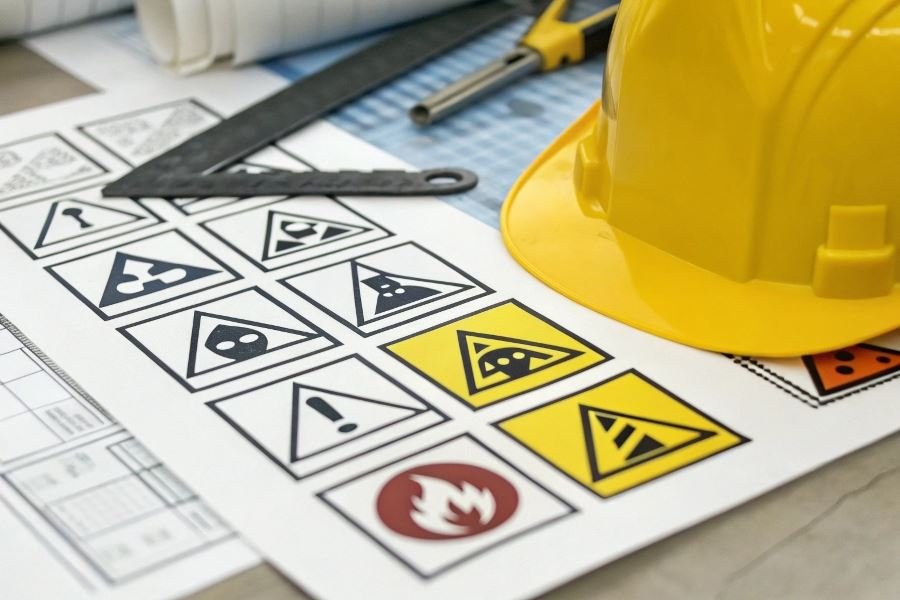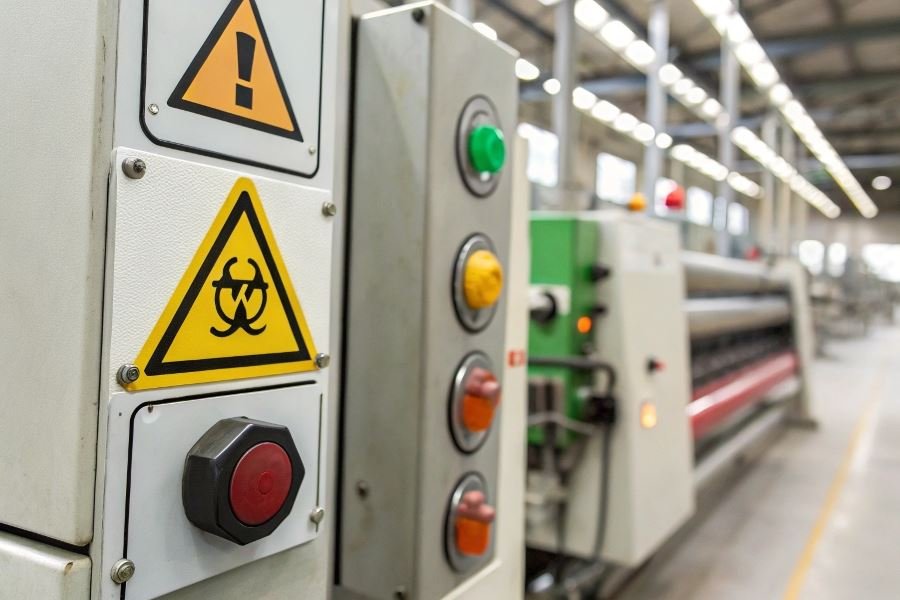
Ever wondered what stands between a routine workday and a catastrophic accident? Often, it’s just a simple warning label.
In manufacturing facilities across America, warning labels serve as the first line of defense against workplace accidents. These unassuming stickers and signs do far more than decorate equipment—they communicate critical information that protects lives and prevents injuries. Choosing the right warning labels for industrial equipment isn’t just good practice; it’s a fundamental responsibility that carries significant legal, financial, and ethical implications.
The life-saving power of proper warnings
Warning labels transform dangerous machinery from silent threats into communicative safety systems. When properly implemented, they:
- Alert workers to non-obvious hazards
- Provide clear instructions for safe operation
- Remind experienced operators about crucial safety protocols
- Serve as visual cues in high-stress or emergency situations
The Occupational Safety and Health Administration (OSHA) reported that inadequate hazard communication contributed to over 1,500 serious workplace injuries in their most recent annual report. Many of these incidents could have been prevented with proper warning labels.
Navigating the regulatory maze
The regulatory landscape for industrial warning labels is comprehensive and exacting. OSHA standards, ANSI Z535 guidelines, and industry-specific regulations create a complex framework that manufacturers and facility managers must navigate. These standards aren’t arbitrary—they’re based on decades of research into human perception, comprehension, and behavior.
“Compliance isn’t just about avoiding fines; it’s about creating a universal visual language of safety that works across literacy levels, languages, and cultural backgrounds.” — National Safety Council
When warnings fail: The high cost of inadequacy
The consequences of inadequate warning labels extend far beyond potential regulatory fines. Companies face:
- Catastrophic financial liability from lawsuits and settlements
- Production disruptions following accidents or regulatory shutdowns
- Damaged reputation and loss of customer confidence
- Decreased employee morale and increased turnover
One manufacturing company faced a $4.7 million settlement after a worker suffered permanent injuries that could have been prevented with proper warning labels—a sobering reminder that cutting corners on safety communication is never worth the risk.
Essential Factors for Industrial Warning Labels
Safety communication in industrial settings demands precision and thoughtfulness. The selection of appropriate warning labels represents a critical investment in workplace safety that pays dividends through accident prevention and regulatory compliance. When evaluating how to choose warning labels for industrial equipment, three fundamental considerations emerge: material durability, design elements, and strategic placement. Each factor plays a vital role in ensuring warnings remain effective throughout the equipment’s operational life.
Material Durability for Harsh Environments
The industrial environment presents unique challenges that standard labels simply cannot withstand. Your warning labels must survive where they live.
Chemical resistance becomes paramount in processing facilities where labels may encounter solvents, acids, or cleaning agents. Polyester and vinyl materials offer excellent chemical resistance, while polycarbonate provides superior protection in particularly aggressive environments.
Temperature extremes require specialized solutions. High-temperature environments demand materials like polyimide (Kapton), which maintains integrity up to 500°F. For freezing conditions, cryogenic-rated labels using acrylic adhesives remain flexible and adherent at temperatures as low as -320°F.
| Environment Type | Recommended Material | Temperature Range | Chemical Resistance |
|---|---|---|---|
| Standard Indoor | Vinyl | 0°F to 150°F | Moderate |
| Outdoor Exposure | Polyester | -40°F to 300°F | High |
| High Temperature | Polyimide | -40°F to 500°F | Excellent |
| Chemical Processing | Polycarbonate | -40°F to 280°F | Superior |
| Freezer/Cold Storage | Cryogenic Acrylic | -320°F to 200°F | Good |
UV exposure degrades standard materials rapidly. For outdoor equipment, UV-resistant laminates extend label life by 3-5 years compared to unprotected alternatives.
Design Elements That Demand Attention
Effective warning labels communicate instantly through strategic use of color, symbols, and text.
ANSI Z535 and ISO 3864 standards provide crucial frameworks for hazard communication. These standards establish color coding conventions: red for danger (imminent hazard), orange for warning (potential hazard), and yellow for caution (minor hazard).
Symbols transcend language barriers and communicate faster than text alone. The human brain processes images in 13 milliseconds—significantly faster than text. Standardized pictograms from ISO 7010 ensure universal recognition across diverse workforces.
Text elements require careful consideration:
- Sans-serif fonts improve readability at distance
- Minimum 14-point font size for primary warnings
- 5:1 contrast ratio between text and background
- Concise messaging (under 50 characters when possible)
Size and Placement Strategies
The effectiveness of even perfectly designed labels diminishes dramatically with poor placement or inadequate sizing.
Viewing distance dictates minimum size requirements. The general rule follows a 1:100 ratio—for every 100 feet of viewing distance, text height should increase by 1 inch. Critical warnings visible from 20 feet require text at least 0.2 inches tall.
Strategic placement considers user workflow and sightlines. Position labels:
- At eye level when possible (approximately 60 inches from floor)
- Within the operator’s natural field of vision
- Before the point of potential hazard
- With 3-5 inches of clearance from controls or moving parts
Multiple identical labels may be necessary for large equipment accessed from various angles. Research indicates that warning effectiveness increases by 65% when labels appear at both the access point and the specific hazard location.
The material-design-placement triad forms the foundation of effective warning label implementation. When these elements work in harmony, they create a safety communication system that protects workers and equipment while satisfying regulatory requirements.
Mastering Warning Label Systems That Actually Work
Documentation that saves lives not just space
Effective warning label systems don’t exist in isolation—they thrive within robust documentation frameworks. The most successful industrial operations maintain digital repositories that track every label’s location, installation date, and compliance status. These systems aren’t just bureaucratic exercises; they’re protective shields against both accidents and regulatory penalties.
A comprehensive documentation system should include:
- Label inventory database with unique identifiers
- Digital photographs of installed labels
- Compliance verification checklists
- Incident reports related to warning label effectiveness
Smart operations use QR codes on documentation that link directly to digital records, creating seamless connections between physical warnings and their digital twins. This approach reduces retrieval time from minutes to seconds during critical safety audits or emergencies.
“Documentation without accessibility is just expensive paper storage. Make your safety records work as hard as your warning labels do.”
Inspection cycles that prevent failures
Warning labels face brutal conditions in industrial environments. Chemical exposure, UV degradation, physical abrasion—these enemies of visibility attack constantly. The most effective operations implement tiered inspection protocols:
| Inspection Type | Frequency | Personnel | Focus Areas |
|---|---|---|---|
| Visual scan | Daily | Operators | Obvious damage, missing labels |
| Detailed check | Monthly | Safety officers | Legibility, attachment security |
| Comprehensive audit | Quarterly | Compliance team | Standards adherence, documentation |
Replacement protocols should trigger automatically when labels show the first signs of degradation—not when they become completely illegible. The best operations maintain on-site label printing capabilities through systems like Brady Workstation to ensure immediate replacement of compromised warnings.
Degradation begins long before visibility fails completely. Establish objective criteria for replacement based on color fading percentages, scratch depth, or character legibility at standard viewing distances.
Training that transforms labels into action
Warning labels only work when people understand and respect them. The most effective training programs go beyond simple recognition exercises to create visceral understanding of consequences.
Effective warning label training includes:
- Simulated emergency scenarios based on specific warning types
- Response time drills for critical warnings
- Comprehension testing across language barriers
- Refresher modules triggered by near-miss incidents
OSHA compliance requires basic hazard communication training, but exceptional operations create immersive experiences using augmented reality platforms like Vector Solutions that demonstrate real-world consequences of ignoring specific warnings.
Cross-train maintenance personnel in basic label replacement techniques to eliminate delays between identification of compromised warnings and their replacement. This distributed responsibility model dramatically reduces warning system vulnerabilities.
The most successful industrial operations treat their warning label systems as living safety infrastructure rather than static compliance requirements. Through meticulous documentation, proactive inspection cycles, and behavior-focused training, these systems become powerful accident prevention tools rather than mere regulatory checkboxes.
Learn how to select compliant industrial warning labels that meet safety regulations. Discover key factors in material durability, design elements, and proper placement to protect workers and avoid costly compliance issues.
Learn how to select compliant industrial warning labels that meet safety regulations. Discover key factors in material durability, design elements, and proper placement to protect workers and avoid costly compliance issues.