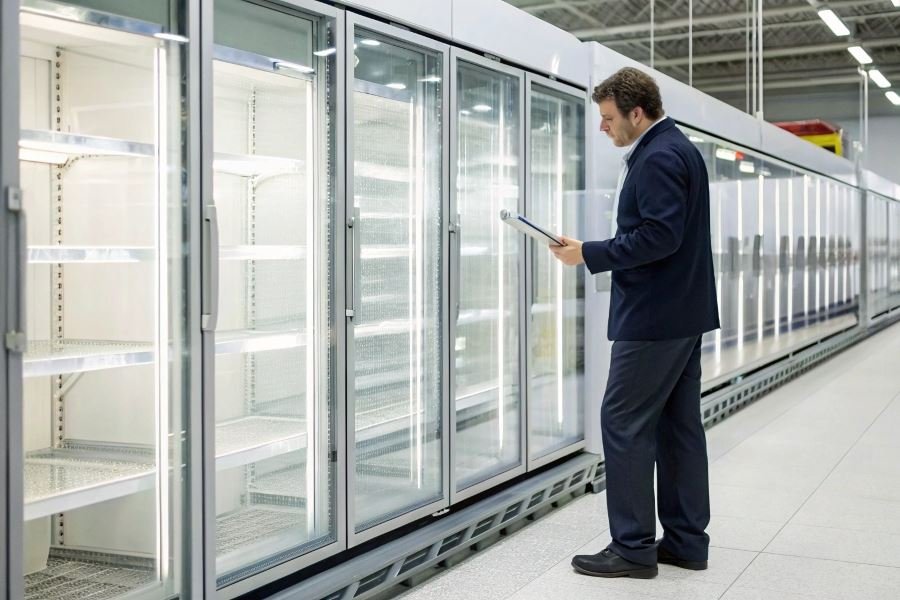
Ever wondered why some refrigeration systems hum along perfectly while others struggle, guzzle electricity, or fail prematurely? The answer often lies not in the quality of components, but in a critical calculation many overlook: proper power sizing.
When calculating refrigeration equipment power, you’re essentially determining how much cooling muscle your system needs to maintain optimal temperatures under your specific conditions. It’s like sizing an engine for a vehicle—too small and it struggles uphill, too large and you’re wasting fuel and money.
The critical factors that determine cooling power
Several key elements influence how much refrigeration power your application requires:
- Thermal load – The amount of heat that must be removed from a space
- Ambient temperature – External conditions affecting system efficiency
- Insulation quality – How well heat transfer is prevented
- Usage patterns – Door openings, product loading schedules, etc.
Speaking the language of refrigeration
Before diving into calculations, you’ll need to understand the terminology:
| Term | Definition | Typical Units |
|---|---|---|
| BTU | British Thermal Unit – amount of heat needed to raise 1 pound of water by 1°F | BTU/hr |
| Ton of Refrigeration | Cooling power equal to melting one ton of ice in 24 hours | Tons (12,000 BTU/hr = 1 ton) |
| Coefficient of Performance (COP) | Ratio of cooling provided to energy required | Dimensionless number |
| Kilowatt (kW) | Standard measure of electrical power consumption | kW |
Properly sized refrigeration doesn’t just perform better—it saves substantial money over equipment lifespan while ensuring product integrity. The difference between guesswork and precise calculation can mean thousands of dollars in operating costs and years of additional service life.
Precision Power Calculation for Refrigeration Systems
The Science of Heat Load Calculation
When determining the appropriate refrigeration capacity for your commercial setup, precision matters more than guesswork. The heat load calculation method stands as the gold standard for professionals who need exact figures. This approach accounts for every BTU (British Thermal Unit) that your system must remove to maintain optimal temperatures.
Understanding how to calculate the required power of refrigeration equipment begins with identifying all heat sources affecting your space. A comprehensive heat load analysis examines heat generated from products, infiltration through doors and walls, equipment operation, lighting, and human activity. Each factor contributes to the total thermal load your refrigeration system must overcome.
The formula looks deceptively simple: Total Heat Load (BTUs) ÷ Operating Hours = Required Hourly Capacity. However, the devil lives in the details. For example, a True Manufacturing commercial refrigerator might need to account for 8,000 BTUs from product cooling, 3,500 BTUs from infiltration, and 2,000 BTUs from lighting and staff—totaling 13,500 BTUs over an 18-hour operating period, requiring a 750 BTU/hour capacity.
Square Footage Calculations Made Simple
For those seeking a more accessible approach, square footage calculations offer a practical alternative. This method applies industry-standard multipliers to your space dimensions.
The beauty of this approach lies in its accessibility—you need only basic measurements and a calculator.
| Space Type | BTU Multiplier (per sq ft) | Example (500 sq ft) |
|---|---|---|
| Walk-in Cooler | 10-15 BTUs | 5,000-7,500 BTUs |
| Walk-in Freezer | 15-20 BTUs | 7,500-10,000 BTUs |
| Display Cases | 25-35 BTUs | 12,500-17,500 BTUs |
Volume-based calculations take this concept further by accounting for the three-dimensional space. For every cubic foot in a refrigerated space, expect to need approximately 2-3 BTUs for coolers and 3-4 BTUs for freezers. A 10’ × 12’ × 8’ walk-in cooler (960 cubic feet) would require between 1,920-2,880 BTUs of refrigeration power.
Environmental Factors That Change Everything
The theoretical calculations above provide an excellent starting point, but real-world conditions demand adjustments. Environmental factors can dramatically alter your refrigeration power requirements.
Ambient temperature creates one of the most significant variables. A system operating in Phoenix will need substantially more power than an identical setup in Seattle. For every 10°F increase in ambient temperature above 90°F, add approximately 15% to your calculated refrigeration load.
The difference between theoretical and actual refrigeration requirements often comes down to usage patterns that engineers never anticipated.
Door openings represent another critical factor. Each time a Hussmann display case or walk-in cooler door opens, cold air escapes and warm air enters. High-traffic installations may require up to 40% more refrigeration capacity than low-traffic equivalents.
Product temperature also matters significantly. Cooling products from room temperature demands more energy than maintaining already-cold items. A produce delivery receiving area might need double the refrigeration capacity of a similar-sized storage area that holds pre-cooled inventory.
Seasonal variations should inform your calculations as well. Many businesses wisely size their systems for peak summer demands, ensuring year-round performance even during the most challenging conditions. This approach might seem like overkill during winter months, but prevents costly product losses during heat waves.
By combining these calculation methods and adjustment factors, you’ll arrive at a refrigeration power specification that delivers reliable performance without wasteful overcapacity—the sweet spot where operational excellence meets energy efficiency.
Turning Theory into Action: Practical Refrigeration Power Calculations
The Commercial Kitchen Calculation Roadmap
Calculating refrigeration power isn’t just theoretical—it’s the difference between perfectly preserved inventory and thousands of dollars in spoilage. Let’s walk through the real-world process that successful food service operations follow:
- Measure your space dimensions precisely—length, width, and height in feet
- Document insulation values (R-values) of walls, ceiling, and floor
- Record ambient temperature conditions both seasonal averages and extremes
- Inventory heat-generating equipment within the space
- Calculate product load based on daily throughput and temperature requirements
- Factor in human traffic patterns (door openings per hour)
- Apply safety factor (typically 10-15%)
The formula becomes: Total BTU/hr = (Space Heat Load + Product Load + Equipment Load + Traffic Load) × Safety Factor
Pro tip: For walk-in coolers, expect approximately 2,500-3,000 BTU/hr per 100 cubic feet as a quick reference point, but always verify with detailed calculations.
Digital Tools That Eliminate Guesswork
The days of back-of-napkin calculations are long gone. Today’s refrigeration professionals leverage sophisticated tools:
- CoolCalc – Industry-standard software that factors in geographical climate data
- Danfoss Coolselector – Comprehensive component selection and load calculation
- Bitzer Software – Precision compressor sizing with performance mapping
For those preferring mobile solutions, apps like HVAC Buddy provide on-the-go calculations that sync with cloud databases of equipment specifications.
The most expensive refrigeration system is the one that fails when you need it most. Proper sizing isn’t about spending more—it’s about spending right.
Verification and Fine-Tuning for Peak Performance
Calculations are just the beginning. Verification ensures your system delivers as expected:
- Monitor pull-down time – How quickly does the system reach target temperature?
- Track duty cycle percentage – Ideally 70-80% during peak demand
- Measure actual power consumption against projected values
- Log temperature stability across different zones
| Performance Indicator | Target Range | Warning Signs |
|---|---|---|
| Compressor Run Time | 16-18 hrs/day | 20 hrs/day |
| Temperature Fluctuation | ±2°F | ±4°F |
| Superheat | 8-12°F | <5°F or >15°F |
| Subcooling | 10-15°F | <8°F or >18°F |
When adjustments are needed, focus on these high-impact areas:
- Superheat settings – Fine-tune expansion valve adjustment
- Condenser airflow – Ensure proper clearance and cleaning schedules
- Evaporator defrost cycles – Optimize timing based on actual frost accumulation
- Insulation integrity – Address thermal bridges and seal failures
Remember that refrigeration systems respond to seasonal changes. What works perfectly in April may struggle in August. Schedule quarterly performance reviews to maintain optimal efficiency year-round.
Learn precise methods for calculating refrigeration equipment power requirements based on heat load, space dimensions, and environmental factors. Master essential calculations for optimal cooling performance and energy efficiency.
Learn precise methods for calculating refrigeration equipment power requirements based on heat load, space dimensions, and environmental factors. Master essential calculations for optimal cooling performance and energy efficiency.