Ever walked into a store’s back room and found employees wading through mountains of boxes, frantically searching for inventory while customers wait? That chaotic scene isn’t just frustrating—it’s bleeding money from your bottom line.
Behind every successful retail operation lies an unsung hero: the unpacking area. This overlooked space directly impacts your profitability in ways most store owners never realize. When properly organized, it becomes the heartbeat of inventory management, dramatically reducing shrinkage and getting products to shelves faster.
The numbers tell a compelling story: retailers with optimized receiving areas experience up to 30% faster inventory processing and reduce damaged merchandise by nearly a quarter. Yet most stores continue struggling with critical challenges:
“We spent thousands on fancy POS systems while ignoring our receiving area. Once we reorganized it, our inventory accuracy jumped from 82% to 97%.” — Independent hardware store owner
The ripple effects of disorganized receiving extend throughout operations. Staff waste precious hours hunting for misplaced items, inventory counts become unreliable, and customer satisfaction plummets when popular items sit unopened instead of on shelves.
Implementing a systematic unpacking workflow delivers immediate benefits:
- Accelerated inventory turnover – Products move from truck to shelf in hours, not days
- Reduced labor costs – The same team processes more inventory in less time
- Enhanced loss prevention – Proper receiving procedures catch discrepancies immediately
- Improved employee satisfaction – Clear processes reduce frustration and errors
The most successful retailers understand that an effective unpacking area isn’t just about organization—it’s about creating a strategic advantage that competitors simply can’t match.
The Anatomy of an Efficient Unpacking Zone
Strategic Space Planning That Drives Productivity
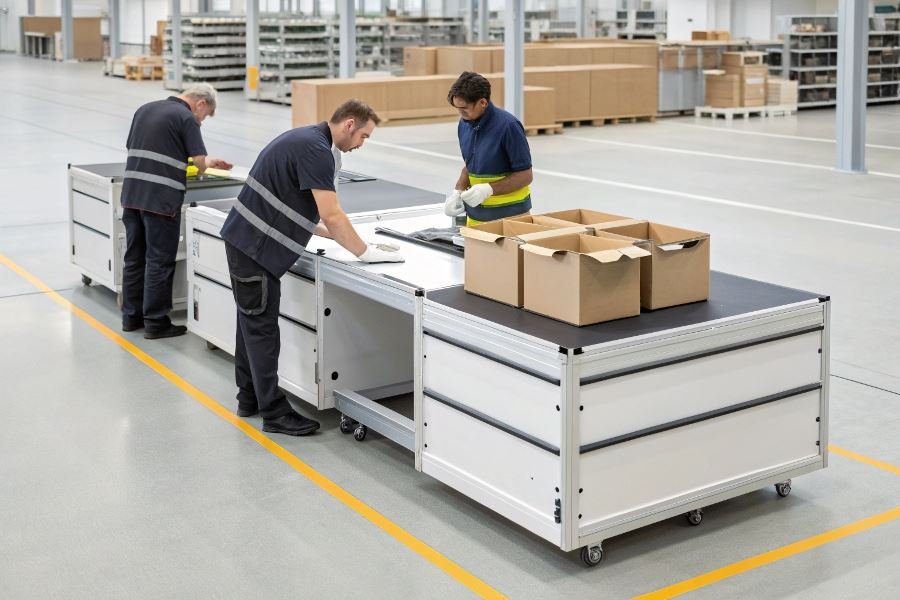
The backbone of retail operations often hides behind the scenes where customers never venture. Creating an optimized unpacking area transforms chaotic backrooms into precision-engineered workspaces that directly impact your bottom line. When planning how to organize an effective unpacking area in a store, the spatial layout becomes your first critical decision point. The ideal configuration follows a linear progression—from receiving dock to shelving prep—with no backtracking or cross-traffic patterns that waste precious steps.
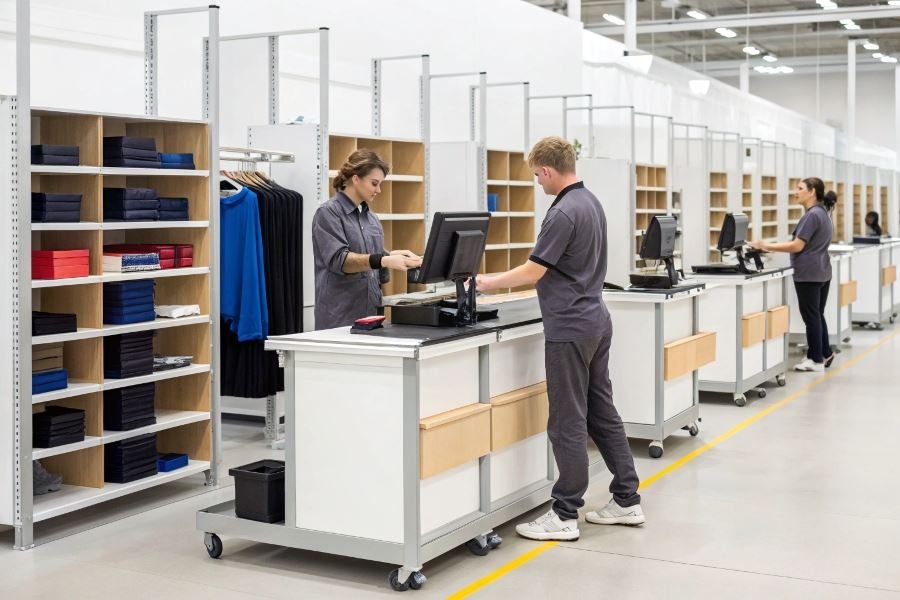
Flow mapping reveals that a U-shaped or L-shaped layout typically outperforms straight-line configurations in spaces under 500 square feet. This design principle reduces walking distance by up to 30% while maintaining clear sightlines across the entire operation. For larger operations, consider dedicated zones with 5-foot minimum pathways between workstations to accommodate both personnel and equipment movement.
The most efficient unpacking areas process inventory in one direction only—items should never move backward through your system.
Equipment Arsenal for Seamless Processing
The right tools transform unpacking from a labor-intensive chore into a streamlined process. Your equipment foundation should include:
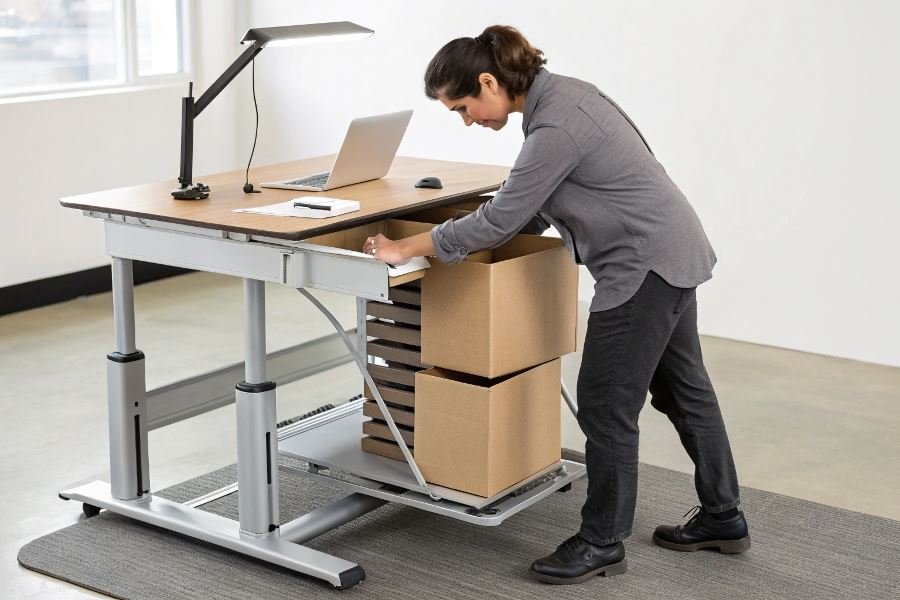
- Adjustable-height workstations (28-42 inches) to prevent employee fatigue and accommodate different product sizes
- Commercial-grade utility carts with minimum 300-pound capacity
- Integrated scale systems for immediate verification against packing slips
- Heavy-duty box cutters with replaceable blades and safety features
The investment in proper shelving cannot be overstated. Metro shelving systems with weight capacities exceeding 800 pounds per shelf provide the versatility to handle everything from delicate electronics to bulky appliances. For operations processing over 200 items daily, consider adding a Vestil hydraulic lift table to reduce strain during heavy lifting tasks.
Inventory Systems: The Digital Backbone
Modern unpacking areas must bridge the physical and digital worlds seamlessly. Implementing barcode scanning at the earliest possible point—the moment items exit shipping containers—reduces errors by 67% compared to traditional manual entry methods.
Your inventory management integration should feature:
| Component | Function | Implementation Priority |
|---|---|---|
| Mobile scanning stations | Real-time inventory updates | Essential |
| Exception flagging system | Immediate damage/shortage alerts | High |
| Cross-reference verification | Automatic PO matching | Medium |
| Staging area designation | Digital location assignment | Medium |
Shopify POS and Square for Retail offer particularly robust receiving modules that integrate directly with unpacking workflows. The key is selecting a system that minimizes the steps between physical handling and digital recording.
Smart storage solutions complete the system by incorporating color-coded zones for different product categories or destinations within the store. This visual management approach reduces training time for new staff while maintaining processing speed during high-volume periods.
The most successful retailers recognize that their unpacking area isn’t just a necessary evil—it’s a competitive advantage when engineered with the same attention to detail given to customer-facing spaces. When properly executed, an efficient unpacking zone becomes the heartbeat of inventory control, driving profitability through precision and speed.
Turning Your Unpacking Area into a Profit Center
Staff training that sticks
The most sophisticated unpacking area design falls flat without properly trained staff. Developing comprehensive standard operating procedures (SOPs) transforms chaotic backrooms into precision operations. The key? Documentation that’s actually useful, not binder-fillers.
Start with visual SOPs that show exactly how products should flow from delivery truck to sales floor. Retailers like Target have mastered this with color-coded workflow charts that even seasonal employees can follow instantly. Your training should cover:
- Receiving protocols with digital verification
- Unpacking sequences by product category
- Quality control checkpoints
- Inventory management system integration
- Waste handling and sustainability practices
The most successful retailers implement cross-training programs where floor staff rotate through backroom operations. This creates organizational empathy—sales associates who understand why inventory accuracy matters sell more effectively.
Metrics that drive performance
What gets measured gets managed. Tracking the right metrics transforms your unpacking area from a cost center to a strategic advantage.
| Metric | Target | Business Impact |
|---|---|---|
| Dock-to-Stock Time | <24 hours | Improved cash flow |
| Inventory Accuracy | 98% | Reduced stockouts |
| Labor Cost per Unit | <$0.15 | Margin protection |
| Damage Rate | <0.5% | Profit preservation |
| Space Utilization | 85% | Reduced overhead |
The most revealing metric? Throughput velocity—how quickly merchandise moves from receiving to selling position. Walmart pioneered this approach, discovering that each 1% improvement in throughput velocity translated to approximately 0.8% increase in sales for seasonal merchandise.
Implement a visual management system where these metrics are displayed prominently in the unpacking area. When teams can see real-time performance, self-correction happens naturally.
Continuous improvement mindset
The most effective unpacking areas evolve constantly. Implement a structured continuous improvement program with these components:
- Weekly kaizen sessions where staff identify friction points
- Monthly process reviews comparing metrics against targets
- Quarterly technology assessments to identify automation opportunities
Home Depot revolutionized their unpacking efficiency by implementing a simple “5S” program (Sort, Set in order, Shine, Standardize, Sustain) that reduced unpacking time by 22% while improving accuracy.
The difference between good and great unpacking operations isn’t technology—it’s creating a culture where everyone owns the process.
Consider implementing a tiered problem-solving approach where frontline staff can make immediate improvements to their workstations, while more complex challenges get escalated to cross-functional teams. This empowers employees while ensuring strategic alignment.
The most sophisticated retailers treat their unpacking areas as innovation labs, testing new approaches before rolling them out company-wide. This creates both operational excellence and competitive advantage—turning what many see as a cost center into a genuine profit driver.
Discover proven strategies to organize an effective unpacking area in your store. Learn spatial layout optimization, essential equipment needs, and inventory management techniques that boost operational efficiency and retail profitability.
Discover proven strategies to organize an effective unpacking area in your store. Learn spatial layout optimization, essential equipment needs, and inventory management techniques that boost operational efficiency and retail profitability.