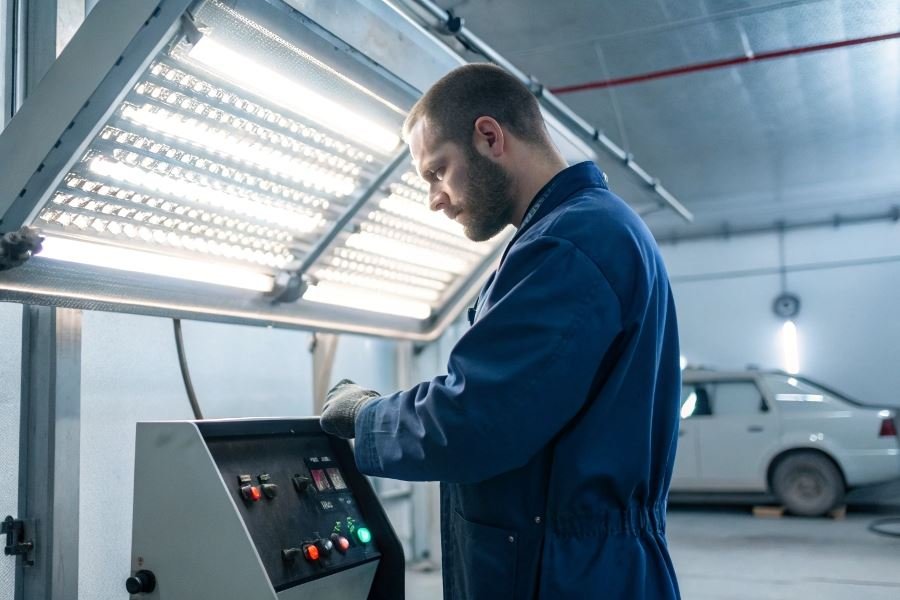
What if you could cut your paint drying time in half while achieving better results? That’s not magic—it’s the reality of infrared drying technology that’s transforming body shops across America.
Infrared drying represents a fundamental shift in how we approach automotive refinishing. At its core, this technology uses electromagnetic radiation to generate heat that penetrates multiple layers of paint simultaneously, curing from the inside out. Unlike conventional methods that heat the surrounding air, infrared waves directly excite the molecules in the coating, creating a more efficient energy transfer and dramatically accelerating the curing process.
The journey to today’s sophisticated infrared systems has been remarkable. Traditional body shops once relied exclusively on ambient air drying—a process that could take days. The introduction of convection ovens in the mid-20th century represented progress but still suffered from inefficiencies and uneven heating. The infrared revolution began in earnest during the 1980s, but early systems were bulky, expensive, and often unreliable. Modern IR technology has overcome these limitations, offering precision, portability, and unprecedented control.
Why your drying equipment choice matters more than you think
Selecting the right infrared drying system isn’t just about speed—it’s about quality and profitability. Proper curing ensures paint durability, color accuracy, and finish integrity. The wrong equipment can lead to costly problems: surface defects, color inconsistencies, and premature failure. For professionals committed to excellence, understanding the criteria for choosing infrared drying equipment isn’t optional—it’s essential for delivering results that stand the test of time.
Technical Essentials for Infrared Drying Excellence
Power that performs when it matters
The foundation of any effective infrared drying system lies in its power output specifications. Professional-grade IR dryers typically range from 1,000 to 15,000 watts, with commercial body shops often requiring at least 3,000 watts for efficient operation. When evaluating criteria for choosing infrared drying for body repair, power density—measured in watts per square foot—provides a more accurate performance indicator than raw wattage alone.
A high-quality system should deliver approximately 100-150 watts per square foot of coverage area to ensure proper curing without hotspots. For context, a 3,000-watt system with optimal design can effectively cure an area of about 20-30 square feet, perfect for standard panel repairs.
Coverage area matters just as much as power. The most powerful system becomes useless if it can’t properly distribute heat across your work surface. Look for systems with adjustable lamp arrays that can be positioned to match the contours of the vehicle panel. Premium systems like the SpeedDry 5000 offer articulating arms with 180° rotation capabilities, allowing technicians to maintain the critical 18-24 inch optimal distance from the surface regardless of panel shape.
Short vs. medium wave: The technology showdown
The wavelength debate represents perhaps the most crucial technical consideration when selecting infrared equipment:
| Wavelength Type | Penetration | Heat-up Time | Energy Efficiency | Ideal Applications |
|---|---|---|---|---|
| Short Wave (0.7-1.4μm) | Surface level | 30-60 seconds | Lower | Clear coats, spot repairs |
| Medium Wave (1.4-3.0μm) | 2-3mm depth | 3-5 minutes | Higher | Primers, fillers, basecoats |
Medium wave technology penetrates deeper into substrates, making it superior for curing body fillers and primers where complete curing throughout the material is essential. The slower heat-up prevents surface skinning that can trap solvents underneath—a common cause of future paint failures.
Short wave systems excel at rapid surface curing, making them ideal for clear coats and quick spot repairs. However, their intense heat requires more precise control to prevent overheating sensitive components.
Many professional shops now invest in hybrid systems that combine both technologies, allowing technicians to select the appropriate wavelength for each specific repair stage.
Precision control transforms good into great
The difference between amateur and professional results often comes down to temperature control precision. Basic IR systems offer simple timers, while advanced models provide:
- Digital PID temperature control maintaining target temperatures within ±5°F
- Programmable multi-stage curing cycles that automatically adjust power levels
- Memory functions storing custom programs for different materials and coatings
- Temperature sensing probes that prevent overheating by monitoring surface conditions
The InfraTech Pro-Control exemplifies this advanced approach with its ability to store up to 40 custom programs and automatic shutdown features that activate when target temperatures are reached.
Remember that programming capabilities directly impact both quality and efficiency. Systems with intuitive interfaces allow technicians to create precise curing profiles for different materials, eliminating guesswork and ensuring consistent results across every repair job.
Practical Evaluation Criteria for IR Drying Systems
Space requirements and mobility factors
When evaluating infrared drying systems for your body shop, space utilization becomes a critical consideration. Traditional paint booths demand significant square footage—typically 200-300 square feet for a standard setup. In contrast, mobile IR systems require as little as 50 square feet of operational space while delivering comparable drying capabilities.
The mobility factor cannot be overstated. Fixed systems anchor your workflow to a single location, while portable IR-Tech or SpeedDry units can move between workstations. This flexibility translates to approximately 30% more throughput in shops with multiple repair bays, as technicians can bring the drying solution to the vehicle rather than competing for dedicated booth time.
Workshop configuration compatibility matters tremendously. Ceiling-mounted systems offer zero-footprint operation but require permanent installation. Floor-standing units with articulating arms provide excellent positioning flexibility but need 3-5 feet of clearance around vehicles. The newest cassette-style systems combine both advantages with modular installation options.
Energy efficiency and operational costs
IR drying systems deliver remarkable energy efficiency compared to conventional methods:
| Drying Method | Energy Consumption | Avg. Cure Time | Cost Per Job |
|---|---|---|---|
| Conventional Air | 25-30 kWh | 45-60 min | $7-10 |
| Short-wave IR | 8-12 kWh | 8-15 min | $2-3 |
| Medium-wave IR | 10-15 kWh | 12-20 min | $2.50-4 |
| Hybrid Systems | 12-18 kWh | 10-18 min | $3-5 |
The operational math becomes compelling when you consider that a busy body shop might perform 8-12 drying cycles daily. Short-wave IR systems can reduce energy costs by up to 70% compared to conventional methods, potentially saving $15,000-20,000 annually for medium-volume operations.
Beyond direct energy savings, faster curing times dramatically increase throughput capacity—allowing shops to complete 2-3 additional repairs daily without extending operating hours.
Durability and long-term value assessment
The durability equation for IR systems hinges on several factors:
Emitter lifespan varies significantly between technologies. Quality short-wave quartz emitters typically deliver 5,000-8,000 operating hours before replacement becomes necessary. Medium-wave ceramic emitters often extend to 10,000+ hours but operate at lower intensity. When evaluating systems from manufacturers like REVO, factor replacement emitter costs ($150-400 each) into your long-term calculations.
Warranty coverage reveals manufacturer confidence. Industry leaders typically offer:
- 3-5 years on control systems and structural components
- 1-2 years on emitters and electronic components
- Extended warranties available at 10-15% of purchase price
The most telling metric for long-term value assessment is total cost of ownership (TCO). A premium IR system priced at $12,000-18,000 typically delivers a TCO advantage over a $9,000 economy model when calculated over a 5-year period. The difference stems from energy efficiency, maintenance requirements, and productivity factors.
When evaluating warranty terms, scrutinize coverage for control boards and sensors—these components represent the most common failure points and can cost $800-1,200 to replace outside warranty periods.
The most sophisticated systems now include diagnostic capabilities that predict maintenance needs before failures occur, potentially saving thousands in emergency repair costs and downtime over the equipment lifecycle.
Discover the 7 critical factors professional auto body shops consider when selecting infrared drying equipment. Learn how power output, wave technology, and temperature control impact repair quality and operational efficiency.
Discover the 7 critical factors professional auto body shops consider when selecting infrared drying equipment. Learn how power output, wave technology, and temperature control impact repair quality and operational efficiency.