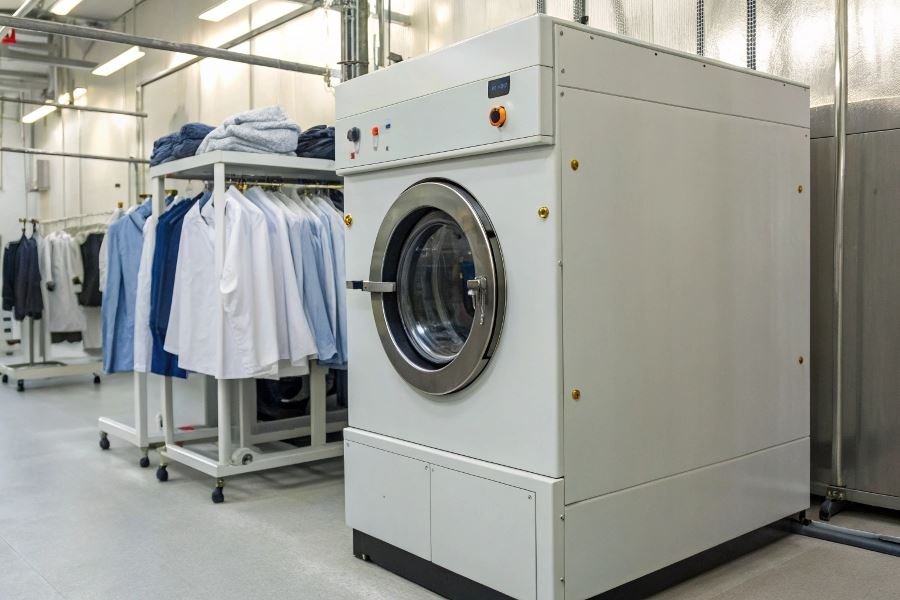
Ever walked into a laundromat and wondered why they don’t just use a row of home dryers from the local appliance store? There’s a $20,000 reason for that—and it’s not just about drying capacity.
When equipping your business with essential drying equipment, the choice between industrial and household models represents one of the most consequential decisions you’ll make. This isn’t merely about drying items; it’s about operational efficiency, long-term costs, and ultimately, your bottom line.
Industrial dryers form the backbone of businesses where consistent, high-volume drying is non-negotiable. Hotels process hundreds of linens daily. Restaurants need kitchen towels ready for the next shift. Manufacturing facilities require specialized drying for materials and uniforms. In these environments, drying equipment isn’t just an appliance—it’s mission-critical infrastructure.
The differences between commercial and residential dryers extend far beyond size. Industrial models offer dramatically different engineering:
- Duty cycles: Commercial units run 12+ hours continuously without overheating
- Throughput capacity: 3-5× the volume per hour compared to household units
- Component durability: Commercial-grade motors and heating elements designed for 15,000+ operating hours
Your decision framework should balance immediate budget constraints against long-term operational needs. A restaurant processing 200 napkins daily faces a fundamentally different challenge than a small boutique hotel with occasional guest laundry.
The right choice ultimately depends on your specific business requirements, growth projections, and available space—factors we’ll explore in depth throughout this guide.
The Business Dryer Showdown: Industrial vs Household Models
When equipping your business with essential laundry equipment, the decision between industrial and household dryers represents a critical investment crossroads. The right choice can dramatically impact your operational efficiency, bottom line, and service quality. Let’s dive into what separates these two categories and help you navigate the selection process.
Capacity and Throughput: Volume Matters
Industrial dryers dominate the capacity game with load capabilities ranging from 25 to 200+ pounds, compared to household models typically maxing out at 7-9 pounds. This translates to real-world throughput differences that can make or break a business operation.
When considering industrial vs household dryers for business applications, the throughput differential becomes immediately apparent. A commercial laundromat equipped with industrial dryers can process approximately 16 loads in the time a household unit completes just one cycle. For hotels, restaurants, or healthcare facilities, this capacity gap isn’t just convenient—it’s essential for maintaining operations.
Practical example: A small hotel with 30 rooms using household dryers might need 5-6 machines running constantly, while a single industrial unit could handle the same volume with capacity to spare.
Energy Efficiency and Operational Costs
| Dryer Type | Initial Cost | Energy Consumption | Monthly Operating Cost |
|---|---|---|---|
| Household | 400−1,200 | 3-5 kWh per cycle | 120−200 |
| Industrial | 3, 000−20,000 | 8-15 kWh per cycle | 300−800 |
While industrial dryers consume more energy per cycle, their efficiency per pound of laundry tells a different story. Modern commercial units from brands like Speed Queen or Dexter feature advanced moisture sensing technology that reduces over-drying, cutting energy costs by up to 30%.
The initial sticker shock of industrial models gives way to long-term operational savings when calculated on a per-pound basis.
Durability and Lifespan: Built to Last
Industrial dryers aren’t just bigger—they’re engineered differently:
- Construction quality: Commercial-grade steel drums, reinforced door hinges, and industrial motors
- Cycle endurance: Built for 15,000+ cycles vs 1,000-4,000 for household models
- Warranty coverage: Typically 3-5 years commercial vs 1 year residential
The average industrial dryer maintains peak performance for 10-15 years of heavy daily use, while household models typically require replacement after 3-5 years in a business setting.
Space Requirements and Installation Considerations
Industrial dryers demand respect in terms of physical footprint:
- Require dedicated electrical circuits (often 208-240V, 3-phase power)
- Need professional venting systems with specific airflow requirements
- May require reinforced flooring to support weight (400-800+ pounds)
Household units offer installation flexibility but at a significant capacity cost. For businesses with space constraints, stackable commercial units from Huebsch provide a middle-ground solution.
Technological Advantages That Drive Efficiency
Modern industrial dryers incorporate features rarely found in consumer models:
- Programmable cycle controls allowing customization for specific fabric types
- Fire suppression systems for safety compliance
- Network connectivity for remote monitoring and diagnostics
- Reversing drums that reduce tangling and improve drying uniformity
These technological advantages translate directly to operational benefits: faster turnaround times, reduced labor costs, and consistent results that maintain quality standards.
For businesses where laundry represents a core function rather than an occasional necessity, industrial dryers deliver capabilities that household models simply cannot match, despite their higher initial investment.
Making the Right Dryer Choice for Your Business
Assess Your Operation’s True Scale
Business size directly impacts your dryer requirements. A small bakery with 2-3 aprons daily faces vastly different needs than a hotel processing 200+ towels. Volume assessment should examine both current and projected needs to avoid costly replacements later.
Industrial dryers handle 30-75 pounds per load compared to household units’ 7-9 pounds. Track your daily laundry volume for two weeks—this data becomes your decision cornerstone.
The throughput difference becomes stark when measured hourly: industrial units can process 4-6 complete cycles per hour while household models typically manage 2-3.
Investment Economics That Matter
Initial costs create the most visible contrast:
| Dryer Type | Initial Investment | Lifespan | Energy Efficiency | Maintenance Costs |
|---|---|---|---|---|
| Household | 400−1,200 | 3-7 years | Moderate | 100−200/year |
| Industrial | 3, 000−15,000 | 10-15+ years | High | 300−800/year |
The true calculation extends beyond purchase price. Industrial dryers deliver superior long-term value through:
- 3-5× longer operational lifespan
- 25-40% greater energy efficiency per pound dried
- Significantly reduced labor costs through faster cycles
- Lower cost-per-load over total ownership period
Compliance Requirements You Can’t Ignore
Different industries face specific regulatory frameworks. Healthcare facilities must meet CDC sanitation guidelines requiring higher temperatures than household units typically reach. Restaurants and food processors must adhere to FDA standards for sanitation.
Industrial dryers offer programmable cycles that maintain precise temperatures needed for compliance, while documentation capabilities provide audit-ready records increasingly demanded by inspectors.
When Industrial Dryers Become Non-Negotiable
-
High-Volume Operations: Businesses processing over 100 pounds daily will find household units completely inadequate, creating bottlenecks and premature equipment failure.
-
Specialized Material Handling: Businesses working with heavy fabrics, specialized materials, or items requiring precise drying parameters need industrial controls unavailable in consumer models.
-
Continuous Operation Environments: Operations running multiple shifts require the durability of commercial-grade components designed for 12+ hour daily use—household units will fail rapidly under such demands.
When Household Dryers Make Business Sense
-
Supplemental Capacity Needs: Small businesses with occasional peak demands might justify a household unit to handle overflow rather than investing in additional industrial capacity.
-
Startups with Growth Plans: New businesses with limited capital might begin with household units while establishing revenue streams, provided they budget for inevitable upgrades.
-
Low-Volume Specialty Businesses: Artisanal operations processing small batches of specialty items (like custom textile artists) may find household units sufficient when cycle count remains under 3-4 daily.
The most expensive dryer isn’t the one with the highest price tag—it’s the one that fails to meet your business requirements or breaks down during peak demand.
Your decision ultimately hinges on honest assessment of your operation’s true needs, growth trajectory, and regulatory environment. The right choice creates operational efficiency; the wrong one becomes a daily frustration and financial drain.
Discover the key differences between industrial and household dryers for your business needs. Compare capacity, energy efficiency, durability, and cost-effectiveness to make a smart investment that aligns with your operation's volume and industry requirements.
Discover the key differences between industrial and household dryers for your business needs. Compare capacity, energy efficiency, durability, and cost-effectiveness to make a smart investment that aligns with your operation's volume and industry requirements.