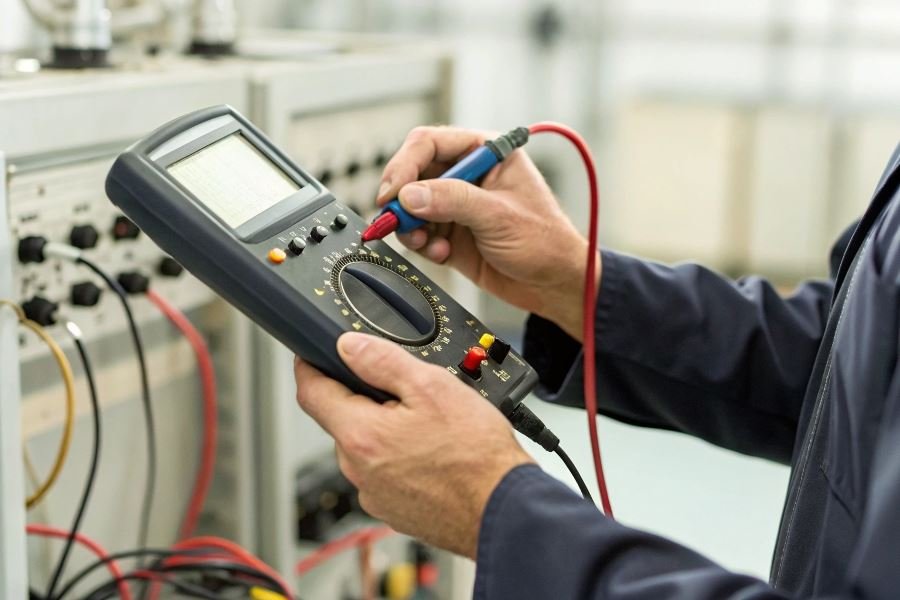
Ever wondered why your multimeter readings sometimes don’t match up with your colleague’s? The difference between “close enough” and “precisely right” can cost companies millions in faulty products, safety incidents, or regulatory non-compliance.
Calibration serves as the backbone of reliable electrical measurements, ensuring that what you measure is what you actually get. When comparing portable and stationary calibrators for electrical instruments, you’re essentially choosing between convenience and capability—a decision that impacts everything from field service operations to laboratory certifications.
“Measurement without calibration is merely an educated guess.” — Engineering maxim
What exactly is calibration?
Calibration is the process of comparing a measuring instrument against a reference standard of known accuracy. For electrical instruments, this means verifying that your voltmeters, ammeters, and oscilloscopes provide readings that match established standards within acceptable tolerance limits.
The National Institute of Standards and Technology (NIST), established in 1901, maintains the national standards that form the foundation of our measurement system. Without regular calibration, instrument drift can silently undermine your measurements, creating a cascade of errors throughout your processes.
Portable vs. stationary: The fundamental divide
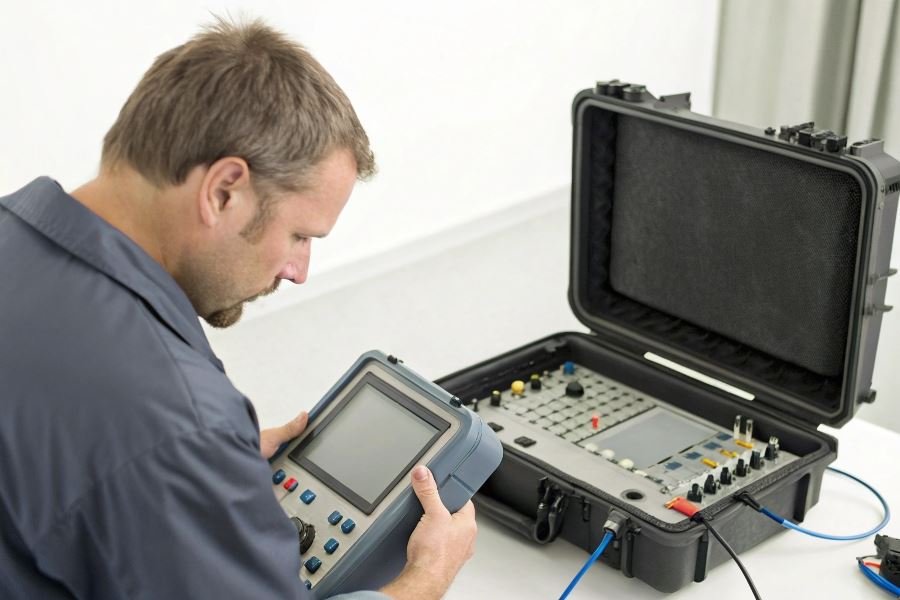
Portable calibrators offer field-ready solutions—lightweight, battery-powered, and designed for on-site work. Stationary systems, meanwhile, deliver higher accuracy, broader measurement ranges, and enhanced stability for laboratory environments.
When selecting between these options, consider these critical factors:
- Accuracy requirements: How precise must your measurements be?
- Environment: Will calibration occur in controlled or variable conditions?
- Measurement range: What parameters and ranges need calibration?
- Traceability needs: What level of documentation and certification is required?
The right calibrator doesn’t just verify—it validates your entire measurement process.
Precision Meets Mobility: The Ultimate Calibrator Showdown
Accuracy that defines excellence
When electrical measurement precision becomes non-negotiable, the calibrator you choose makes all the difference. Stationary calibrators typically offer accuracy ratings of ±0.003% or better, while their portable counterparts have narrowed the gap impressively to around ±0.01%. This seemingly small difference becomes critical when calibrating high-precision instruments used in aerospace or medical equipment manufacturing.
The comprehensive comparison of portable and stationary calibrators for electrical measuring instruments reveals that laboratory-grade stationary systems like the Fluke 5730A deliver reference-level precision with stability measured in parts per million over months. Meanwhile, field-ready units such as the Transmille 3041 sacrifice minimal accuracy for tremendous mobility advantages.
Real-world precision matters: A stationary calibrator in a controlled 23°C (±1°C) environment maintains its specifications indefinitely, while portable units must compensate for temperature variations from -10°C to +50°C, humidity changes, and physical movement.
Flexibility across environments
Portable calibrators shine in their operational versatility. Weighing typically between 2-15 pounds, these units can:
- Perform on-site calibrations, eliminating instrument transport risks
- Function in remote locations with battery power (8-12 hours typical runtime)
- Calibrate equipment that cannot be moved or powered down
Stationary systems excel in different ways:
- Support multiple simultaneous calibrations
- Offer broader measurement ranges and functions
- Provide superior stability for reference-level work
“The environment dictates the tool,” as calibration professionals often say. A nuclear facility might require on-site calibration despite having laboratory space, while a metrology lab prioritizes benchmark accuracy above all.
Investment versus long-term value
| Calibrator Type | Initial Cost | 10-Year TCO | Calibration Interval |
|---|---|---|---|
| Premium Portable | $5,000-15,000 | $12,000-25,000 | 6-12 months |
| Mid-Range Stationary | $20,000-45,000 | $30,000-60,000 | 12-24 months |
| Reference Stationary | $60,000-120,000+ | $75,000-150,000 | 12-36 months |
The initial investment difference is substantial, but consider that stationary systems typically:
- Require calibration half as frequently
- Last 15+ years versus 7-10 for portables
- Support more functions and measurement types
- Serve multiple departments or customers
Value calculation tip: Divide your annual calibration workload by calibrator capacity to determine true cost-per-calibration over the equipment lifecycle.
Maintenance realities
Portable calibrators endure physical stress that stationary units never experience. This translates to:
- More frequent recalibration (typically every 6-12 months versus 12-24 months)
- Higher repair incidence due to transport damage
- Battery replacement costs every 2-3 years
- More susceptibility to environmental contamination
Stationary systems demand different considerations:
- Dedicated climate-controlled space
- Uninterruptible power supplies
- Longer warm-up times (1-4 hours for full specifications)
- Specialized training for operators
Space and integration considerations
The footprint difference is dramatic. A comprehensive stationary calibration system might require 15-30 square feet of dedicated laboratory space with controlled temperature, humidity, and power conditioning. Portable units can operate virtually anywhere but sacrifice measurement capability and often require additional accessories for full functionality.
Integration with calibration management software has become essential, with systems like Beamex CMX supporting both portable and stationary calibrators while maintaining complete audit trails for regulatory compliance.
The ultimate decision comes down to your specific measurement needs, workload volume, and whether your instruments can come to the calibrator—or if the calibrator must go to them.
Making the Right Call: Calibrator Selection for Electrical Precision
Application-driven calibrator decisions
Choosing between portable and stationary calibrators ultimately comes down to your specific operational needs. Field service teams benefit tremendously from portable calibrators when maintaining equipment across multiple sites. Their lightweight design and battery operation make them ideal for utilities, telecommunications, and manufacturing facilities where technicians must verify instrument accuracy on-site.
Conversely, calibration laboratories and quality control departments typically require the enhanced precision and broader measurement capabilities of stationary systems. These environments demand the highest accuracy levels—often 2-5 times better than portable units—and benefit from the comprehensive documentation features built into bench systems.
Consider your calibration frequency and volume as well. Organizations performing daily calibrations across numerous devices will find the automation capabilities of stationary systems deliver significant time savings and consistency. Meanwhile, companies with occasional calibration needs or distributed equipment may find portable units more cost-effective despite their typically higher per-function cost.
The environment itself often dictates your choice. Harsh industrial settings with temperature extremes, dust, or moisture favor ruggedized portable units designed to IP65 or higher protection standards. Laboratory environments can leverage the precision of stationary systems without these environmental concerns.
Tomorrow’s calibration landscape
The calibration technology horizon shows several exciting developments that will reshape both portable and stationary systems:
-
Cloud integration and IoT connectivity is revolutionizing calibration management. Modern calibrators increasingly feature wireless capabilities that automatically synchronize calibration data with central databases, enabling real-time compliance monitoring and predictive maintenance.
-
Artificial intelligence is entering calibration workflows, with systems that can identify measurement drift patterns and recommend optimal calibration intervals based on actual performance rather than fixed schedules.
-
Multifunction capabilities continue to expand, with single devices now able to calibrate pressure, temperature, electrical, and flow instruments—reducing the equipment investment needed for comprehensive calibration programs.
-
Augmented reality guidance is emerging in newer portable calibrators, providing technicians with visual step-by-step procedures overlaid on their physical workspace, dramatically reducing errors and training requirements.
Building your calibration program
Implementing an effective calibration program requires more than just selecting the right equipment. Organizations achieving calibration excellence typically follow these best practices:
-
Document your measurement requirements before purchasing any calibrator. Identify accuracy needs, measurement ranges, and environmental conditions for each instrument requiring calibration.
-
Establish clear calibration intervals based on manufacturer recommendations, regulatory requirements, and historical drift data. The most sophisticated programs use statistical analysis to optimize these intervals.
-
Implement robust traceability by ensuring your calibrators themselves are regularly calibrated by accredited laboratories with direct traceability to national standards.
-
Train technicians thoroughly not just on calibrator operation but on measurement science fundamentals. The most accurate calibrator becomes worthless in untrained hands.
The true value of calibration isn’t in the equipment itself but in the confidence it provides in your measurement data.
For organizations with mixed needs, a hybrid approach often proves most effective—utilizing stationary systems for laboratory work while deploying portable calibrators for field operations. This combination delivers the precision and efficiency benefits of both technologies while optimizing your calibration investment.
Discover the key differences between portable and stationary calibrators for electrical measuring instruments. Learn about accuracy, flexibility, cost considerations, and maintenance requirements to make an informed choice for your precision measurement needs.
Discover the key differences between portable and stationary calibrators for electrical measuring instruments. Learn about accuracy, flexibility, cost considerations, and maintenance requirements to make an informed choice for your precision measurement needs.