
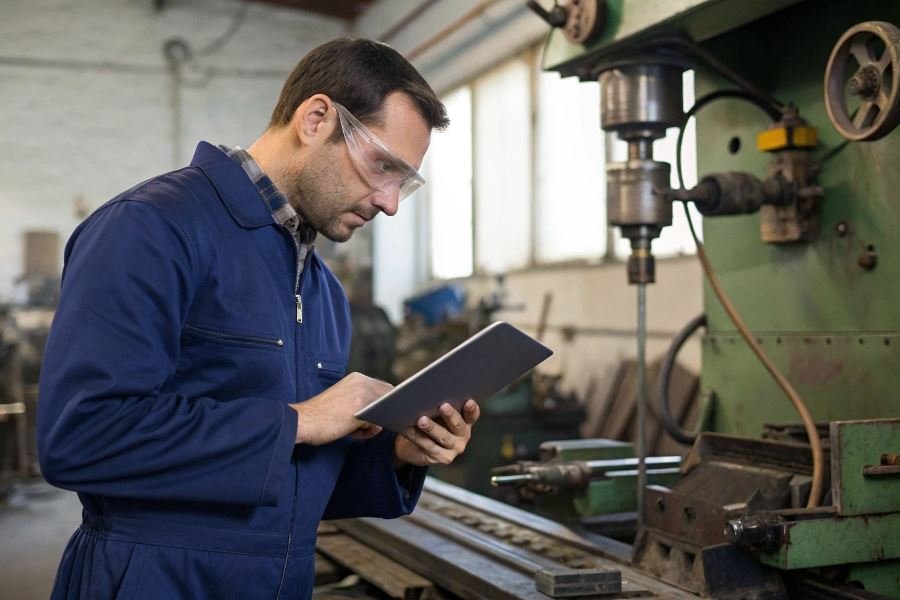
Ever watched a master chef struggle with a dull knife? The right tools don’t just make work possible—they make excellence achievable.
Selecting production and technical equipment for your small business isn’t just a shopping exercise—it’s a strategic decision that directly impacts your operational efficiency, product quality, and bottom line. When a custom furniture maker invests in a precision CNC router instead of traditional hand tools, they’re not just buying equipment—they’re purchasing the ability to compete in a market that demands both craftsmanship and consistency.
Aligning equipment with your business vision
The most successful small businesses don’t start with equipment catalogs—they start with clear objectives. A boutique coffee roaster needs different capabilities than a small-batch soap maker. Begin by documenting your production processes in detail, identifying bottlenecks, and understanding what equipment features would solve your specific challenges.
“The right equipment amplifies your strengths; the wrong equipment amplifies your frustrations.”
Budgeting beyond the price tag
Equipment investment requires financial realism. While that $50,000 commercial-grade mixer might seem perfect, can your current revenue justify it? Consider these often-overlooked factors:
- Total cost of ownership: Maintenance, energy consumption, and training
- Scalability potential: Will it accommodate growth for at least 3-5 years?
- Financing options: Equipment leasing can preserve capital for other business needs
Smart entrepreneurs balance immediate needs with future growth, often starting with versatile equipment that can adapt as their business evolves. Remember—the goal isn’t having the most impressive equipment, but the most appropriate equipment for your unique business journey.
The Smart Equipment Selection Framework
Quality, durability, and reliability aren’t just buzzwords—they’re the foundation of every successful equipment purchase. When entrepreneurs approach the process of selecting production and technical equipment for small business operations, these factors become the difference between thriving and merely surviving in competitive markets.
The equipment selection process requires methodical evaluation across multiple dimensions. High-quality machinery doesn’t just perform better; it transforms your operational capacity and ultimately shapes your business trajectory. A CNC machine from Haas Automation with tight tolerances might cost 30% more upfront but deliver precision that eliminates waste and rework for years to come.
Quality indicators that never lie
Quality assessment begins with material composition and build standards. Equipment constructed with commercial-grade components will consistently outperform consumer-grade alternatives. Consider these quality markers:
- Certification standards: UL, CE, ISO 9001
- Material composition: Industrial-grade metals vs. lightweight alternatives
- Precision tolerances: Measured in thousandths of an inch or micrometers
- Warranty terms: Comprehensive coverage signals manufacturer confidence
The Caterpillar approach to equipment manufacturing demonstrates how rigorous testing protocols—including stress testing under extreme conditions—translates to field reliability. Their equipment often maintains 85% of original performance even after a decade of use.
Maintenance realities and service ecosystems
Maintenance requirements represent the hidden costs of equipment ownership. A $15,000 machine requiring quarterly $2,000 service visits quickly becomes the most expensive option, not the most economical.
The true cost of ownership extends far beyond the purchase price.
| Equipment Type | Typical Maintenance Frequency | Annual Maintenance Cost (% of Purchase) | Average Downtime |
|---|---|---|---|
| CNC Machinery | Quarterly | 8-12% | 2-5 days/year |
| Commercial Ovens | Bi-annually | 5-7% | 1-3 days/year |
| Printing Equipment | Monthly | 15-20% | 6-10 days/year |
When evaluating service support, investigate:
- Local technician availability from manufacturers like Konica Minolta who maintain service networks in all 50 states
- Parts supply chains and typical delivery timeframes
- Remote diagnostics capabilities that can reduce downtime by 40%
- Training programs for in-house maintenance of routine issues
Space optimization and facility requirements
The physical footprint of equipment often receives insufficient attention until installation day arrives. Modern manufacturing spaces average $12-25 per square foot annually, making spatial efficiency a direct contributor to profitability.
Equipment from Biesse often features modular designs that can adapt to changing production needs while maintaining a consistent footprint. Consider these facility factors:
- Utility requirements: 3-phase power, compressed air, water, ventilation
- Floor load capacity: Measured in pounds per square foot
- Clearance needs: Operation, maintenance access, material flow
- Environmental controls: Temperature, humidity, dust containment
Smart facility planning means considering tomorrow’s needs today. Equipment that allows for modular expansion can grow with your business without requiring costly facility modifications or relocations.
The most successful small businesses approach equipment selection as a strategic investment rather than a mere purchase, carefully balancing immediate capabilities against long-term operational implications.
Strategic Equipment Decisions That Drive Business Growth
Purchase vs Lease: The Financial Crossroads
When equipping your small business, the purchase-versus-lease decision represents perhaps the most consequential financial fork in the road. Each path offers distinct advantages that align with different business realities.
Purchasing equipment outright delivers long-term ownership benefits. The equipment becomes a business asset, depreciable over time for tax advantages. A CNC machine purchased for $75,000 might depreciate over seven years, providing annual tax deductions while building equity. Ownership also means freedom from usage restrictions and complete control over maintenance schedules.
Leasing, by contrast, preserves capital and creates breathing room. With monthly payments typically 30-40% lower than loan payments, businesses can redirect funds toward growth initiatives. Equipment leasing also shields against technological obsolescence – particularly crucial for industries where innovation cycles are measured in months rather than years.
Consider this comparison:
| Factor | Purchase | Lease |
|---|---|---|
| Initial capital outlay | High (10, 000−100,000+) | Low (first/last payment) |
| Monthly cash flow impact | Higher loan payments | Lower lease payments |
| Tax benefits | Depreciation, Section 179 | Full payment deductibility |
| Obsolescence risk | Borne by business | Transferable through upgrades |
| End-of-term options | Continued use, resale | Return, purchase, or upgrade |
The decision ultimately hinges on your cash position, growth trajectory, and the equipment’s expected useful life. Manufacturing equipment with 15+ year lifespans often justifies purchase, while technology with rapid obsolescence cycles frequently favors leasing arrangements.
Vendor Reputation: The Insurance Policy You Don’t Pay For
A vendor’s reputation represents an unwritten warranty that extends far beyond the printed guarantee. Thorough vendor vetting prevents catastrophic downtime that can cripple production schedules and customer relationships.
When researching vendors, prioritize:
- Service response times – How quickly do technicians arrive when equipment fails?
- Parts availability – Are replacement components stocked locally or shipped from overseas?
- Technical support accessibility – Is help available during your operating hours?
- User communities – Do other businesses using this equipment report satisfaction?
The Machinery Dealers National Association provides certification for equipment dealers who meet rigorous standards for business practices and technical competence. Similarly, industry-specific forums often contain unfiltered feedback about vendor performance during critical equipment failures.
Scalability: Equipment That Grows With You
Equipment scalability – the capacity to expand capabilities without wholesale replacement – represents perhaps the most overlooked aspect of equipment acquisition. Modular systems that accommodate incremental expansion prevent the painful choice between capacity constraints and premature reinvestment.
When evaluating scalability:
- Assess whether production capacity can increase through add-on components rather than complete replacement
- Examine if software upgrades can enhance functionality without hardware changes
- Determine compatibility with automation systems you might implement as labor costs increase
- Consider whether the manufacturer has a clear technology roadmap indicating future compatibility
A commercial bakery might start with a basic mixer that accepts attachments for expanded production capabilities. A woodworking shop might select a CNC router with an expandable bed size. These forward-looking decisions prevent the costly equipment churn that devours capital during growth phases.
The most strategic equipment decisions anticipate tomorrow’s needs while solving today’s problems – creating a foundation for growth rather than obstacles to overcome later.
Discover how to select the right production and technical equipment for your small business with our comprehensive guide. Learn to evaluate quality, maintenance needs, and acquisition options while staying within budget and planning for growth.
Discover how to select the right production and technical equipment for your small business with our comprehensive guide. Learn to evaluate quality, maintenance needs, and acquisition options while staying within budget and planning for growth.


