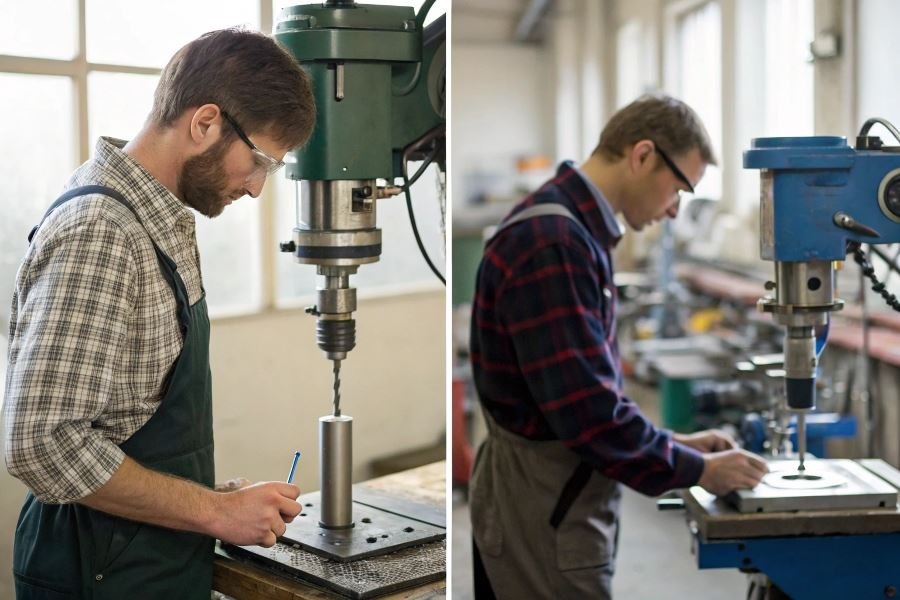
What if you could drill 24 holes simultaneously with perfect alignment every time? This isn’t manufacturing fantasy—it’s the everyday reality for companies leveraging multi-spindle drilling technology.
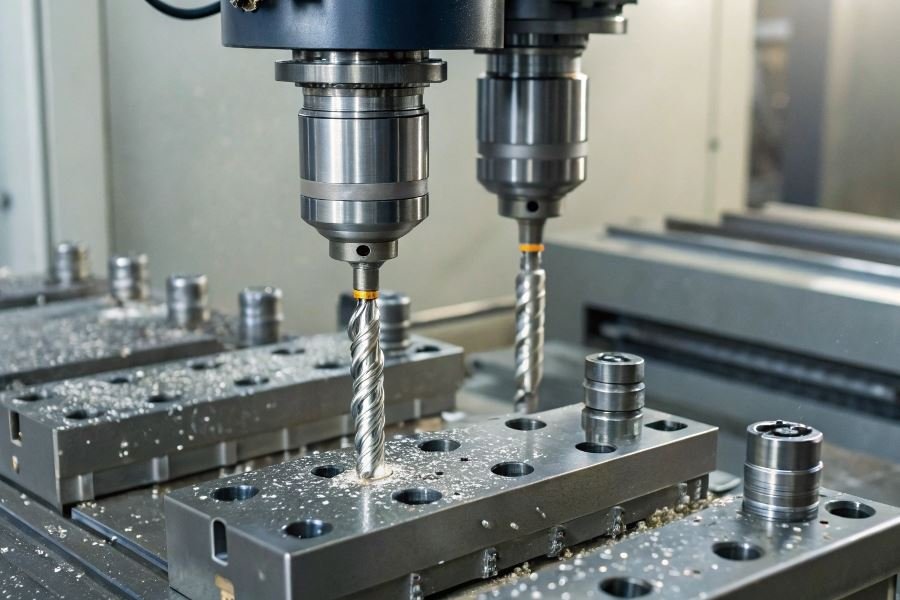
At their core, multi-spindle drilling machines represent a quantum leap in manufacturing efficiency. These sophisticated systems feature multiple drilling units operating in perfect synchronization, allowing manufacturers to create multiple holes in a workpiece during a single operation. Unlike conventional single-spindle machines that process one hole at a time, multi-spindle systems can simultaneously drill, ream, tap, and counterbore multiple holes—slashing production time by up to 80%.
The evolution of multi-drilling precision
Multi-spindle technology has come a remarkably long way since its industrial introduction in the 1940s. Early models featured fixed spindle arrangements with limited flexibility, while today’s CNC-controlled systems offer programmable positioning with micron-level precision. The manufacturing landscape transformed dramatically when these machines gained widespread adoption in the automotive industry during the 1970s, revolutionizing engine block production.
Anatomy of modern multi-spindle systems
The brilliance of these machines lies in their architecture. Modern systems typically feature:
- Spindle head assembly: Houses multiple drilling units in adjustable configurations
- Workpiece fixturing: Precision clamping systems ensuring perfect alignment
- Power transmission: Sophisticated gearing distributing torque evenly across spindles
- Control systems: Advanced programming interfaces for complex drilling patterns
What makes these systems truly remarkable is their adaptability. From fixed-position models ideal for high-volume production to adjustable configurations perfect for small-batch manufacturing, multi-spindle machines shine whenever consistent hole patterns must be reproduced with unwavering accuracy.
Core Applications That Demand Multi-Spindle Drilling
Manufacturing efficiency isn’t just about speed—it’s about intelligent process design that eliminates bottlenecks and maximizes throughput. When production demands escalate, traditional single-spindle drilling operations quickly become the limiting factor. This is precisely when multi-spindle drilling machines become necessary, transforming sequential operations into synchronized, simultaneous drilling that can multiply productivity by factors of 5, 10, or even 20 times.
When Multi-Spindle Drilling Becomes Essential
High-Volume Production Scenarios
In automotive manufacturing, where a single vehicle might require hundreds of precisely placed holes, multi-spindle drilling machines deliver game-changing efficiency. Consider transmission housing production: using a 12-spindle configuration, manufacturers can drill all mounting holes in a single operation, reducing cycle time from 4.5 minutes to just 22 seconds.
Production volume thresholds typically indicate when the investment becomes justified:
- 10,000+ identical parts annually: Strong ROI potential
- 25,000+ identical parts annually: Nearly mandatory for competitiveness
- 50,000+ identical parts annually: Single-spindle approaches become economically unsustainable
The aerospace industry provides another compelling example. Wing components requiring 200+ precisely positioned holes can be processed in a single setup, reducing not just time but also the potential for human error that comes with multiple setups.
Complex Workpieces With Demanding Specifications
Multi-spindle drilling machines excel when workpieces present:
- Multiple hole patterns with varying diameters
- Tight tolerances (±0.001″ or better)
- Complex geometric relationships between holes
- Materials that are difficult to machine
Precision electronics manufacturing demonstrates this perfectly. Circuit board mounting plates might require dozens of precisely positioned holes that must align perfectly with components. The synchronous operation of multi-spindle machines ensures hole-to-hole relationships maintain perfect geometry, something nearly impossible to achieve with sequential operations.
| Complexity Factor | Single-Spindle Limitation | Multi-Spindle Advantage |
|---|---|---|
| Pattern Accuracy | Cumulative error between operations | All holes drilled in perfect relation |
| Tolerance Control | Varies with tool wear across operations | Consistent tool engagement across all holes |
| Setup Time | Multiple setups for different hole sizes | One comprehensive setup |
| Cycle Time | Linear increase with hole count | Near-constant regardless of hole quantity |
Industries Reaping Maximum Benefits
While multi-spindle drilling technology offers advantages across manufacturing sectors, certain industries see transformative benefits:
-
Automotive Manufacturing: Engine blocks, transmission cases, and cylinder heads all require precise hole patterns that must maintain perfect relationships. Ford Motor Company and General Motors have implemented multi-spindle systems that reduced drilling operations from hours to minutes while improving quality metrics.
-
Aerospace Production: The aircraft industry’s demanding tolerances and high-value components make multi-spindle drilling particularly valuable. Boeing utilizes massive multi-spindle arrays for fuselage components, where hole alignment directly impacts structural integrity and safety.
-
Oil and Gas Equipment: Pressure vessels, valve bodies, and flanges require multiple precisely positioned holes that must withstand extreme operating conditions. Multi-spindle drilling ensures consistency across thousands of identical components.
-
Heavy Machinery: Farm equipment, construction machinery, and industrial systems benefit from multi-spindle drilling’s ability to process thick, hardened materials efficiently while maintaining tight tolerances across complex hole patterns.
The technology continues to evolve, with modern CNC multi-spindle systems offering programmable positioning that can adapt to different product configurations without lengthy changeovers—making them increasingly valuable for manufacturers seeking both volume production capability and flexibility.
Making the Smart Investment in Multi-Spindle Drilling
The real cost equation
When evaluating multi-spindle drilling machines against conventional alternatives, the initial sticker shock often masks the true economic picture. A standard single-spindle CNC drill might cost $75,000-150,000, while multi-spindle systems typically start at $200,000 and can exceed $500,000 for advanced configurations. However, this surface-level comparison misses the deeper financial story.
The ROI calculation hinges on throughput multiplication. A 6-spindle machine doesn’t just work 6 times faster—it eliminates 5 separate setups, reduces floor space requirements by 60-70%, and cuts labor costs dramatically. For manufacturers processing over 10,000 identical components monthly, the payback period typically shrinks to 12-18 months.
The math is compelling: When production volume × complexity × precision requirements exceeds a certain threshold, multi-spindle drilling becomes not just viable but necessary.
Energy consumption presents another surprising advantage. While multi-spindle systems draw more power instantaneously, their efficiency per hole drilled is typically 30-40% better than running multiple single-spindle machines. A recent analysis by the Manufacturing Technology Centre found that per-component energy costs dropped by 37% after implementing Heller multi-spindle systems.
Integration without disruption
Implementing multi-spindle drilling technology requires thoughtful planning but needn’t disrupt existing operations. The integration process typically follows three phases:
- Workflow analysis and bottleneck identification
- Machine selection and customization
- Phased implementation and operator training
The most successful implementations maintain parallel production lines during transition, gradually shifting volume as operators gain proficiency. This approach minimizes downtime risk while maximizing knowledge transfer.
| Integration Factor | Consideration Points |
|---|---|
| Footprint | Requires 40-60% less space than equivalent single-spindle capacity |
| Power Requirements | 3-phase, typically 480V with 100+ amp service |
| Tooling Compatibility | Most accept standard tooling with specialized holders |
| Software Integration | Modern systems offer open API connections to MES/ERP |
| Training Requirements | 2-3 weeks for experienced machinists |
Compatibility with existing fixtures and tooling systems represents a critical decision point. Leading manufacturers like DMG MORI and Makino have developed adaptive interfaces that accommodate legacy tooling, significantly reducing switchover costs.
The horizon of possibility
The multi-spindle drilling landscape continues to evolve rapidly. Three key developments are reshaping what’s possible:
Adaptive spindle technology now enables variable-speed operation of individual spindles within the same head, allowing complex mixed-material applications previously impossible on multi-spindle platforms. This breakthrough extends the technology’s reach into aerospace and medical device manufacturing.
AI-powered optimization is transforming setup and operation. Systems from FANUC now incorporate real-time monitoring that adjusts feed rates and spindle speeds based on material variations, extending tool life by 30-45% while maintaining precision.
Modular configurations represent perhaps the most significant advancement. New systems feature quick-change spindle heads that can be swapped in under 15 minutes, allowing manufacturers to reconfigure from 4 to 12 spindles based on batch requirements.
The future clearly belongs to flexible, intelligent multi-spindle systems that adapt to changing production needs while delivering the fundamental throughput advantages that make them essential for high-volume manufacturing.
Discover when multi-spindle drilling machines become essential for manufacturing operations. Learn how these systems boost efficiency, reduce production time, and deliver precision results for high-volume industrial applications with complex hole patterns.
Discover when multi-spindle drilling machines become essential for manufacturing operations. Learn how these systems boost efficiency, reduce production time, and deliver precision results for high-volume industrial applications with complex hole patterns.