$8.23 billion – that’s what poorly chosen industrial packaging costs American manufacturers annually in product damage alone. Behind every successful product lies a strategic packaging decision that balances protection, cost, and sustainability.
When selecting packaging materials for industrial production, you’re not just picking a container – you’re making a critical business decision that impacts everything from your bottom line to your environmental footprint. The landscape has transformed dramatically since the cardboard box first revolutionized shipping in the 1890s. Today’s manufacturers navigate a complex ecosystem of traditional materials like corrugated fiberboard alongside innovative options such as biodegradable polymers and mushroom-based composites.
Three factors dominate every packaging decision: product requirements (weight, fragility, shelf life), logistics considerations (transportation method, storage conditions), and sustainability goals. The most successful manufacturers recognize that these factors aren’t competing priorities but interconnected variables in a sophisticated equation.
The regulatory maze
Navigating packaging regulations isn’t optional – it’s mandatory. FDA requirements for food-contact materials, ASTM testing standards, and ISO certifications create a complex framework that varies by industry and geography. The Sustainable Packaging Coalition reports that 76% of industrial manufacturers have faced compliance challenges in the past year.
“The right packaging decision balances protection, cost-efficiency, and regulatory compliance while supporting your sustainability commitments.”
Smart manufacturers don’t view these standards as obstacles but as guardrails that ensure quality and safety while driving innovation in material science and design.
Essential Criteria for Selecting Industrial Packaging Materials
When manufacturing operations scale up, the importance of proper packaging becomes exponentially critical. Selecting the right packaging materials for industrial production requires methodical analysis of multiple factors that directly impact product integrity, market perception, and bottom-line results.
The process of how to choose packaging materials for industrial production demands a strategic approach that balances protection requirements with practical considerations. Manufacturing leaders who master this selection process gain significant advantages in product safety, sustainability credentials, and operational efficiency.
Protection Tailored to Your Product
Every product has unique vulnerabilities. Pharmaceutical items may require moisture barriers, while electronics need static protection, and food products demand oxygen barriers. The packaging material selection must begin with a thorough assessment of:
- Physical protection needs: Resistance to impact, vibration, compression
- Barrier properties: Protection against moisture, oxygen, light, or contaminants
- Chemical compatibility: Ensuring packaging won’t react with the product
- Temperature tolerance: Withstanding expected storage and transport conditions
For example, high-barrier films with oxygen transmission rates below 10 cc/m²/day might be essential for sensitive food products, while cushioning materials with compression resistance of 25-35 psi could be critical for fragile electronics.
Sustainability as a Strategic Imperative
Environmental considerations have transformed from nice-to-have to business-critical factors. Modern packaging selection must evaluate:
| Sustainability Factor | Key Considerations | Industry Benchmarks |
|---|---|---|
| Recyclability | Material acceptance in recycling streams | 60% recyclable content |
| Biodegradability | Decomposition timeframe | <6 months for compostable options |
| Resource Efficiency | Material-to-product ratio | 15-20% reduction targets |
| Carbon Footprint | Emissions throughout lifecycle | 30% reduction vs. conventional |
Leading manufacturers are increasingly partnering with suppliers like TetraPak and Amcor who provide detailed environmental impact data for their packaging solutions.
Cost-Efficiency Beyond Purchase Price
The true cost of packaging extends far beyond the initial material price. A comprehensive cost analysis includes:
Material acquisition costs represent only about 40-60% of total packaging expenses.
Volume efficiency directly impacts transportation costs—optimized packaging can reduce shipping expenses by 15-25% through better space utilization. Meanwhile, automation compatibility determines labor costs, with properly designed packaging potentially reducing packaging line labor by 30-40%.
Scalability considerations must also factor in minimum order quantities, lead times, and storage requirements. Materials that offer flexibility across production volumes provide strategic advantages as demand fluctuates.
Technical Performance Specifications
The technical requirements for industrial packaging materials must be precisely defined and measured:
- Tensile strength: Typically 2,500-5,000 psi for industrial films
- Burst strength: Often 200-400 kPa for corrugated materials
- Seal integrity: Measured in seal strength (N/15mm) and leak rates
- Barrier properties: Quantified in transmission rates (WVTR, OTR)
- Printability: Resolution capabilities, ink adhesion, and durability
These specifications should be documented in comprehensive material requirement documents and verified through standardized testing protocols from organizations like ASTM International or ISO.
By methodically evaluating these four essential criteria, manufacturers can develop packaging solutions that protect products, please customers, preserve the environment, and promote profitability.
The Material Matchup: Packaging Solutions for Industrial Production
Rigid Packaging: The Fortress Approach
When durability and protection are non-negotiable, rigid packaging solutions stand as the industrial gold standard. Metal containers—particularly aluminum and steel—offer unparalleled strength-to-weight ratios and barrier properties that keep oxygen, light, and moisture at bay. Alcoa aluminum containers, for instance, provide 100% recyclability while maintaining structural integrity through extreme temperature fluctuations.
Glass packaging, though heavier, delivers complete product visibility and zero chemical interaction. The O-I Glass manufacturing process has evolved to reduce thickness by 30% since 2000 while maintaining impact resistance—a remarkable engineering achievement.
Hard plastics like high-density polyethylene (HDPE) and polyethylene terephthalate (PET) strike the balance between protection and weight. SABIC industrial plastics can withstand compression forces exceeding 400 pounds while weighing 87% less than comparable glass containers.
Material insight: Rigid packaging typically accounts for 43% of industrial packaging applications where product integrity cannot be compromised.
Flexible Packaging: Adaptability Unleashed
The flexible packaging revolution continues to transform industrial logistics with its adaptability and efficiency. Multi-layer films combining polyethylene, polypropylene, and barrier materials like ethylene vinyl alcohol (EVOH) create customized protection profiles for specific product needs.
Stand-up pouches have emerged as the flexible packaging MVP, reducing material usage by up to 70% compared to rigid alternatives. Amcor flexible packaging solutions incorporate proprietary barrier technologies that extend shelf life while reducing transportation costs through their collapsible nature.
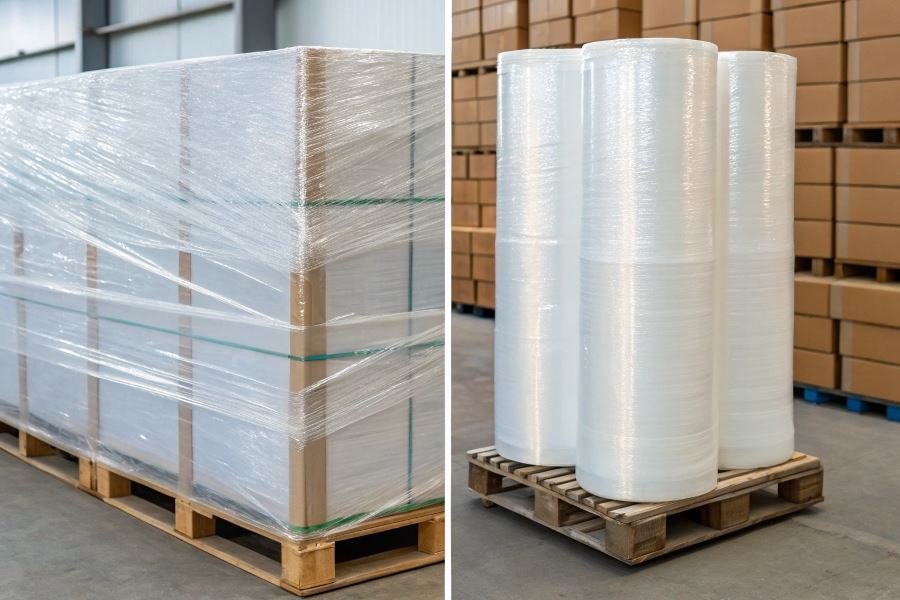
Shrink wraps and stretch films provide secondary containment that’s both visible and secure. Modern industrial films from Berry Global can stretch up to 300% of their original dimensions while maintaining puncture resistance of 700 grams-force.
Material efficiency matrix:
| Packaging Type | Material Reduction | Space Efficiency | Customization Potential |
|---|---|---|---|
| Stand-up Pouches | 60-70% | High | Excellent |
| Barrier Films | 40-50% | Medium-High | Very Good |
| Shrink/Stretch Wrap | 30-40% | Medium | Good |
Fiber-Based Packaging: Sustainable Strength
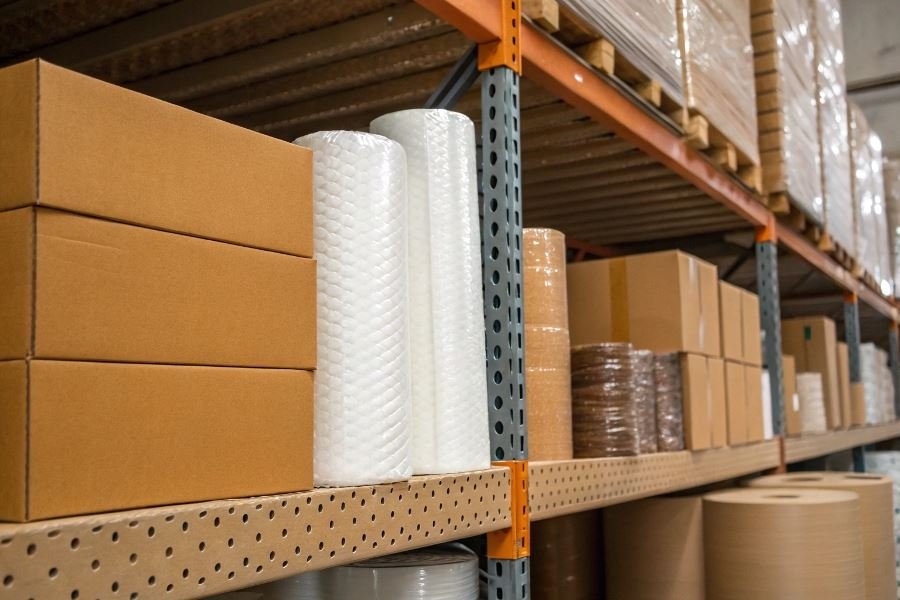
Corrugated packaging remains the backbone of industrial shipping, with innovations pushing its performance boundaries. Triple-wall corrugated from International Paper delivers edge crush test (ECT) values exceeding 80 pounds per linear inch—sufficient for products weighing up to 300 pounds.
Paperboard solutions have evolved beyond simple folding cartons to engineered structures capable of replacing plastic in many applications. The latest solid bleached sulfate (SBS) boards offer moisture resistance previously unimaginable in fiber-based materials.
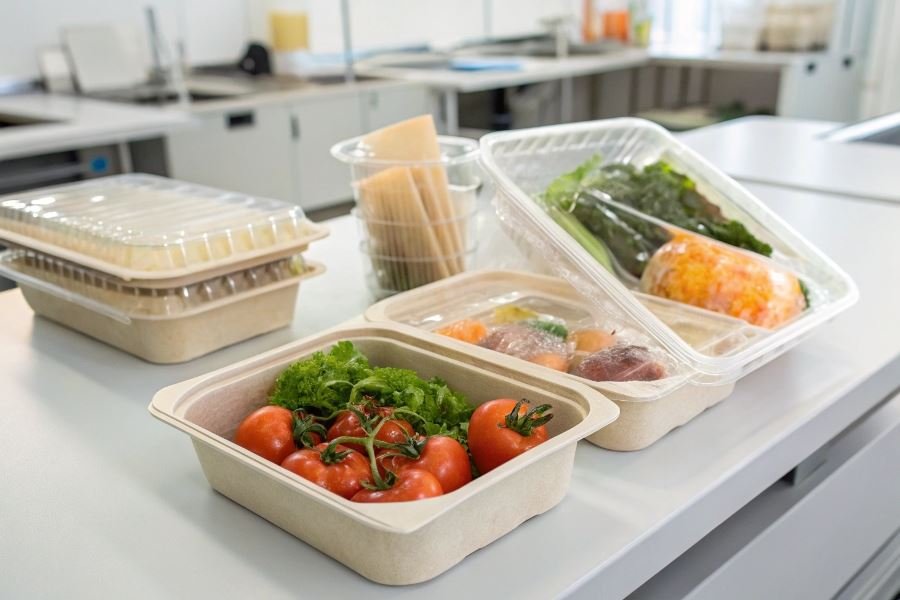
Molded pulp has undergone a renaissance, with precision-engineered trays and inserts providing custom-fit protection for delicate components. These solutions from companies like Sonoco combine the cushioning properties of expanded polystyrene with complete biodegradability.
The sustainability advantage: Fiber-based packaging typically contains 70-100% recycled content and biodegrades in 2-6 months under proper conditions, compared to 450+ years for some plastics.
The industrial packaging landscape demands material selection based on product requirements, supply chain realities, and sustainability goals. The most successful manufacturers typically employ a strategic mix of rigid, flexible, and fiber-based solutions to optimize protection, cost, and environmental impact across their product portfolio.
Discover the comprehensive guide to selecting optimal packaging materials for industrial manufacturing. Learn essential criteria, explore top material categories, and implement effective testing protocols to maximize protection, sustainability, and cost-efficiency.
Discover the comprehensive guide to selecting optimal packaging materials for industrial manufacturing. Learn essential criteria, explore top material categories, and implement effective testing protocols to maximize protection, sustainability, and cost-efficiency.