What’s the real cost of a security breach at your facility? It’s not just about stolen assets—it’s about operational disruption, safety compromises, and reputation damage that can take years to rebuild.
Industrial facilities face unique security challenges that standard access solutions simply can’t handle. The intersection of high-value assets, safety protocols, and operational efficiency demands specialized entry management systems that don’t just control access—they enhance your entire security ecosystem.
The security backbone of modern industry
Turnstiles have evolved from simple mechanical barriers to sophisticated security command centers. Today’s industrial-grade turnstiles integrate seamlessly with biometric verification, time-tracking software, and emergency protocols, creating a unified security approach that protects without impeding productivity.
“The right turnstile doesn’t just stop unauthorized entry—it streamlines authorized access, creating efficiency where there was once friction.”
Selection factors that truly matter
When evaluating turnstiles for industrial applications, three considerations rise above all others:
- Durability in harsh environments – Can it withstand extreme temperatures, dust, vibration, and potentially corrosive atmospheres?
- Throughput capacity – How efficiently can it process shift changes without creating bottlenecks?
- Integration capabilities – Will it communicate effectively with your existing security infrastructure?
Technology transforming industrial access
The latest advancements have revolutionized what’s possible in industrial access control. AI-powered analytics can now detect tailgating attempts, while predictive maintenance alerts facility managers before failures occur. Some systems even adjust their operation based on traffic patterns, optimizing flow during peak periods while maintaining stringent security protocols.
Securing the Perimeter: Industrial Turnstile Solutions
When facility security demands more than a simple door, industrial turnstiles become the frontline defenders of controlled access. These robust gatekeepers combine physical deterrence with sophisticated authorization systems, creating security checkpoints that efficiently manage personnel flow while maintaining safety protocols.
The landscape of industrial access control has evolved dramatically since the early mechanical barriers first appeared in the 1960s. Today’s top 3 turnstiles for industrial facilities represent the culmination of decades of security engineering, offering specialized solutions for environments ranging from manufacturing plants to energy facilities. Each type brings distinct advantages in security posture, operational efficiency, and integration capabilities that savvy facility managers must evaluate against their specific requirements.
Full-height turnstiles: The fortress approach
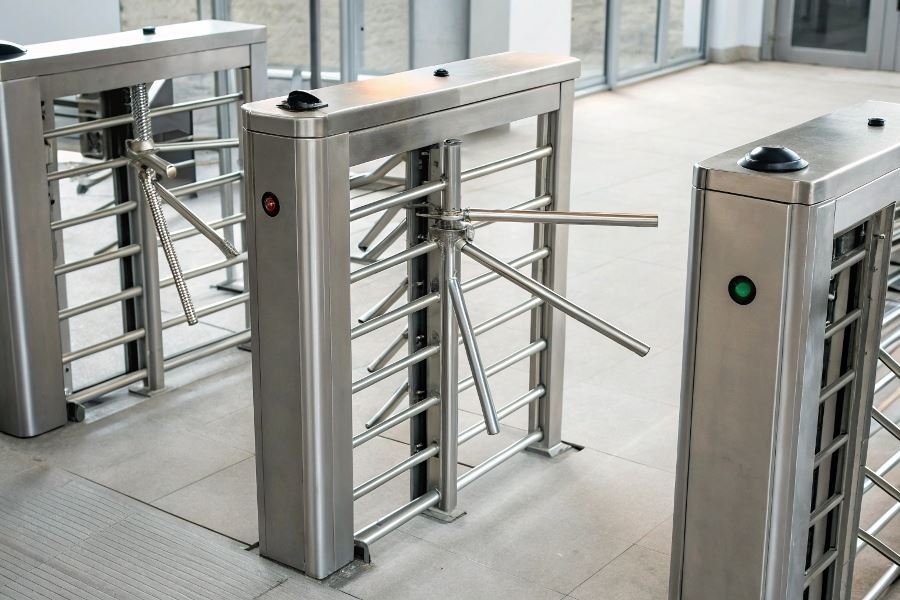
Full-height turnstiles represent the most imposing physical barrier in the turnstile family, extending from floor to ceiling to create virtually impenetrable access points. These security powerhouses excel in high-security environments where unauthorized entry must be prevented at all costs.
Key security features of modern full-height systems include:
- Anti-tailgating design that physically prevents multiple entries on a single authorization
- Weather-resistant construction for perimeter installations
- Integration with biometric systems for multi-factor authentication
The durability factor cannot be overstated—premium models from manufacturers like Gunnebo and Alvarado feature hot-dip galvanized steel construction rated for 10+ million cycles, with some installations functioning flawlessly after 15+ years in harsh industrial environments.
Implementation consideration: Full-height turnstiles require substantial foundation work and overhead clearance of at least 7 feet, making retrofit installations potentially challenging.
Optical turnstiles: Intelligence at the threshold
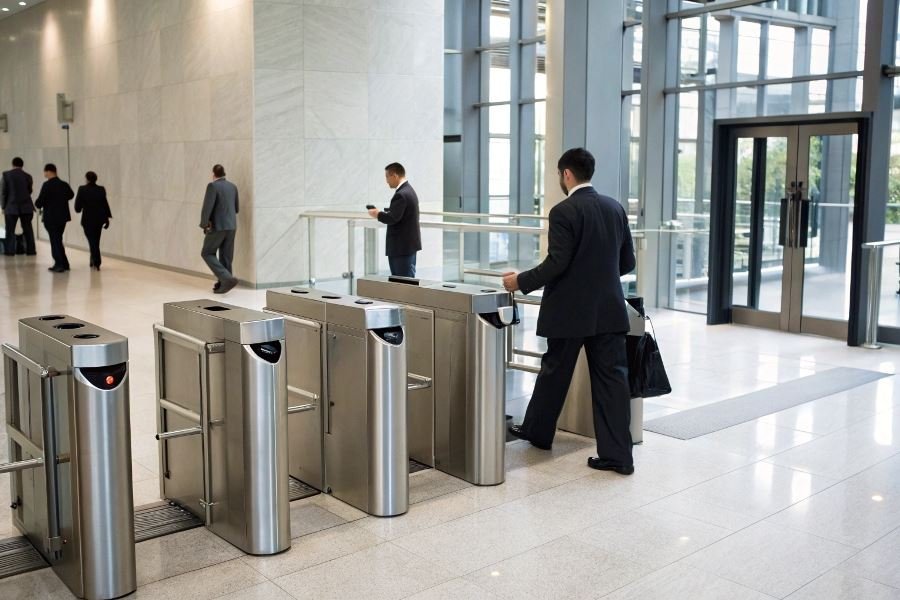
Optical turnstiles represent the technological vanguard of access control, using infrared beams and sophisticated sensors rather than physical barriers to monitor and control passage.
| Feature | Benefit | Consideration |
|---|---|---|
| Throughput rate | Up to 60 people per minute | Requires proper credential preparation |
| Barrier options | Glass wings, sliding doors, or barrier-free | Higher cost for physical barriers |
| Detection accuracy | Millimeter-precision tracking | Requires clean environment |
The integration capabilities of optical systems from Automatic Systems and Boon Edam extend beyond simple card readers to encompass facial recognition, mobile credentials, and centralized security management platforms. This flexibility allows security teams to implement unified access policies across diverse facility types.
Maintenance requirements remain surprisingly minimal despite the sophisticated technology. Most systems require only quarterly sensor cleaning and annual calibration checks, with mean time between failures often exceeding 3 million cycles.
Tripod turnstiles: Practical efficiency in action
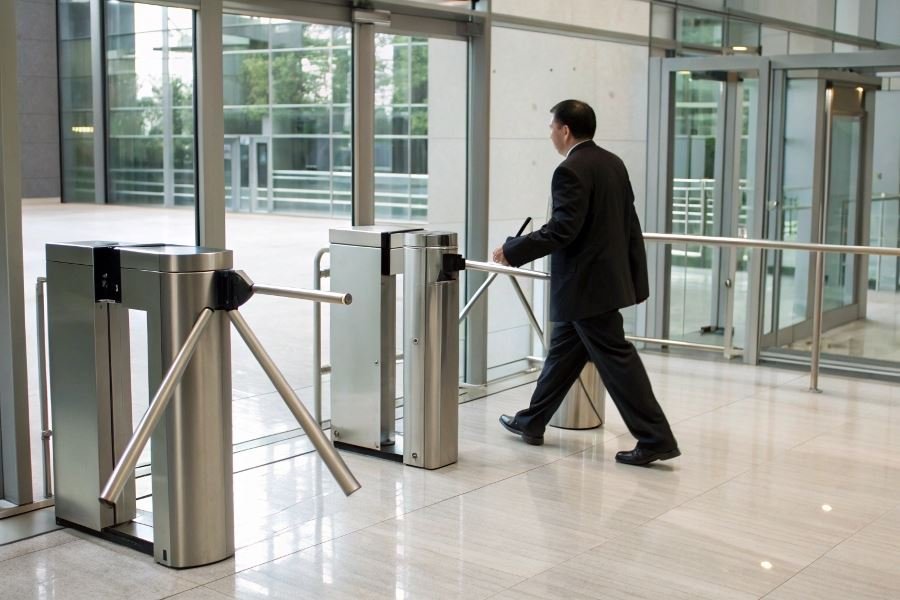
The workhorse of industrial access control, tripod turnstiles deliver remarkable security value through simple, effective design. Their cost-effectiveness stems from standardized components and straightforward installation requirements, typically running 40-60% less than full-height alternatives.
Space efficiency represents another significant advantage—a standard tripod unit from Dormakaba occupies just 4-5 square feet of floor space while processing up to 30 people per minute. This compact footprint makes tripods ideal for facilities with space constraints or those requiring multiple entry points.
Installation complexity varies by model but generally involves:
- Simple surface mounting with 4-8 anchor points
- Standard power requirements (typically 110-240V)
- Plug-and-play integration with most access control systems
While tripods provide less physical deterrence than full-height models, their combination of affordability, reliability, and ease of implementation makes them the preferred choice for many industrial applications where moderate security meets practical operational needs.
Maximizing Your Turnstile Investment
Seamless security integration
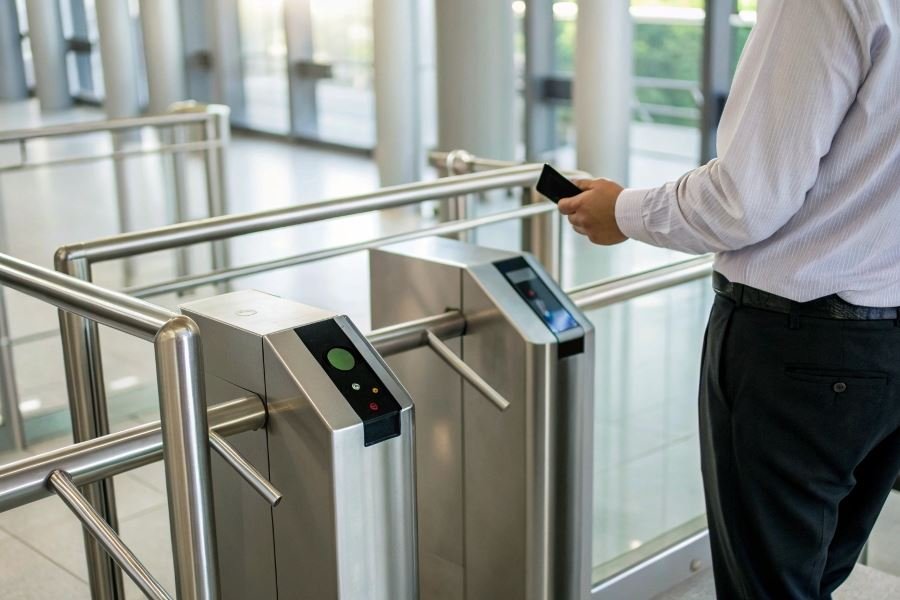
The true power of industrial turnstiles emerges when they’re thoughtfully integrated with your existing security ecosystem. The Gunnebo SpeedStile series exemplifies this integration potential, offering native compatibility with most RFID card systems, biometric scanners, and centralized security management platforms.
When implementing turnstiles, consider your current access control architecture first. Most facilities find that modern turnstiles require minimal retrofitting—the Automatic Systems SmartLane models, for instance, connect directly to standard Wiegand interfaces used by virtually all major access control systems.
Integration tip: Create a detailed map of your current security touchpoints before installation. This prevents the all-too-common “security island” syndrome where turnstiles operate independently from your main security infrastructure.
For facilities with legacy systems, middleware solutions like those offered by Gallagher Command Centre can bridge the gap, allowing new turnstiles to communicate with older infrastructure without requiring a complete system overhaul.
The dollars and sense of turnstile deployment
Industrial turnstiles represent a significant capital investment, but their ROI timeline is often shorter than decision-makers anticipate. Let’s break down the numbers:
| Cost Factor | Traditional Guard Station | Automated Turnstile System |
|---|---|---|
| Initial investment | $5,000-15,000 | $15,000-45,000 |
| Annual labor costs | $150,000+ | $0 |
| Maintenance | $1,000/year | $2,500-4,000/year |
| 5-year total cost | $756,000+ | $27,500-65,000 |
The Boon Edam Speedlane systems typically achieve ROI within 8-14 months in high-traffic industrial environments, primarily through labor reduction and improved throughput efficiency.
Beyond direct cost savings, turnstiles deliver value through enhanced security metrics, reduced tailgating incidents, and comprehensive access logs that prove invaluable during security audits.
When calculating ROI, factor in these often-overlooked benefits:
- Reduced insurance premiums (typically 5-12%)
- Decreased inventory shrinkage
- Improved emergency evacuation management
- Enhanced compliance documentation
Maintaining peak performance
The reliability of industrial turnstiles directly correlates with adherence to maintenance protocols. Unlike passive security measures, turnstiles contain moving parts and electronic components requiring regular attention.
For optimal performance, implement these maintenance practices:
- Weekly visual inspections of moving components, sensors, and user interface elements
- Monthly cleaning of optical sensors and biometric readers using manufacturer-approved methods
- Quarterly lubrication of mechanical components (using only specified lubricants)
- Bi-annual professional service including firmware updates and calibration
Preventative maintenance costs approximately 30% less than reactive maintenance over a turnstile’s lifecycle.
Most manufacturers recommend establishing service contracts that include emergency response provisions. The Automatic Systems service packages typically include 24/7 technical support and guaranteed response times of under 4 hours for critical failures.
Performance preservation: Document all maintenance activities meticulously. This not only ensures warranty compliance but creates a performance history that helps predict and prevent future issues before they impact operations.
By approaching turnstile implementation strategically—with careful integration planning, thorough ROI analysis, and disciplined maintenance protocols—industrial facilities can transform these access points from mere security devices into valuable operational assets that deliver returns for years beyond their initial deployment.
Discover the ultimate comparison of industrial security solutions with our in-depth analysis of full-height, optical, and tripod turnstiles. Learn key selection factors, integration capabilities, and ROI considerations for optimal facility protection.
Discover the ultimate comparison of industrial security solutions with our in-depth analysis of full-height, optical, and tripod turnstiles. Learn key selection factors, integration capabilities, and ROI considerations for optimal facility protection.