Ever watched a sweeper clear a massive parking lot in what seems like minutes? That efficiency isn’t magic—it’s mathematics. When facility managers miscalculate sweeping equipment productivity, they’re essentially throwing money into the wind—sometimes tens of thousands of dollars annually.
The productivity of your sweeping equipment directly translates to operational costs, maintenance schedules, and ultimately, your site’s cleanliness standards. Yet surprisingly, a 2023 industry survey revealed that 68% of property managers couldn’t accurately estimate their sweeping equipment’s true productivity rate.
Calculating sweeping productivity isn’t just about square footage per hour—it’s a multidimensional equation. The formula balances machine specifications against real-world variables: surface conditions, debris types, obstacle density, operator skill, and even weather patterns. Each variable creates ripple effects throughout your maintenance budget.
Why these calculations matter: When you precisely understand your equipment’s productivity, you can:
- Optimize labor scheduling (eliminating costly overtime)
- Accurately bid maintenance contracts (no more unprofitable jobs)
- Determine true equipment ROI (beyond the sticker price)
- Predict maintenance intervals with remarkable precision
The difference between estimated and actual productivity often exceeds 30%—a gap that silently erodes profitability while creating scheduling nightmares. By mastering these calculations, you transform guesswork into a strategic advantage that competitors simply can’t match.
The Productivity Calculation Matrix for Sweeping Equipment
When it comes to maintaining clean, professional-looking properties, the devil is in the details—specifically, in how efficiently your sweeping equipment can handle the job. Property managers who understand how to calculate the productivity of sweeping equipment for your site gain a significant advantage in resource allocation, cost management, and overall site cleanliness.
Site Variables That Make or Break Performance
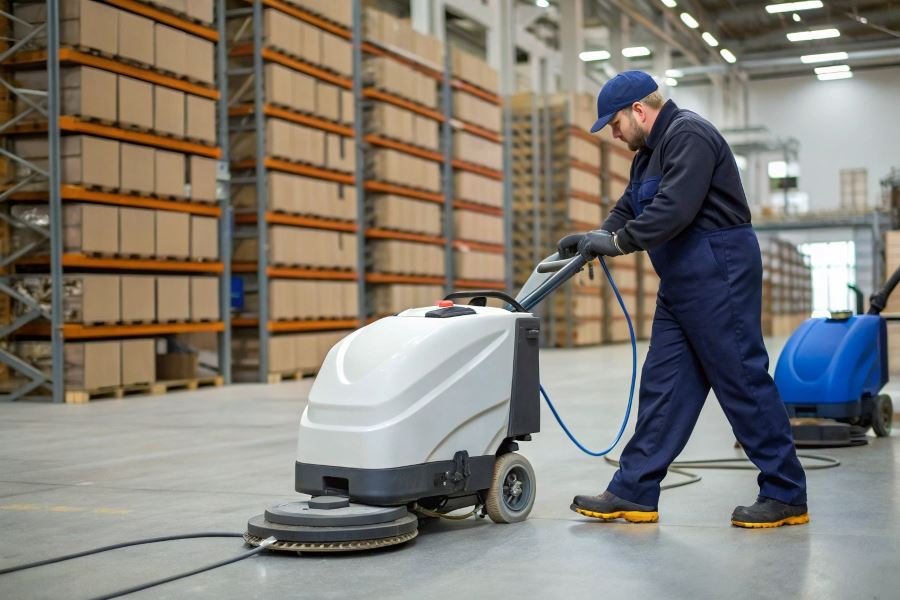
The foundation of any productivity calculation begins with your site’s unique characteristics. A 100,000 square foot smooth concrete warehouse floor presents dramatically different challenges than a 20,000 square foot outdoor parking lot with speed bumps and planters.
Surface area measurement isn’t just about square footage—it’s about sweepable square footage. A 50,000 sq ft property with densely packed equipment might only have 30,000 sq ft of actually sweepable space. Accurate measurement is non-negotiable.
Surface types create varying degrees of resistance and debris capture rates:
| Surface Type | Productivity Impact | Special Considerations |
|---|---|---|
| Smooth concrete | +15-20% efficiency | Dust control critical |
| Asphalt | Baseline standard | More brush wear |
| Textured/grooved | -10-15% efficiency | Requires slower speeds |
| Gravel/unpaved | -30-40% efficiency | Specialized equipment needed |
Obstacle density transforms theoretical productivity into practical reality. Each column, barrier, or tight corner can add 15-30 seconds to operation time. Properties with high obstacle counts may require smaller, more maneuverable equipment despite their seemingly lower specs.
Equipment Specifications: The Numbers That Matter
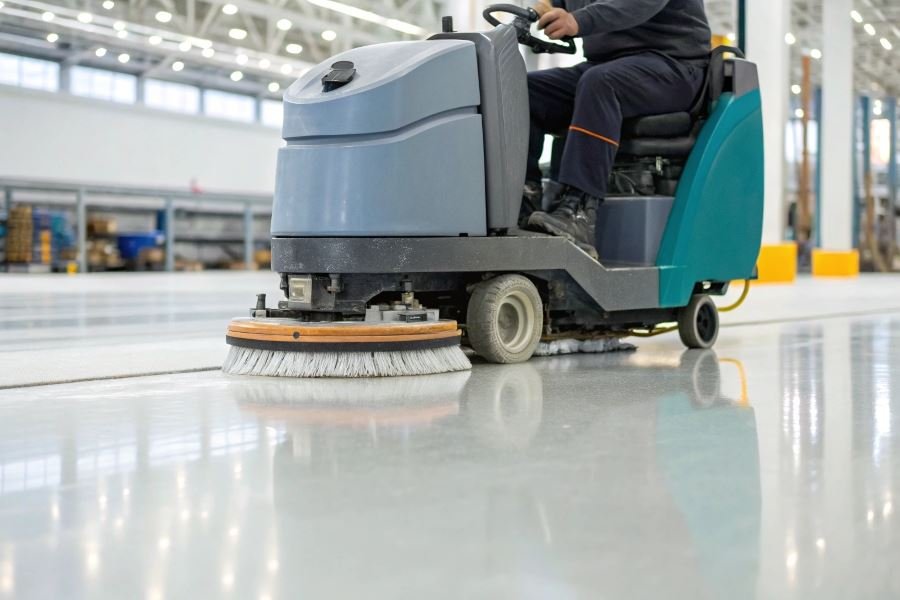
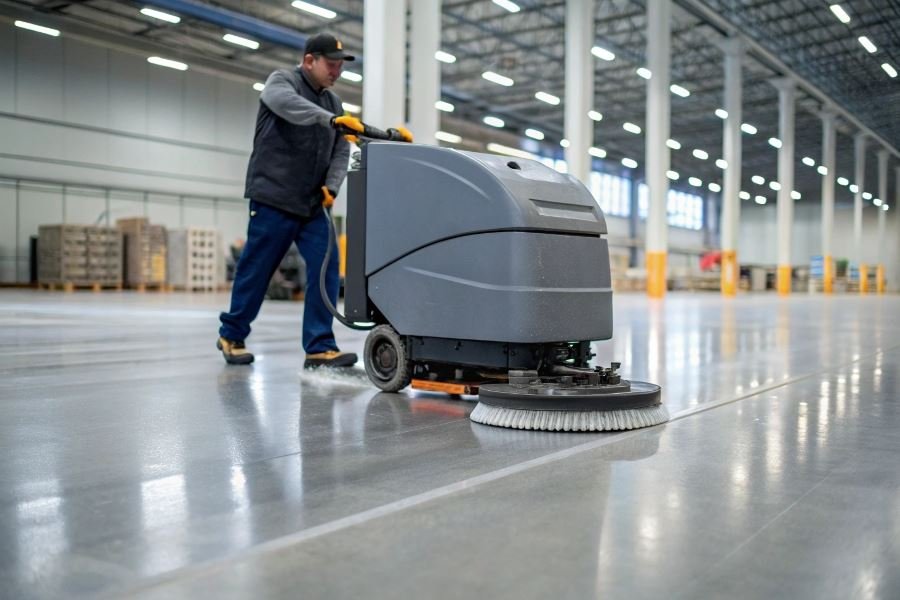
The sweeping width of your equipment creates your productivity baseline. A 36-inch sweeper covers 3,000 sq ft per hour at standard walking speed, while a 65-inch ride-on can theoretically cover 15,000+ sq ft in the same timeframe.
Speed capabilities vary dramatically between models. The Tennant S30 sweeper, for instance, operates at up to 8 mph, while many walk-behind models max out at 2-3 mph. This translates directly to productivity—but only when surface conditions permit maximum speed.
Debris capacity creates a critical calculation point many overlook. A sweeper with a 2.5 cubic foot hopper might need emptying twice during a job that a 3.5 cubic foot model could complete without interruption. Each emptying cycle typically adds 5-10 minutes of downtime.
Environmental and Operational Realities
Weather conditions create significant productivity variables. Wet surfaces can reduce sweeping efficiency by 25-40% and increase the risk of streaking. Wind speeds above 15 mph can scatter debris ahead of the sweeper, creating frustrating rework.
Debris type determines appropriate equipment selection and realistic productivity expectations:
“The difference between sweeping light dust versus heavy, wet leaves can mean a 300% variation in productivity rates with identical equipment.”
Operator efficiency remains perhaps the most underestimated factor. A well-trained operator familiar with the equipment and property can achieve up to 30% higher productivity than an inexperienced one. Training investments pay dividends in operational efficiency.
When calculating productivity needs, factor in seasonal variations. Fall leaf cleanup might require 2-3 times the equipment capacity of summer maintenance. The Toro Groundsmaster series offers seasonal attachment options that can transform productivity calculations throughout the year.
By thoroughly analyzing these essential factors, you’ll develop a comprehensive understanding of your true sweeping equipment needs—preventing both costly over-purchasing and frustrating under-capacity situations.
Calculating Sweeper Productivity That Actually Matches Your Site Needs
Ever watched a sweeper crawl across your property at a snail’s pace when the sales rep promised lightning-fast cleaning? Or perhaps you’ve invested in equipment that’s comically oversized for your needs? Let’s fix that with a precision approach to calculating sweeper productivity that actually reflects real-world conditions.
The Theoretical Maximum Formula
The foundation of all sweeper productivity calculations starts with this deceptively simple formula:
Theoretical Productivity = Working Width × Operating Speed
For example, a sweeper with a 60-inch (5-foot) cleaning path moving at 3 mph theoretically cleans:
- 5 feet × 3 mph = 15 feet²/minute
- Convert to hourly: 15 × 60 = 900 feet²/hour
- Convert to acres: 900 ÷ 43,560 = 0.021 acres/hour
But here’s where most calculations go terribly wrong: this theoretical maximum never matches reality.
Real-World Efficiency Factors
Your sweeper doesn’t operate at 100% efficiency. Several critical factors reduce actual productivity:
| Efficiency Factor | Typical Range | Impact |
|---|---|---|
| Overlap | 10-30% | Necessary overlap between passes |
| Turning Time | 5-15% | Time spent maneuvering |
| Debris Load | 5-25% | Slowing as debris accumulates |
| Terrain Difficulty | 5-40% | Slopes, obstacles, surface type |
| Operator Skill | 5-20% | Experience level affects speed |
To calculate actual productivity, multiply your theoretical maximum by each efficiency factor:
Actual Productivity = Theoretical Productivity × (1-Overlap) × (1-Turning) × (1-Debris) × (1-Terrain) × (1-Operator)
Site-Specific Adjustments
Different sites demand different adjustments:
- Surface Type Coefficient
- Smooth concrete: 0.9-1.0
- Asphalt: 0.8-0.9
- Textured surfaces: 0.6-0.8
- Uneven/rough: 0.4-0.6
- Obstacle Density
- Calculate the percentage of your site covered by obstacles requiring maneuvering
- For every 10% obstacle coverage, reduce efficiency by approximately 15%
- Traffic Patterns
- High-traffic areas may require multiple passes or slower speeds
- Each doubling of foot traffic typically reduces efficiency by 20%
Practical Example: Warehouse Floor
Let’s calculate for a Tennant S30 ride-on sweeper in a 50,000 sq ft warehouse:
- Working width: 62 inches (5.17 feet)
- Operating speed: 4.5 mph
- Theoretical productivity: 5.17 × 4.5 × 5,280 = 122,817 sq ft/hour
Applying efficiency factors:
- Overlap: 15% (0.85)
- Turning time: 10% (0.90)
- Debris load: 15% (0.85)
- Smooth concrete: 0.95
- Skilled operator: 0.90
Actual productivity = 122,817 × 0.85 × 0.90 × 0.85 × 0.95 × 0.90 = 71,518 sq ft/hour
This means the warehouse would take approximately 42 minutes to sweep completely.
Digital Calculation Tools
Several manufacturers offer productivity calculators:
These tools incorporate equipment-specific data and can export detailed reports for procurement justification.
Remember: Accurate productivity calculations prevent costly mismatches between equipment capabilities and site requirements. The difference between theoretical and actual productivity often represents thousands of dollars in operational efficiency.
Learn how to accurately calculate sweeping equipment productivity for your specific site. Discover key factors affecting efficiency, step-by-step calculation methods, and practical adjustments to optimize performance and reduce operational costs.
Learn how to accurately calculate sweeping equipment productivity for your specific site. Discover key factors affecting efficiency, step-by-step calculation methods, and practical adjustments to optimize performance and reduce operational costs.