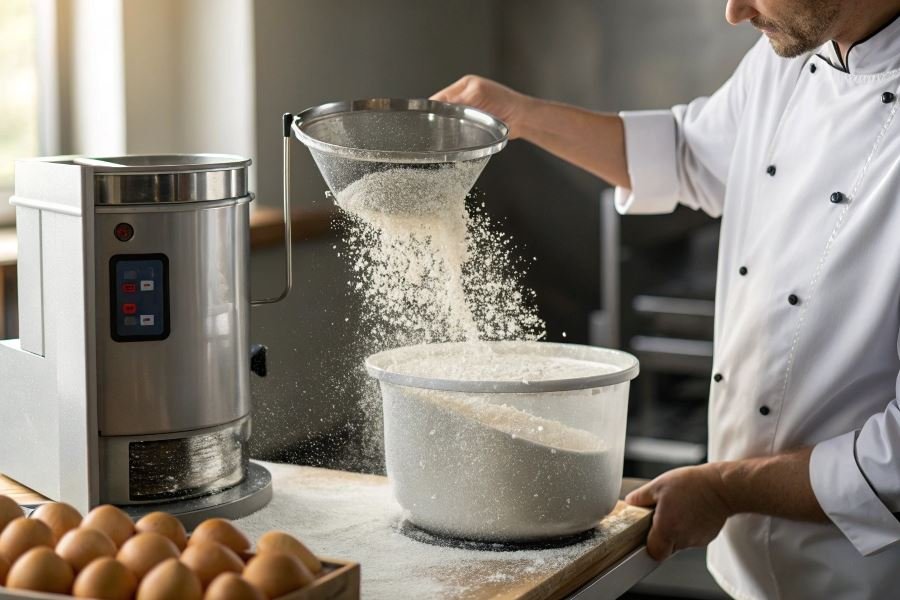
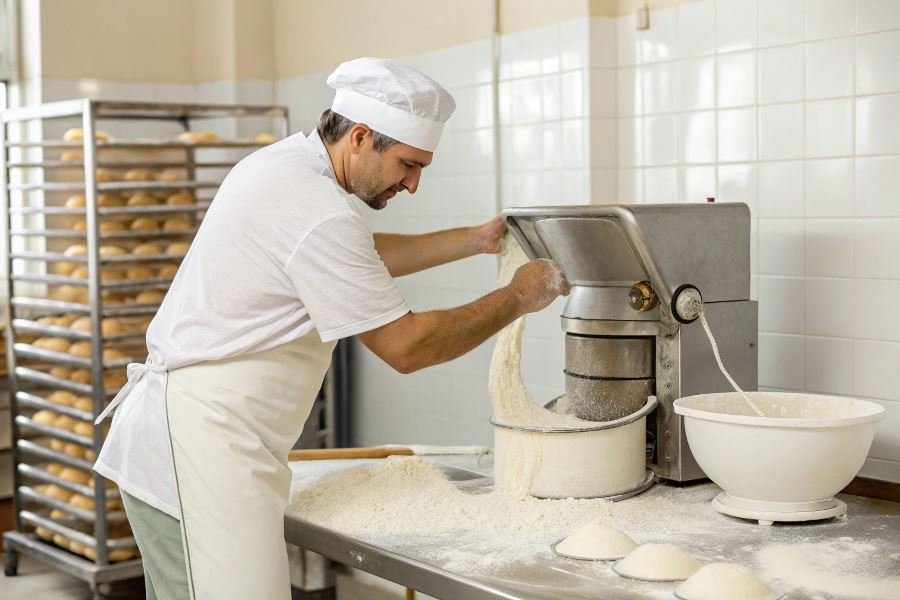
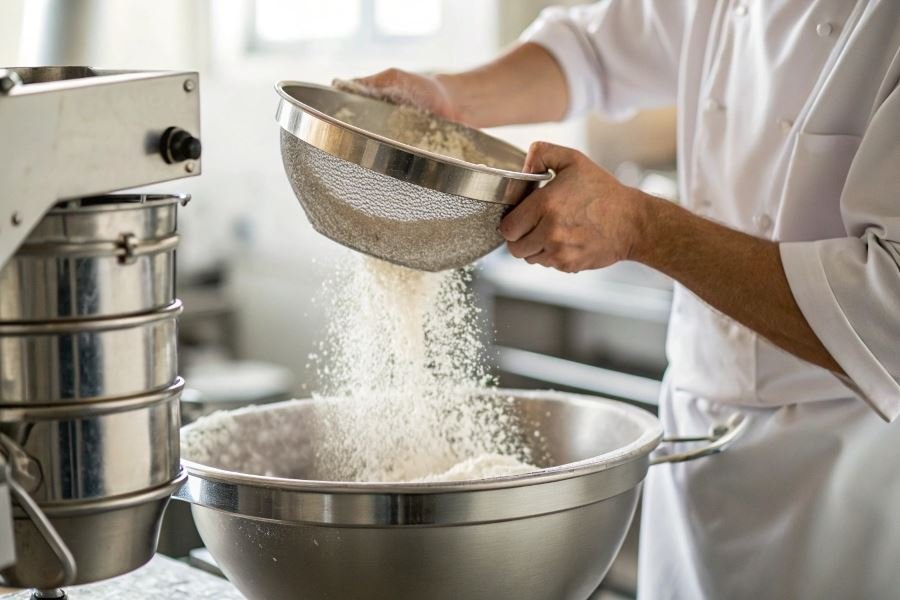
Ever watched a master baker gently sift flour, creating a cloud of fine powder that settles like fresh snow? That seemingly simple act might be the secret weapon separating exceptional baked goods from mediocre ones. In commercial settings, this detail becomes exponentially more crucial.
The humble flour sifter—often overlooked in production discussions—stands as the unsung hero in professional kitchens and food manufacturing facilities. Whether you’re producing artisanal sourdough loaves or mass-producing cookies, the type of flour sifter you choose directly impacts texture, consistency, and ultimately, customer satisfaction.
Why sifting matters more than you think
Flour naturally clumps during storage and transportation. These clumps aren’t just aesthetic problems—they create inconsistencies that ripple through your entire production process. A proper sifting system removes foreign particles, breaks down lumps, and aerates the flour, resulting in:
- Consistent texture across batches (crucial for brand reputation)
- Enhanced volume in finished products
- Improved ingredient incorporation during mixing
- Elimination of unwanted debris that could compromise food safety
The quality connection
Different sifter designs—from traditional hand-cranked models to sophisticated industrial vibrating systems—produce distinctly different results. The mesh size alone can dramatically alter your product’s final texture. A bakery producing delicate pastries requires a finer sift than one focused on rustic breads.
“The difference between good and exceptional baked goods often comes down to how thoroughly and consistently the flour is sifted.”
When selecting a flour sifter for your production needs, consider not just output volume, but how each design might enhance your specific products. The right choice becomes your silent partner in quality control.
Flour Sifter Types for Every Production Scale
When selecting equipment for your bakery or food processing facility, understanding the various types of flour sifters available can dramatically impact your production efficiency and product quality. The right flour sifter doesn’t just remove impurities—it aerates your flour, creating lighter, more consistent baked goods while ensuring food safety standards are met.
Choosing between manual, electric, or industrial flour sifters depends entirely on your production volume, available space, and specific requirements. Types of flour sifters suitable for your production range from simple hand-cranked models for artisanal bakeries to sophisticated industrial systems capable of processing thousands of pounds per hour. Let’s explore each category to help you make an informed decision.
Manual Sifters for Artisanal Production
Hand-cranked drum sifters remain the workhorses of small-batch production. These classic tools typically process 1-5 cups of flour per minute and offer exceptional control for specialty bakers.
The tactile feedback from manual sifters allows bakers to develop an intuitive feel for their ingredients—something many artisans consider irreplaceable.
Key features of quality manual sifters include:
- Stainless steel mesh (typically 30-60 gauge)
- Ergonomic handles to prevent wrist fatigue
- Single or double-screen options for different sifting intensities
Handheld sieve models provide even greater precision for ultra-small batches or specialty ingredients. These lightweight tools are perfect for dusting work surfaces or adding the final touches to pastries.
Electric Sifters for Medium-Scale Operations
As production demands increase, bench-top electric sifters offer the perfect middle ground. These compact units process 5-20 pounds of flour per hour while requiring minimal counter space.
Most bench-top models feature:
- Variable speed controls
- Removable collection bins
- 1/4 to 1/2 horsepower motors
- Noise levels under 70 decibels
Stand-alone electric sifters represent the next step up, handling 20-100 pounds per hour. These units often include:
| Feature | Benefit |
|---|---|
| Programmable timers | Consistent batches with minimal oversight |
| Multiple screen options | Customizable sifting for different flours |
| Dust containment systems | Improved air quality and reduced waste |
| Wheeled bases | Flexibility in production layout |
Industrial Sifting Systems for High-Volume Production
Large-scale operations require industrial-grade solutions that balance throughput with precision.
Rotary sifters excel at continuous operation, processing 100-500 pounds per hour. Their horizontal drum design uses centrifugal force to push flour through screens while foreign particles are ejected through a separate chute.
Vibratory sifters utilize multi-deck screens that oscillate at high frequencies. These powerhouses can handle 500-2,000 pounds hourly and are particularly effective at removing even the smallest contaminants.
The efficiency gains from properly sized industrial sifters often pay for themselves within months through reduced labor costs and improved product consistency.
Centrifugal sifters represent the pinnacle of industrial flour processing, capable of handling 2,000+ pounds per hour. These sophisticated machines use high-speed rotating paddles to force flour through precision screens while automatically ejecting foreign materials.
Key considerations for industrial systems include:
- Installation footprint and ceiling height requirements
- Power consumption (typically 2-10 kW)
- Cleaning and maintenance accessibility
- Integration with existing production lines
- Dust collection and filtration capabilities
Selecting the right flour sifter category is just the first step—within each type, specifications and features vary widely to match your specific production needs.
Decision Factors for Selecting the Right Flour Sifter
Choosing the optimal flour sifter for your production facility isn’t just about finding equipment that works—it’s about discovering a solution that transforms your operation. The right sifter becomes an invisible hero in your production line, silently ensuring quality while maximizing efficiency. Let’s dive into the critical factors that should guide your decision.
Production Volume and Throughput Requirements
The heartbeat of your selection process should be your production demands. Flour sifters come in dramatically different capacities, ranging from modest 500 pounds per hour units to industrial powerhouses processing 50,000+ pounds hourly.
Matching capacity to actual needs is crucial. Undersized sifters create bottlenecks and production delays, while oversized units waste capital and energy. Consider not just your current output but your projected growth over the next 3-5 years.
The relationship between sifter size and throughput isn’t always linear. Many facilities find that multiple medium-capacity units offer better operational flexibility than a single large unit, especially when handling different flour types.
| Sifter Type | Typical Capacity (lbs/hr) | Best For |
|---|---|---|
| Vibratory | 500-10,000 | Small to medium bakeries |
| Centrifugal | 2,000-25,000 | Medium production facilities |
| Rotary | 10,000-50,000+ | Large industrial operations |
| Pneumatic | 5,000-30,000 | Facilities with existing air systems |
Space Constraints and Installation Considerations
Your facility’s physical layout can make or break your sifter implementation. Modern production spaces are increasingly designed for maximum efficiency per square foot.
Vertical clearance matters as much as floor space. Many operations overlook height requirements until installation day—a costly oversight. Centrifugal sifters typically require less floor space but more height, while rotary models often have a larger footprint but lower profile.
Integration with existing systems requires careful planning. Consider:
- Power requirements and availability
- Proximity to other processing equipment
- Material handling systems for input and output
- Dust collection infrastructure
Modular designs from manufacturers like Great Western Manufacturing or Bühler Group offer flexibility for challenging spaces, allowing components to be arranged to fit your specific layout constraints.
Maintenance Needs and Food Safety Compliance
The most powerful sifter becomes a liability if it can’t be properly maintained or fails to meet increasingly stringent food safety standards.
Quick-change screens reduce downtime dramatically. Some modern designs allow for screen changes in under 15 minutes without tools, compared to older models requiring hours of labor. This feature alone can justify premium pricing through increased uptime.
Sanitation requirements should drive design selection. Look for:
“The best sifters aren’t just easy to clean—they’re designed to eliminate places where flour can hide in the first place.”
FDA-compliant materials are non-negotiable, but the structural design matters equally. Tool-free disassembly, smooth welded seams, and elimination of horizontal surfaces where product can accumulate are hallmarks of truly sanitary designs.
Consider maintenance schedules alongside cleaning protocols. Sifters from Kason Corporation feature sealed bearings that require minimal lubrication, reducing both maintenance time and contamination risks.
The most successful facilities approach sifter selection holistically, weighing throughput needs against space limitations and maintenance requirements. The perfect sifter isn’t just powerful—it’s the right fit for your unique production environment.
Discover the perfect commercial flour sifter for your business with our comprehensive guide to manual, electric, and industrial options. Learn how to choose based on production volume, space requirements, and food safety standards.
Discover the perfect commercial flour sifter for your business with our comprehensive guide to manual, electric, and industrial options. Learn how to choose based on production volume, space requirements, and food safety standards.