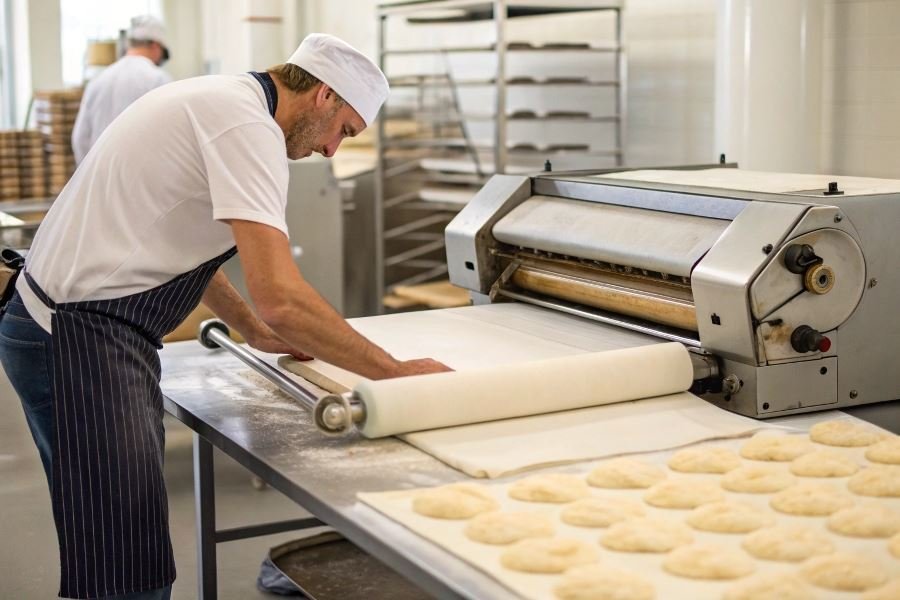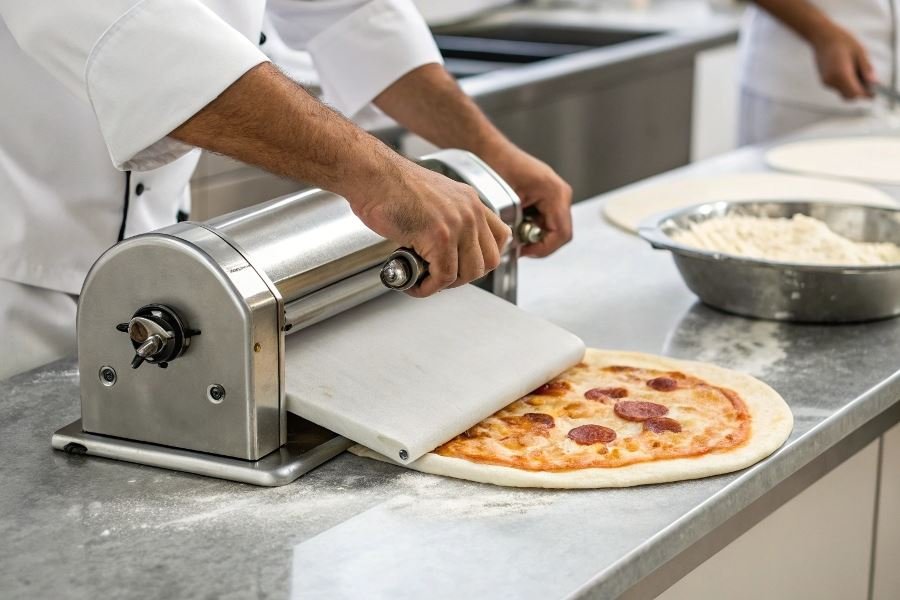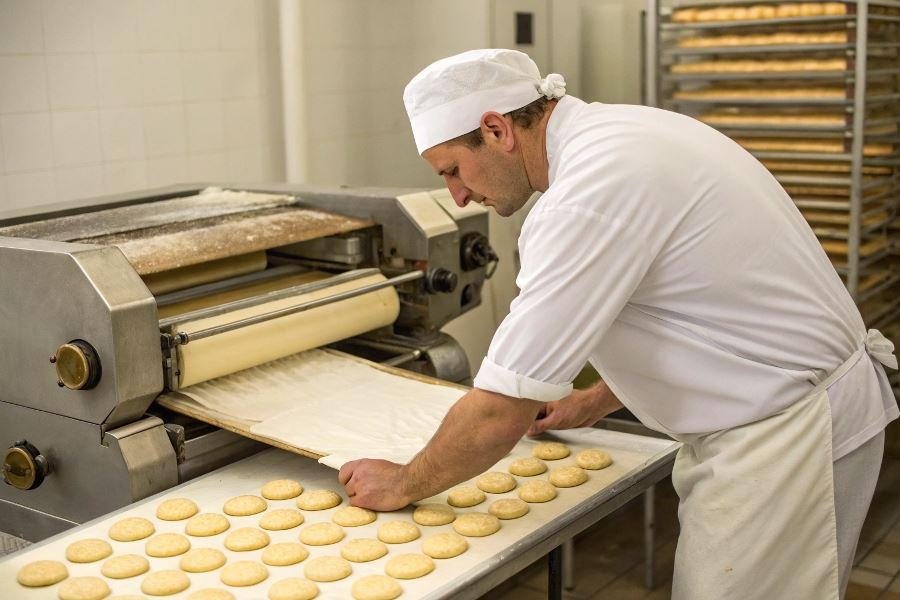
Ever watched a master pastry chef roll dough to perfect, consistent thickness with seemingly effortless precision? That’s not just skill—it’s technology working hand-in-hand with craftsmanship. Tabletop dough sheeters are revolutionizing small pastry operations, turning hours of manual labor into minutes of automated perfection.
A tabletop dough sheeter is essentially your tireless assistant that rolls and flattens dough to precise, uniform thicknesses. Unlike their industrial counterparts, these compact machines fit comfortably in limited spaces while delivering professional results. They transform the painstaking process of hand-rolling into a streamlined operation, ensuring consistency across every croissant, pie crust, or puff pastry.
Why small bakeries are embracing this technology:
- Labor efficiency: What once took 30 minutes by hand now takes 3 minutes by machine
- Consistency: Every pastry achieves identical thickness, eliminating the “amateur look”
- Reduced physical strain: Prevents repetitive motion injuries common among bakers
- Product quality: Creates the perfect lamination for flakier, more professional results
When selecting your sheeter, three factors should guide your decision: space availability, production volume, and dough versatility. The ideal machine accommodates your specific dough types—from delicate pastry to pizza—while fitting your workspace and meeting daily production needs.
“The difference between good pastry and exceptional pastry often comes down to consistency. That’s where a quality sheeter becomes invaluable.”
The investment typically ranges from $1,200 for entry-level models to $3,500 for premium options with advanced features—a cost quickly recovered through increased productivity and product quality.
Top 3 Tabletop Dough Sheeters That Will Transform Your Pastry Shop
The difference between good pastry and exceptional pastry often comes down to consistency—particularly in dough thickness. For small bakeries and pastry shops where every square inch matters, tabletop dough sheeters have become essential tools that deliver professional results without consuming precious floor space.
Tabletop dough sheeters for small pastry shops offer the perfect balance between functionality and spatial efficiency. These compact powerhouses can dramatically increase production speed while ensuring uniform dough thickness for everything from croissants to pizza bases. Let’s explore the best options across three distinct categories to help you find the perfect match for your operation.
Space-saving champions for tight quarters
When counter space is at an absolute premium, these compact models deliver impressive performance:
-
Doyon LMA516 – At just 20 inches wide, this mini marvel handles dough sheets up to 16 inches wide. Its reversible operation allows for progressive thickness reduction without repositioning your dough.
-
Omcan DS-MINI-B – Weighing only 55 pounds with a footprint smaller than most microwave ovens, this Italian-engineered unit still manages to process up to 15 pounds of dough per hour.
These ultra-compact units sacrifice some production capacity but deliver professional results in spaces where larger sheeters simply wouldn’t fit.
Versatility meets efficiency in mid-range models
For operations needing more throughput without sacrificing counter space:
| Model | Sheet Width | Thickness Range | Special Features |
|---|---|---|---|
| Thunderbird TBS-130 | 13″ | 0-30mm | Digital controls, removable tables |
| Proluxe DSA-420 | 16.5″ | 0-25mm | Dual-speed operation, safety guards |
| Eurodib LMA520 | 20″ | 0-34mm | Stainless construction, foot pedal |
These mid-range tabletop sheeters handle higher volumes while offering features like adjustable speeds and removable tables for easier cleaning. The Thunderbird TBS-130 particularly stands out with its digital thickness control that allows for precise adjustments down to 0.5mm increments.
Premium features for serious artisans
When production demands and quality standards are highest, these premium tabletop models deliver advanced capabilities:
-
Somerset CDR-600F – This American-made sheeter features a unique dough relaxing system that prevents shrinkage during rolling. Its programmable memory stores up to 10 different dough settings for consistent results across various recipes.
-
Rondo Doge Midy – Swiss engineering at its finest, this premium model offers automatic thickness progression and can handle everything from delicate pastry to pizza dough. Its patented flour duster ensures dough never sticks during processing.
What separates these premium models is their ability to handle specialty doughs like laminated pastry with exceptional precision, making them ideal for high-end patisseries and bakeries focused on artisanal products.
The right tabletop sheeter can dramatically improve your production efficiency while ensuring consistent quality. Whether you’re working in a tiny space or need advanced features for specialty pastries, today’s compact sheeters offer solutions that were once only available in much larger machines. The investment typically pays for itself through labor savings and product consistency within months.
Maximizing ROI with Tabletop Dough Sheeters
Productivity that pays for itself
Small pastry shops face a constant battle between quality and efficiency. A quality tabletop dough sheeter can transform this equation dramatically. The numbers speak volumes: manual dough rolling typically processes 15-20 dough sheets per hour, while even entry-level sheeters handle 60-80 sheets in the same timeframe—a 300% productivity boost.
This translates directly to labor savings. Consider this: at an average wage of $18/hour for bakery staff, a sheeter that saves just 3 hours daily represents nearly $17,000 in annual labor cost reduction. Most bakeries report recouping their initial investment within 8-14 months.
The true value of a dough sheeter isn’t just speed—it’s consistency that eliminates waste and elevates quality simultaneously.
Beyond raw productivity, these machines deliver precision that human hands simply cannot match. Consistent dough thickness means predictable baking times, reduced ingredient waste, and standardized product quality that customers notice and appreciate.
Maintenance economics and longevity
The financial equation doesn’t end with the purchase. Maintenance requirements vary significantly between models and directly impact your long-term ROI.
Stainless steel models from manufacturers like Doyon and Somerset typically demand minimal maintenance while offering 10+ years of service life. Their higher initial cost (averaging $4,500-7,000) is offset by remarkable durability.
Aluminum-framed alternatives (typically $2,800-4,200) require more vigilant maintenance but can still deliver 5-8 years of reliable service when properly maintained.
The maintenance math is straightforward:
| Maintenance Task | Frequency | Annual Cost | Notes |
|---|---|---|---|
| Belt replacement | Every 2-3 years | $180-350 | Higher for premium models |
| Roller cleaning | Daily | Labor only | Critical for longevity |
| Lubrication | Monthly | $40-60 | Food-grade lubricants required |
| Professional service | Annually | $200-400 | Preventative maintenance pays off |
Shops that implement rigorous maintenance protocols report up to 40% longer equipment lifespan—a compelling argument for creating and following a maintenance schedule.
Training for maximum return
The most sophisticated sheeter delivers minimal value without proper training. Effective staff training transforms a good investment into an exceptional one.
Start with fundamentals: proper dough preparation (temperature and hydration levels dramatically affect sheeter performance), machine setup, and safety protocols. Then advance to technique refinement—different products require different approaches.
Cross-training multiple staff members prevents production bottlenecks when key personnel are absent. Document standard operating procedures with photos or videos for consistent reference.
The American Institute of Baking offers specialized training programs that many owners find invaluable for maximizing equipment efficiency.
Tracking performance metrics before and after training initiatives reveals their impact. Bakeries implementing comprehensive training programs report 15-25% higher throughput from identical equipment compared to those with minimal training.
Remember that training isn’t a one-time event but an ongoing process. Schedule quarterly refreshers and ensure new techniques are shared across your team. This continuous improvement approach ensures your investment in both equipment and people delivers maximum returns year after year.
Discover the top 3 tabletop dough sheeters perfect for small pastry shops with limited space. Compare compact, mid-range, and premium models to boost productivity, reduce labor costs, and elevate your pastry production quality.
Discover the top 3 tabletop dough sheeters perfect for small pastry shops with limited space. Compare compact, mid-range, and premium models to boost productivity, reduce labor costs, and elevate your pastry production quality.