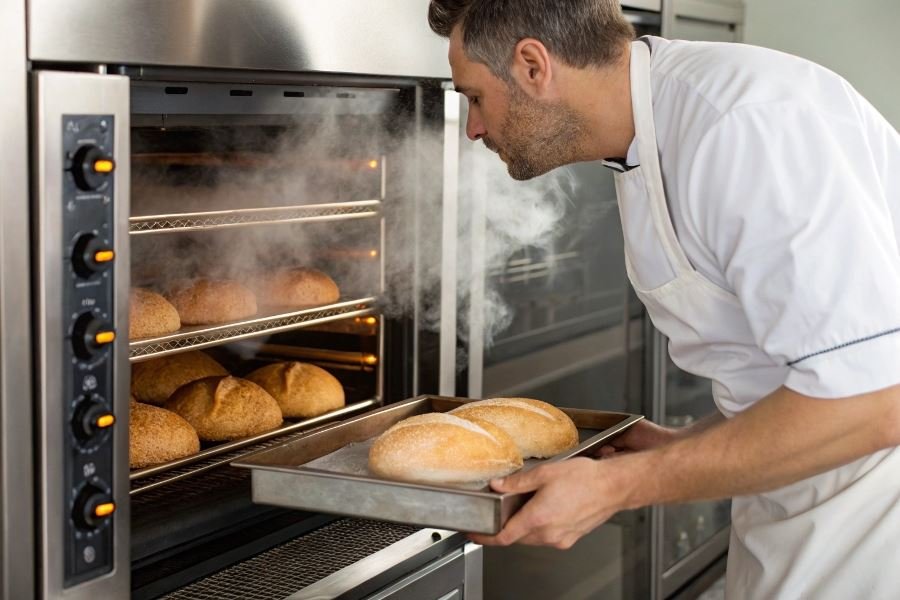
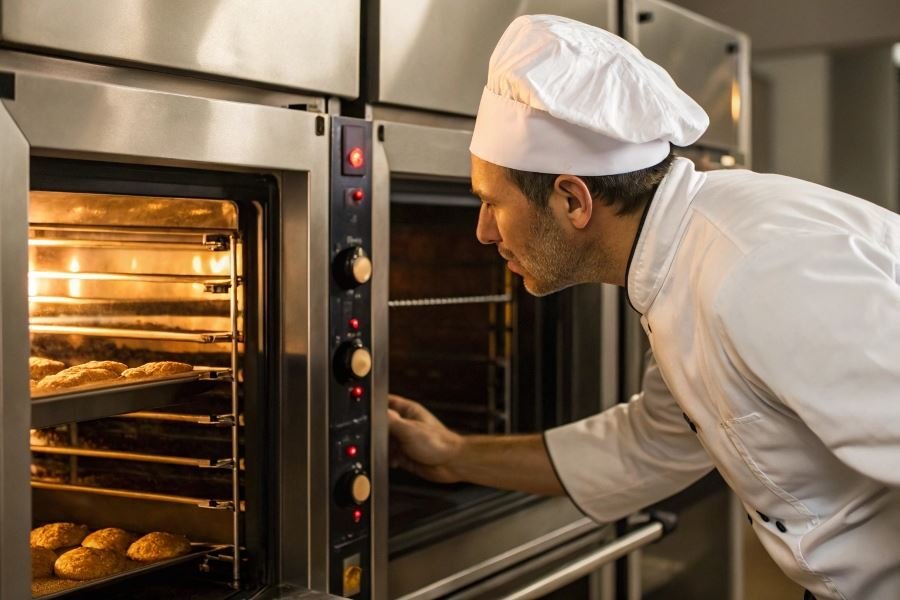
The difference between a good loaf and a legendary one often comes down to 15 seconds of bake time and 7 degrees of temperature.
Behind every flaky croissant, perfectly risen sourdough, or melt-in-your-mouth cookie stands an unsung hero: the bakery oven. This powerhouse doesn’t just cook your products—it breathes life into them, transforming raw ingredients into culinary masterpieces that keep customers coming back.
Selecting the right oven isn’t just a purchasing decision; it’s a strategic business move that directly impacts your bottom line. When master baker Peter Reinhart opened his award-winning bakery in San Francisco, he spent three months testing ovens before investing $85,000 in his final selection—a decision he credits with saving over $30,000 annually in reduced energy costs and product waste.
The technology landscape
Today’s bakery oven market offers unprecedented variety—from traditional deck ovens that create that perfect artisanal crust to high-tech convection systems that ensure consistency across large batches. Modern rack ovens now incorporate steam injection systems that can be programmed to the millisecond, while hybrid models combine multiple heating methods for versatility.
The profitability equation
The right oven doesn’t just produce better products—it transforms your entire operation. Consider this: a properly selected oven can reduce energy consumption by up to 30%, decrease labor costs through automation, and significantly extend maintenance intervals. More importantly, it ensures the consistent quality that builds brand loyalty in an increasingly competitive market.
The truth is simple: your oven isn’t just equipment—it’s the beating heart of your bakery’s success.
Technical Essentials for Your Bakery Oven Selection
Selecting the right oven for your bakery isn’t just about finding equipment—it’s about choosing the heartbeat of your operation. The technical specifications of your oven will directly impact everything from product quality to operational costs, making this decision critical to your bakery’s success.
When evaluating how to choose an oven for a bakery: main criteria, technical specifications should be at the top of your checklist. These aren’t just numbers on a spec sheet—they’re the difference between consistent, profitable production and constant headaches.
Production Capacity That Matches Your Ambition
Your oven’s capacity needs to align perfectly with your production goals. Consider:
- Daily output requirements in pounds or units
- Peak production periods and how they affect your needs
- The product mix and how different items require different space
A small artisan bakery might thrive with a deck oven that handles 12-15 loaves per hour, while high-volume operations often require rack ovens that can process 150+ pounds of product hourly.
| Oven Type | Typical Capacity | Ideal For |
|---|---|---|
| Deck Oven | 12-20 loaves/hour per deck | Artisan breads, pizzas |
| Rack Oven | 150-300 lbs/hour | High-volume, diverse products |
| Convection | 80-120 lbs/hour | Pastries, cookies, light baking |
| Tunnel Oven | 500+ lbs/hour | Industrial production |
Temperature Precision and Heat Distribution
The difference between good and exceptional baked goods often comes down to temperature control and heat distribution.
Temperature range matters tremendously—most commercial bakery ovens should offer:
- Minimum range of 150°F to 500°F (65°C to 260°C)
- Precise controls with 5-degree increments or better
- Recovery time of less than 5 minutes after door opening
Heat distribution is equally crucial. Hobart ovens, for example, often feature advanced air circulation systems that eliminate hot spots and ensure even browning across all products.
Energy Considerations and Utility Requirements
Your choice between gas, electric, or wood-fired ovens will impact both your product and your bottom line.
Gas ovens typically offer:
- Lower operating costs (20-30% less than electric)
- Faster heat recovery
- Moister heat environment beneficial for many breads
Electric ovens provide:
- More precise temperature control
- Easier installation (no ventilation requirements)
- Cleaner operation with no combustion byproducts
Wood-fired ovens deliver:
- Unique flavor profiles impossible to replicate
- Marketing appeal for artisan bakeries
- Higher labor requirements for operation
Energy efficiency ratings should be scrutinized carefully—a Rational oven with higher upfront costs might save $3,000-5,000 annually through reduced energy consumption.
Space Planning and Installation Realities
The perfect oven on paper becomes problematic if it won’t fit your space or requires infrastructure you don’t have.
Consider:
- Footprint dimensions including required clearances (typically 18-24 inches)
- Ventilation requirements and hood systems
- Weight load capacity of your floors
- Utility access points and potential modification costs
Installation costs can easily add $2,000-10,000 to your investment depending on your existing infrastructure. Blodgett offers pre-installation planning services that can help identify potential issues before they become expensive surprises.
Remember that the right oven isn’t just about today’s needs—it should accommodate your growth plans for the next 5-7 years, as quality commercial ovens represent a significant long-term investment in your bakery’s future.
Sealing the Deal: The Final Decision Framework for Your Bakery Oven
Beyond the price tag
Selecting the perfect bakery oven isn’t just about finding the lowest sticker price—it’s about understanding the complete financial picture. The total cost of ownership (TCO) often reveals surprising truths about which oven truly delivers value.
A commercial deck oven priced at $15,000 might seem expensive compared to a $9,000 alternative, but dig deeper. Energy efficiency ratings can translate to 3, 000−4,000 in annual savings for high-efficiency models. One bakery owner in Portland discovered his premium Polin oven paid for its price difference in just 19 months through reduced energy consumption.
Maintenance costs vary dramatically between models. Convection ovens typically require service 2-3 times annually, while stone-deck ovens might need attention just once yearly. Factor in average service calls (350−500 each) and parts availability when calculating true ownership costs.
The cheapest oven is rarely the most economical. The best value often hides behind a higher price tag, revealing itself over years of operation.
Vendor credibility as insurance
The manufacturer standing behind your oven matters as much as the oven itself. When evaluating vendors, look beyond glossy brochures to substantive indicators:
Warranty depth matters more than length. A comprehensive 1-year warranty covering parts and labor often outperforms a 3-year limited warranty with exclusions. Baxter and Sveba Dahlen consistently offer warranties that bakers describe as “hassle-free” with minimal exclusions.
After-sales support separates industry leaders from the pack. Key questions to investigate:
- Response time guarantees (24 hours should be standard)
- Availability of certified technicians in your region
- Parts warehousing locations and shipping timeframes
- Emergency support options (weekend/holiday coverage)
The proof is in the baking
Never—and this bears repeating—never purchase a commercial oven without testing it first. Theoretical specifications fade in importance when faced with real-world performance.
Arrange comprehensive testing using:
| Testing Approach | What to Look For | Why It Matters |
|---|---|---|
| On-site demos | Consistency across multiple rack positions | Reveals hot/cold spots invisible in specs |
| Bakery visits | Speaking with current users | Uncovers long-term satisfaction patterns |
| Test kitchen sessions | Baking your specific recipes | Confirms suitability for your product line |
When testing, bring your own ingredients and recipes. The Empire test kitchen in New York allows bakers to spend a full day running production tests—an investment of time that prevents costly mistakes.
Document performance metrics during testing: recovery times between batches, temperature consistency, steam quality for crusty breads, and energy consumption under load. These data points provide objective comparison criteria beyond sales pitches.
The final decision matrix should weigh TCO (40%), vendor reliability (30%), and performance testing (30%) to arrive at a balanced evaluation that serves your bakery’s long-term success. Remember that the right oven becomes a silent partner in your business, working reliably for 15-20 years when chosen wisely.
Discover the essential criteria for selecting the perfect bakery oven that maximizes product quality and business profitability. Learn about capacity requirements, heat distribution, energy efficiency, and cost considerations to make an informed investment decision.
Discover the essential criteria for selecting the perfect bakery oven that maximizes product quality and business profitability. Learn about capacity requirements, heat distribution, energy efficiency, and cost considerations to make an informed investment decision.