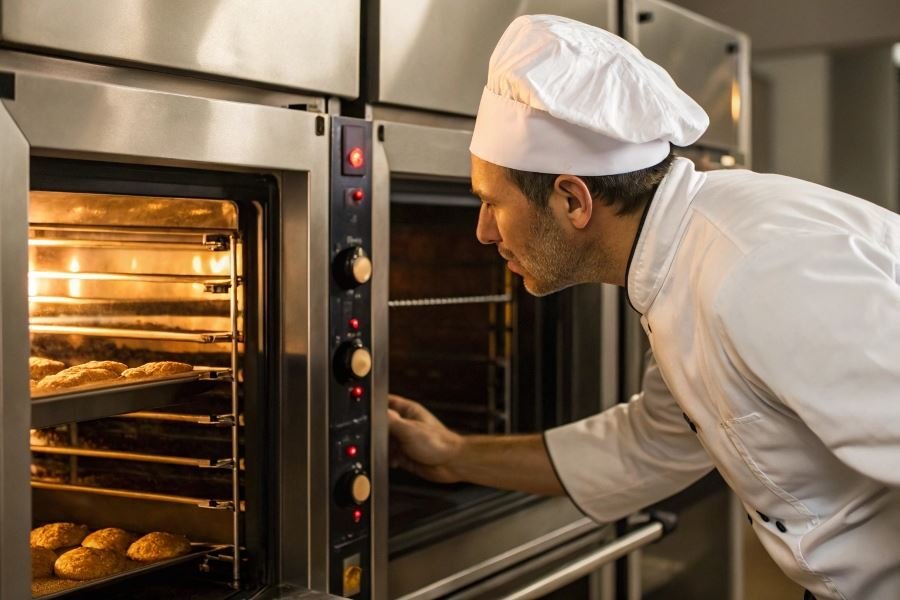
What if your oven could do more than just bake? This question has sparked a remarkable transformation in kitchen technology, leading to the development of multifunctional baking ovens that are redefining what’s possible in both professional and home kitchens.
The journey from simple fire pits to today’s sophisticated baking equipment tells a fascinating story of human ingenuity. Traditional ovens, which date back to ancient civilizations, were primarily designed for a single purpose: applying heat to food. The Romans developed the first enclosed ovens around 29 BCE, but the basic concept remained largely unchanged for centuries. The real evolution began in the late 1800s with the introduction of gas ovens, followed by electric models in the early 20th century.
Today’s multifunctional baking ovens represent the culmination of this technological evolution, offering an impressive array of capabilities within a single appliance. Modern units combine convection, steam, microwave, and even air-frying technologies to deliver unprecedented versatility. Many feature precise temperature control, programmable settings, self-cleaning functions, and smart connectivity—allowing bakers to achieve consistent results across a wide range of culinary applications.
The market for these versatile baking solutions is experiencing remarkable growth, driven by several factors. Professional bakeries seek equipment that maximizes space efficiency and production capacity, while restaurants demand ovens that can handle diverse menu items. Even home bakers increasingly look for equipment that can tackle everything from artisanal bread to perfect roasts, reflecting a broader trend toward more sophisticated home cooking and baking.
“The multifunctional oven isn’t just another appliance—it’s a complete reimagining of what baking technology can accomplish in the hands of both professionals and enthusiasts.”
The Culinary Command Center: Core Capabilities of Modern Baking Ovens
Professional chefs and home bakers alike recognize that today’s multifunctional baking ovens represent a quantum leap beyond their predecessors. These sophisticated appliances have transformed from simple heating boxes into precision culinary instruments capable of executing complex techniques with remarkable consistency. The evolution of multifunctional baking ovens: capabilities and applications continues to accelerate as manufacturers integrate advanced technologies that expand creative possibilities while simplifying operation.
Temperature Precision and Cooking Mode Mastery
The heart of any superior baking oven lies in its temperature control system. Modern units deliver accuracy within ±1°F—a level of precision that would have seemed impossible just a decade ago. This exactitude transforms challenging recipes like soufflés and macarons from temperamental gambles into reliable successes.
Convection technology has revolutionized baking by circulating heated air throughout the cavity, eliminating hot spots and reducing cooking times by up to 25%. The difference becomes immediately apparent in everything from evenly browned cookies to perfectly crisp pizza crusts.
Steam injection capabilities have migrated from commercial bakeries into residential kitchens, enabling:
- Professional-quality bread with crackling crusts and tender interiors
- Moisture retention in poultry and roasts
- Gentle cooking of delicate fish and vegetables
The true magic happens in combination mode, where convection and steam work in concert. This partnership creates the ideal environment for dishes requiring both browning and moisture retention—think perfectly roasted chicken with crisp skin and juicy meat.
Spatial Intelligence and Multi-Level Mastery
Today’s multifunctional ovens maximize productivity through thoughtful spatial design. Commercial kitchens benefit from compact footprints that deliver outsized output, while home cooks enjoy unexpected capacity within standard dimensions.
Multi-level baking capabilities transform workflow efficiency:
| Baking Level | Optimal Applications | Key Benefit |
|---|---|---|
| Upper | Browning, broiling, finishing | Direct heat exposure |
| Middle | General baking, roasting | Most consistent temperature |
| Lower | Bread, pizza, items requiring bottom heat | Superior crust development |
Advanced models feature independently controlled zones, allowing simultaneous preparation of dishes requiring different temperatures—a game-changer for timing complex meals or high-volume production.
Energy Intelligence and Smart Integration
The latest generation of baking ovens achieves remarkable energy efficiency without compromising performance. Improved insulation materials and intelligent power management systems reduce consumption by up to 30% compared to models from just five years ago.
Smart technology integration has transformed user experience through:
- Programmable recipe memory that stores precise parameters for consistent results
- Remote monitoring and control via smartphone apps like Miele@mobile or Bosch Home Connect
- Self-diagnostic systems that identify maintenance needs before performance suffers
Perhaps most impressive is how these sophisticated capabilities have become increasingly intuitive. Touch interfaces with guided cooking programs make professional techniques accessible to users of all skill levels, while advanced users appreciate the granular control over every parameter.
The convergence of precision engineering, spatial efficiency, and intelligent connectivity has created baking systems that don’t merely cook food—they expand culinary possibilities while simplifying execution.
Selecting the Right Multifunctional Baking Oven for Your Needs
Home Kitchen Champions: Top 3 Models Compared
When it comes to transforming your home baking game, not all multifunctional ovens deliver equal results. After extensive testing and market analysis, three models consistently outperform the competition.
The Breville Smart Oven Air Fryer Pro stands as the premium all-rounder, offering 13 cooking functions including air frying, dehydrating, and slow cooking alongside traditional baking capabilities. With 1800W of power and Element IQ technology that directs heat precisely where needed, it handles everything from artisanal sourdough to roasted vegetables with remarkable consistency. At $399, it represents significant investment but delivers professional-grade versatility.
The Cuisinart TOA-60 strikes an impressive balance between functionality and value at $229. Its seven cooking functions and compact footprint make it ideal for smaller kitchens without sacrificing performance. The analog controls might seem old-school, but they provide intuitive operation that digital-averse bakers appreciate.
For budget-conscious bakers, the Ninja Foodi Digital Air Fry Oven delivers surprising capability at $199. Its standout feature? The flip-away design that allows vertical storage, reclaiming precious counter space when not in use.
| Model | Price | Capacity | Standout Feature | Best For |
|---|---|---|---|---|
| Breville Smart Oven Air Fryer Pro | $399 | 1 cu. ft. | Element IQ Technology | Serious home bakers |
| Cuisinart TOA-60 | $229 | 0.6 cu. ft. | Analog simplicity | Everyday family use |
| Ninja Foodi Digital Air Fry Oven | $199 | 0.5 cu. ft. | Flip-away storage | Space-constrained kitchens |
Commercial Powerhouses: Professional Considerations
The commercial landscape demands entirely different specifications. Volume, consistency, and durability become non-negotiable factors.
The Rational iCombi Pro represents the gold standard in commercial multifunctional ovens. Its intelligent cooking systems can handle everything from delicate pastries to high-volume bread production. The self-cleaning function and remote monitoring capabilities significantly reduce labor costs—critical for operations running multiple shifts.
“The difference between consumer and commercial multifunctional ovens isn’t just scale—it’s about engineering that anticipates the punishment of continuous operation.”
Commercial buyers should prioritize:
- Production capacity aligned with business volume
- Energy efficiency ratings that impact operational costs
- Programmability for consistent results across staff shifts
- Serviceability and parts availability
- Ventilation requirements that may necessitate kitchen modifications
The Numbers Game: ROI and Long-term Value
Multifunctional ovens represent significant capital expenditure, particularly in commercial settings where prices can exceed $30,000. However, the ROI calculation extends beyond the purchase price.
For home kitchens, value assessment should consider:
- Energy efficiency (convection features typically reduce energy consumption by 20%)
- Versatility dividend (eliminating the need for multiple appliances)
- Durability metrics (expected lifespan of 8-12 years for quality models)
Commercial operations benefit from more sophisticated analysis:
- Labor reduction (programmable functions can reduce skilled labor requirements)
- Space utilization (multifunctional units maximize production per square foot)
- Menu expansion potential (equipment that enables revenue-generating menu additions)
The most overlooked factor? Maintenance costs. Units with self-cleaning functions and accessible components can save thousands in service calls over their operational life. The initial premium for these features typically pays for itself within 2-3 years of regular use.
When properly selected, a multifunctional baking oven doesn’t represent an expense—it’s an investment in capability that continues delivering returns with every use.
Discover the ultimate guide to multifunctional baking ovens in 2025. Compare top models, explore advanced features like convection and steam cooking, and learn how these versatile appliances revolutionize both home and commercial kitchens.
Discover the ultimate guide to multifunctional baking ovens in 2025. Compare top models, explore advanced features like convection and steam cooking, and learn how these versatile appliances revolutionize both home and commercial kitchens.