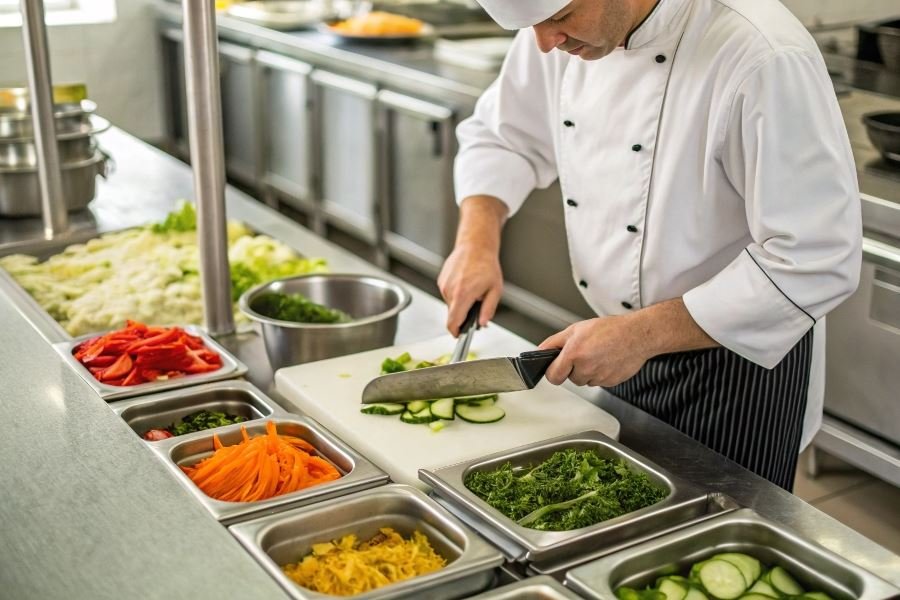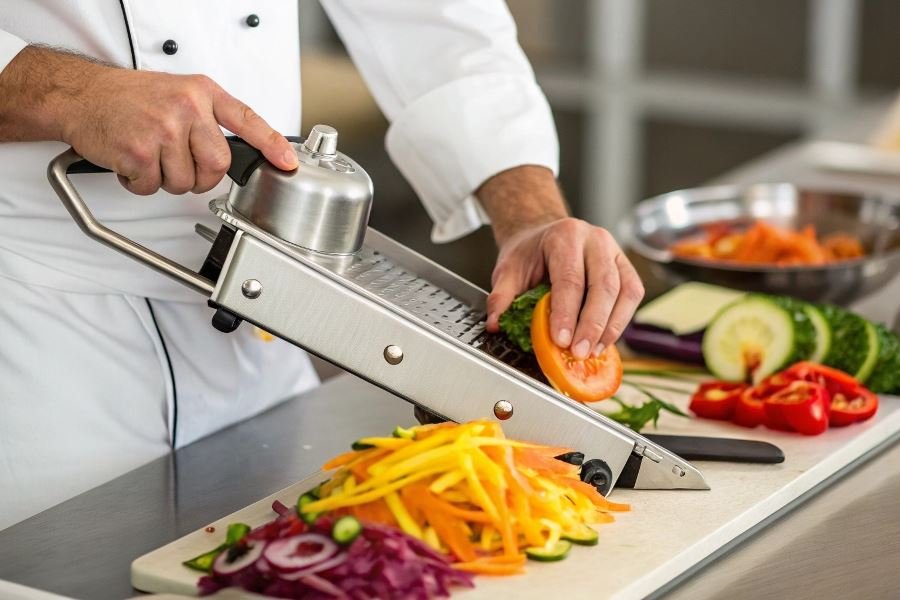
Ever watched a professional chef transform a mountain of vegetables into perfectly uniform pieces in minutes? That’s not just skill—it’s the right equipment making magic happen. In commercial kitchens, where time literally equals money, vegetable cutter productivity isn’t just a specification—it’s the difference between profit and loss.
Productivity in commercial vegetable cutters refers to the volume of properly processed vegetables a machine can handle within a specific timeframe. Think of it as the heartbeat of your prep station. A high-productivity cutter processing 700 pounds of vegetables per hour versus one handling 300 pounds creates dramatically different operational realities.
The productivity equation isn’t simple, though. It’s influenced by multiple factors working in concert: motor power (measured in horsepower or watts), blade quality and design, feed tube dimensions, and mechanical efficiency. The most powerful motor means nothing if paired with dull blades or poorly designed cutting chambers.
Why does this matter so intensely? Every minute saved in food preparation translates directly to labor cost reduction. A restaurant processing 200 pounds of vegetables daily could save approximately $12,000 annually in labor costs by upgrading from a standard to high-productivity cutter.
Beyond the obvious time savings, productivity impacts:
- Food consistency: Higher productivity machines typically deliver more uniform cuts
- Waste reduction: Precision cutting means less trimming waste
- Energy efficiency: Modern high-productivity units often consume less power per pound processed
- Staff allocation: Freeing skilled workers from repetitive cutting tasks
When evaluating productivity claims, remember that real-world performance often differs from laboratory testing. The true measure comes when processing your specific ingredient mix under your kitchen conditions.
Essential Productivity Factors for Commercial Vegetable Cutters
When evaluating commercial vegetable cutters for your kitchen operation, understanding the core productivity factors can mean the difference between smooth operations and frustrating bottlenecks. Professional chefs and kitchen managers know that the productivity of vegetable cutters depends on several critical specifications that directly impact your food preparation workflow and output quality.
Motor Power and Cutting Capacity
The engine room of any vegetable cutter is its motor. Commercial-grade machines typically range from 1/2 HP (375 watts) for light-duty applications to robust 2 HP (1,500 watts) motors for high-volume operations. This power differential isn’t just about speed—it fundamentally determines what your machine can handle.
Power-to-performance correlation:
| Motor Power | Ideal Usage | Daily Capacity | Typical Applications |
|---|---|---|---|
| 1/2 HP (375W) | Light duty | 50-100 lbs | Small restaurants, cafés |
| 1 HP (750W) | Medium duty | 100-300 lbs | Mid-sized restaurants |
| 2 HP (1,500W) | Heavy duty | 300-800+ lbs | Commissaries, institutions |
A restaurant processing 200 pounds of vegetables daily needs sufficient motor power to maintain consistent productivity without overheating or stalling when facing dense root vegetables like carrots or beets. The cutting capacity specifications should match your peak production needs with at least 20% headroom for unexpected volume increases.
Blade Quality and Design Options
The unsung heroes of vegetable preparation are the blades themselves. Commercial vegetable cutters typically offer interchangeable blade options that dramatically affect both productivity and finished product quality.
Key blade considerations:
- Material composition: Look for high-carbon stainless steel blades that resist corrosion while maintaining sharpness
- Edge retention: Premium blades maintain their cutting edge through thousands of pounds of produce
- Interchangeability: The best systems offer quick-change mechanisms for rapid switching between cuts
Most professional kitchens require at minimum:
- Slicing discs (1mm to 10mm thickness)
- Dicing grids (6mm to 25mm cubes)
- Julienne/matchstick blades
- Grating/shredding options
The Robot Coupe R2 Dice, for example, offers over 20 different blade configurations, allowing kitchens to produce everything from paper-thin cucumber slices to perfect 10mm carrot cubes without changing machines.
Feed Mechanism and Throughput Efficiency
The feed mechanism design dramatically impacts real-world productivity more than almost any specification. Even powerful motors with premium blades can be bottlenecked by poor feeding systems.
Continuous feed systems maintain higher throughput rates by allowing operators to load produce while the machine is running. These systems typically achieve 30-40% higher hourly output compared to batch-feed alternatives.
Throughput comparison by feed type:
| Feed Mechanism | Hourly Capacity (Potatoes) | Labor Requirement | Best For |
|---|---|---|---|
| Manual batch | 200-300 lbs | High | Small operations, varied cuts |
| Continuous feed | 400-600 lbs | Medium | Medium volume, consistent cuts |
| Automated belt | 800-1,200+ lbs | Low | High volume, industrial settings |
The Hobart FP series incorporates an ergonomic feed design that reduces operator fatigue while maintaining consistent pressure against the cutting plates—a critical factor in achieving uniform cuts and preventing jams that interrupt workflow.
When evaluating vegetable cutters, remember that theoretical capacity ratings often assume perfect conditions. Real-world productivity depends on the interplay between motor power, blade design, and feed mechanism efficiency. The most productive systems balance all three factors while considering your specific volume requirements and produce types.
Making the Smart Investment in Vegetable Cutter Productivity
Built to last or built to break
The true value of a commercial vegetable cutter emerges long after the initial purchase. Premium models like the Robot Coupe CL50 might command $1,200-2,500 upfront, but their induction motors often deliver 10+ years of reliable service. Meanwhile, budget alternatives priced under $500 typically require replacement within 2-3 years under heavy use.
Maintenance requirements vary dramatically across price points. High-end cutters feature removable, dishwasher-safe components and tool-free disassembly for quick cleaning. Many professional models require just 3-5 minutes of maintenance daily, while economy options often demand 15+ minutes of meticulous hand cleaning to prevent food buildup in hard-to-reach areas.
The maintenance equation isn’t just about time—it’s about operational continuity. When a blade dulls or a component fails, how quickly can you return to production? Leading manufacturers like Hobart and Hallde offer 24-hour parts shipping and modular designs where components can be swapped without specialized tools.
Versatility that pays dividends
The most productive vegetable cutters adapt to your changing menu requirements without requiring additional equipment purchases.
| Cutting Style | Basic Models | Professional Models |
|---|---|---|
| Slicing | 1-2 thickness options | 0.5mm-14mm adjustable |
| Dicing | Limited or none | 5mm-25mm with interchangeable grids |
| Julienne | Single size | Multiple width options |
| Grating | Coarse only | Fine to extra-coarse |
Vegetable compatibility represents another crucial productivity factor. Budget machines excel with firm vegetables like carrots and potatoes but struggle with tomatoes, leafy greens, or high-water-content produce. Premium cutters handle everything from delicate herbs to dense root vegetables without adjustment.
The Urschel Sprint exemplifies this versatility with its ability to process over 55 different vegetables using the same base unit—simply swap cutting attachments to transition from shredding cabbage to dicing onions in under 30 seconds.
The productivity economics equation
When evaluating return on investment, throughput capacity becomes the critical metric. Commercial kitchens should calculate their cost-per-pound of processed vegetables:
Daily operational cost = (Purchase price ÷ Expected lifespan in days) + Daily maintenance labor + Energy costs
A $2,000 vegetable cutter with a 7-year lifespan processing 200 pounds daily costs approximately $0.04 per pound in equipment depreciation. Compare this to manual cutting, which typically costs $0.35-0.50 per pound in labor alone.
The productivity gap widens further when considering consistency and waste reduction. Professional-grade cutters achieve 95%+ yield from raw vegetables, while manual cutting typically wastes 15-20% through irregular cuts and human error.
Energy efficiency creates another long-term productivity advantage. Modern vegetable cutters from manufacturers like Electrolux Professional incorporate variable-speed motors that adjust power consumption based on the vegetable’s density, reducing electricity usage by up to 30% compared to fixed-speed alternatives.
The most productive investment balances initial cost against daily throughput, maintenance requirements, and operational lifespan. For operations processing more than 50 pounds of vegetables daily, commercial-grade equipment typically reaches ROI within 12-18 months, while continuing to deliver productivity benefits for years afterward.
Discover how to select a high-performance vegetable cutter that maximizes efficiency in your kitchen. Learn about motor power, blade quality, and throughput rates to make a smart investment that delivers long-term productivity and cost savings.
Discover how to select a high-performance vegetable cutter that maximizes efficiency in your kitchen. Learn about motor power, blade quality, and throughput rates to make a smart investment that delivers long-term productivity and cost savings.