Ever watched a bakery employee struggle with an inefficient bread slicer while a line of customers grows increasingly impatient? That single moment can cost you more than just time—it impacts customer satisfaction, employee morale, and ultimately, your bottom line.
For small bakeries and food service operations, bread slicing isn’t just a mundane task—it’s a critical operational component that directly affects productivity and product quality. The difference between perfectly uniform slices and inconsistent results can determine whether customers return or seek alternatives elsewhere.
The bread and butter of slicing technology
Bread slicing technology has evolved significantly since Otto Frederick Rohwedder invented the first automatic bread slicer in 1928. Today’s small business owners face a crucial decision between two primary options:
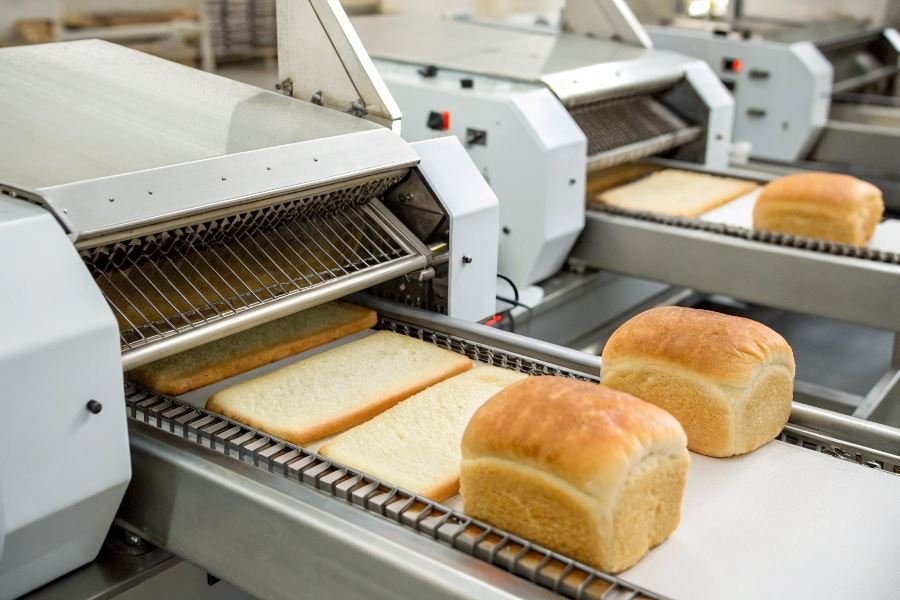
Automatic bread slicers operate with minimal human intervention—simply load the loaf, press a button, and collect perfectly uniform slices. These machines typically handle higher volumes and maintain consistent slice thickness throughout operation.
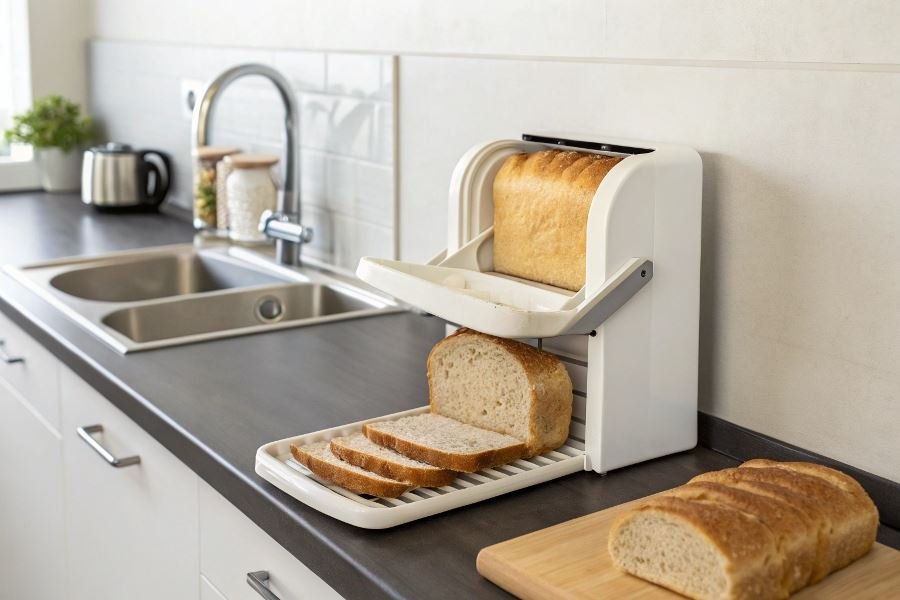
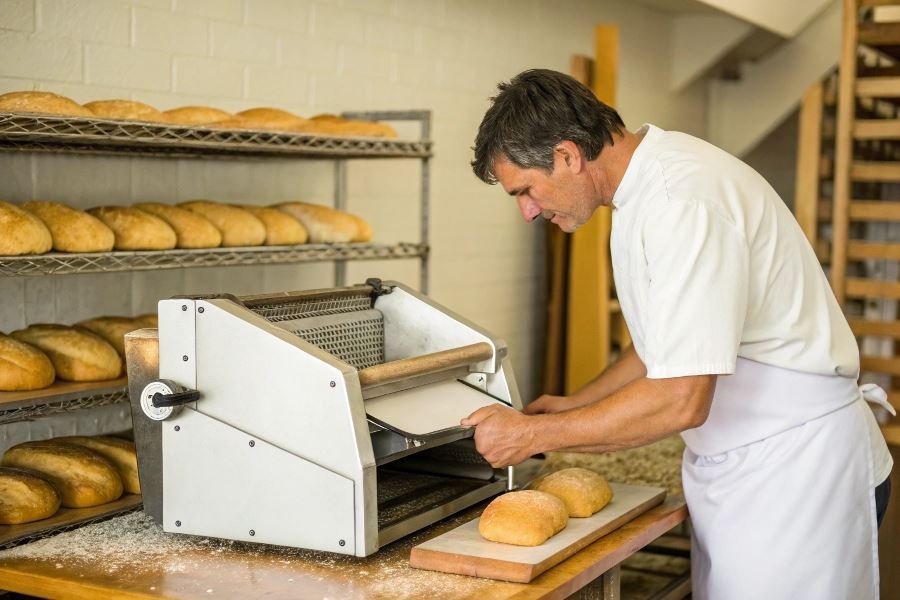
Semi-automatic slicers require operators to manually push bread through the cutting mechanism, offering more control over the slicing process but demanding greater labor input and attention.
Decision factors that truly matter
When evaluating which technology best suits your operation, consider these critical factors:
- Production volume: How many loaves need slicing during peak periods?
- Labor availability: Can you dedicate staff time to bread slicing?
- Space constraints: Where will the machine live in your already-crowded kitchen?
- Product variety: Will you slice primarily one type of bread, or does your menu feature artisanal varieties with different textures and densities?
- Budget reality: Can the investment in fully automatic technology be justified by labor savings and consistency improvements?
The right choice isn’t universal—it’s intimately tied to your specific business needs, operational workflow, and growth trajectory.
The Business Baker’s Dilemma: Automatic vs Semi-Automatic Slicers
When equipment decisions impact your bottom line, the choice between automatic and semi-automatic bread slicers deserves careful consideration. The right slicer doesn’t just cut bread—it cuts costs, saves time, and potentially transforms your operation. Let’s slice into the details that matter.
For bakery owners weighing their options between automatic vs semi-automatic bread slicers, the decision extends far beyond the initial purchase price. Each system offers distinct advantages that align differently with various business models, production volumes, and growth trajectories.
Investment Economics: Beyond the Price Tag
Initial investment represents just the first slice of your financial commitment:
- Semi-automatic slicers: 1, 200−3,500
- Automatic slicers: 4, 000−12,000+
However, the true cost story unfolds over time. Semi-automatic models typically require blade replacements every 3-6 months depending on usage, while premium automatic systems often extend that timeline to 9-12 months with hardened steel blades.
The cheapest slicer is rarely the most economical when calculated per slice over a five-year period.
Maintenance expenses reveal another crucial difference:
| Slicer Type | Annual Maintenance | Labor Hours | Parts Replacement |
|---|---|---|---|
| Semi-Auto | 300−600 | 15-25 hrs | More frequent |
| Automatic | 700−1,200 | 8-12 hrs | Less frequent |
Operational Efficiency: The Productivity Equation
Throughput capacity creates perhaps the most significant differentiation:
- Semi-automatic: 30-60 loaves per hour (operator dependent)
- Automatic: 100-400+ loaves per hour (consistent performance)
This translates directly to labor requirements. A semi-automatic system demands continuous operator attention, while automatic slicers free staff for other value-adding tasks. For businesses producing over 200 loaves daily, an automatic slicer typically pays for itself within 12-18 months through labor savings alone.
Physical Footprint and Integration
Space considerations often become decisive factors for smaller operations:
- Semi-automatic models: 2-3 square feet of counter space
- Automatic systems: 6-15 square feet plus clearance zones
Beyond dimensions, integration factors include:
- Power requirements: Semi-automatics typically run on standard 110V circuits, while automatics often need 220V connections
- Noise levels: Automatics generally operate at 65-75dB versus 55-65dB for semi-automatics
- Workflow compatibility: How the slicer positions relative to packaging stations and cooling racks
Bread Versatility: Handling Your Product Range
Product flexibility varies dramatically between systems:
- Semi-automatics excel with artisanal, irregular shapes and delicate crusts
- Automatics perform best with consistent sizes but struggle with extremely soft or extremely crusty products
The most versatile automatic systems offer:
- Adjustable slice thickness (3mm-30mm)
- Programmable settings for different bread types
- Quick-change blade configurations
For bakeries with diverse product lines, this versatility factor often outweighs pure speed considerations.
The ideal choice ultimately depends on your specific operation, growth projections, and labor costs. Many successful bakeries begin with quality semi-automatic equipment, then graduate to automatic systems when production volumes justify the investment.
Making the Right Bread Slicer Choice for Your Business
When Automatic Slicers Shine Brightest
Automatic bread slicers truly excel in high-volume operations where consistency is paramount. First, bakeries producing over 100 loaves daily see dramatic efficiency gains with automatic models like the BakeMax BMBS-1 that can process up to 30 loaves per minute with uniform precision.
Second, retail bakeries with customer-facing operations benefit tremendously from automatic slicers. The sleek design and quiet operation of machines like the JAC Duro create an impressive visual experience while maintaining a pleasant shopping environment—something impossible with the manual handling required by semi-automatic models.
Third, operations with limited skilled staff find automatic slicers invaluable. With one-button operation and safety features that prevent operation when guards are open, these machines reduce training requirements and virtually eliminate the risk of workplace injuries that can devastate small businesses.
When Semi-Automatic Makes Perfect Sense
Semi-automatic slicers prove superior in artisanal bakeries with diverse product lines. When your business produces everything from crusty sourdough to delicate brioche, the adjustable blade spacing and tension controls on models like the Oliver 797 allow for customization that automatic slicers simply can’t match.
For businesses with space constraints, semi-automatic slicers deliver substantial value. Most quality semi-automatic models occupy approximately 40% less floor space than their automatic counterparts—a critical advantage when every square foot generates revenue.
Finally, bakeries with fluctuating production needs benefit from the flexibility of semi-automatic equipment. These machines can be quickly adjusted between batches and don’t require the extensive warm-up and calibration time that automatic slicers demand when switching between product types.
Calculating Your Slicer ROI
To determine which slicer type offers better return on investment, consider this framework:
| Factor | Calculation Method | Typical Range |
|---|---|---|
| Labor Cost | (Hours saved per day × Hourly wage × Days operated) ÷ Equipment cost | 15-30% annual return |
| Throughput | (Additional units sold × Profit per unit) ÷ Equipment cost difference | 20-40% annual return |
| Waste Reduction | (Current waste percentage – Expected waste percentage) × Annual production value | 5-15% annual return |
| Maintenance | Annual service costs + Parts replacement estimates | 500−2,500 annually |
The most overlooked factor in ROI calculations is often waste reduction. Automatic slicers typically reduce product waste by 3-7% compared to semi-automatic models, which can translate to thousands of dollars annually for even modest operations.
Implementation and Staff Training Realities
Implementing an automatic slicer requires dedicated electrical infrastructure (typically 220V service) and often professional installation. Budget approximately 800−1,200 for proper setup beyond the machine cost.
Staff training for automatic slicers focuses primarily on maintenance routines and troubleshooting rather than operation. Most manufacturers provide comprehensive video training, but allocate 2-3 hours per staff member for hands-on practice.
Semi-automatic slicers demand more operational training—typically 4-6 hours per employee—with emphasis on consistent technique and safety protocols. The Eberhardt Safety System has revolutionized semi-automatic slicer safety with its blade-guard technology, reducing the historical injury risk by over 80%.
Cross-training multiple employees on either slicer type is essential for operational continuity. Create laminated quick-reference guides that outline daily cleaning procedures, common troubleshooting steps, and emergency shutdown protocols to maintain efficiency even when primary operators are unavailable.
Discover which bread slicer maximizes efficiency and ROI for your small bakery or food service. Compare automatic vs semi-automatic models based on cost, throughput capacity, space requirements, and bread versatility to make the optimal investment decision.
Discover which bread slicer maximizes efficiency and ROI for your small bakery or food service. Compare automatic vs semi-automatic models based on cost, throughput capacity, space requirements, and bread versatility to make the optimal investment decision.