Ever walked into a bustling restaurant kitchen during peak service? That seamless choreography of chefs and servers depends heavily on one unsung hero: properly organized storage racks. These aren’t just metal shelves—they’re the critical infrastructure that keeps $13 billion worth of commercial kitchen equipment functioning at peak efficiency.
Food equipment racks serve as the organizational foundation for commercial kitchens, providing strategic storage solutions that maximize space, maintain hygiene standards, and ensure operational efficiency. From the walk-in refrigerator to the dish station, these specialized structures keep everything accessible while protecting valuable equipment from damage and contamination.
Selecting the perfect rack: Beyond basic measurements
When choosing racks for your operation, several factors demand careful consideration:
- Load capacity – Professional-grade racks must support anywhere from 300 to 800 pounds per shelf, depending on application
- Material composition – Stainless steel offers corrosion resistance while chrome-plated options provide budget-friendly alternatives
- Mobility requirements – Fixed versus rolling configurations dramatically impact workflow efficiency
- Environmental conditions – High-humidity areas require different materials than dry storage zones
Meeting the gold standard: Regulatory compliance
The food service industry operates under strict regulatory frameworks. The NSF (National Sanitation Foundation) certification represents the gold standard for food-grade equipment, ensuring racks meet rigorous cleanliness and safety requirements. Additionally, FDA food code guidelines mandate specific clearances—at least 6 inches above the floor for stored items—to prevent contamination and facilitate proper cleaning.
Smart rack selection doesn’t just organize your kitchen—it transforms operational efficiency while maintaining compliance with health regulations that protect your customers and your business reputation.
The Backbone of Commercial Kitchens: Rack Systems
Behind every efficient commercial kitchen stands a thoughtfully designed storage system. The unsung heroes of these systems are the various types of racks that keep equipment organized, accessible, and protected. Understanding the different types of racks for food equipment and their application can transform a chaotic kitchen into a model of efficiency, allowing staff to focus on what truly matters: creating exceptional culinary experiences.
Wire Shelving Racks: Versatility Meets Airflow
Wire shelving represents the gold standard in commercial kitchen storage for good reason. These open-design racks feature a grid pattern that delivers unmatched benefits:
- Superior air circulation prevents moisture buildup and reduces the risk of mold
- Visibility from all angles eliminates time wasted searching for items
- Lightweight yet capable of supporting up to 800 pounds per shelf when properly installed
Wire shelving excels in refrigeration environments where airflow is critical for maintaining consistent temperatures. In walk-in coolers, these racks allow cold air to circulate freely around stored items, reducing energy costs and extending food freshness.
The NSF certification on quality wire shelving isn’t just a badge—it’s your assurance that the shelving meets rigorous standards for food safety and sanitation.
For drying applications, wire racks provide the perfect solution. From freshly washed produce to sanitized dishware, items dry faster and more completely when stored on wire shelving, reducing contamination risks.
Solid Shelving Racks: When Strength Matters Most
When dealing with heavy equipment or items that might slip through wire grids, solid shelving racks deliver uncompromising performance:
| Feature | Benefit |
|---|---|
| Continuous surface | Prevents small items from falling through |
| Reinforced edges | Distributes weight evenly across the shelf |
| Corrosion-resistant materials | Extends shelf life even in humid environments |
Solid shelving from Metro or Cambro provides the perfect foundation for heavy food processors, mixers, and other substantial equipment. These shelves typically support 25-50% more weight than their wire counterparts, making them ideal for dry storage areas housing bulk ingredients.
For specialized storage needs, solid shelving offers unmatched versatility. Chemical storage areas benefit from containment capabilities, while delicate items receive protection from dust and overhead drips. Many operations use a strategic mix of solid and wire shelving to optimize their storage solutions.
Mobile Racks: Flexibility When You Need It Most
The modern commercial kitchen demands adaptability, and mobile racks deliver exactly that:
- Quick reconfiguration for changing menu needs or seasonal adjustments
- Simplified cleaning as racks can be moved to access hard-to-reach areas
- Efficient transport of prepared items from kitchen to service areas
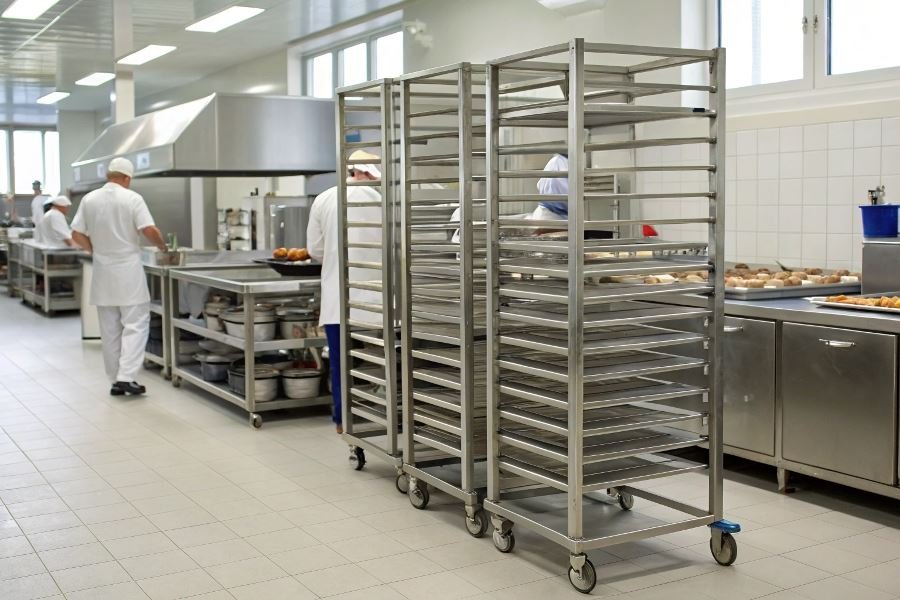
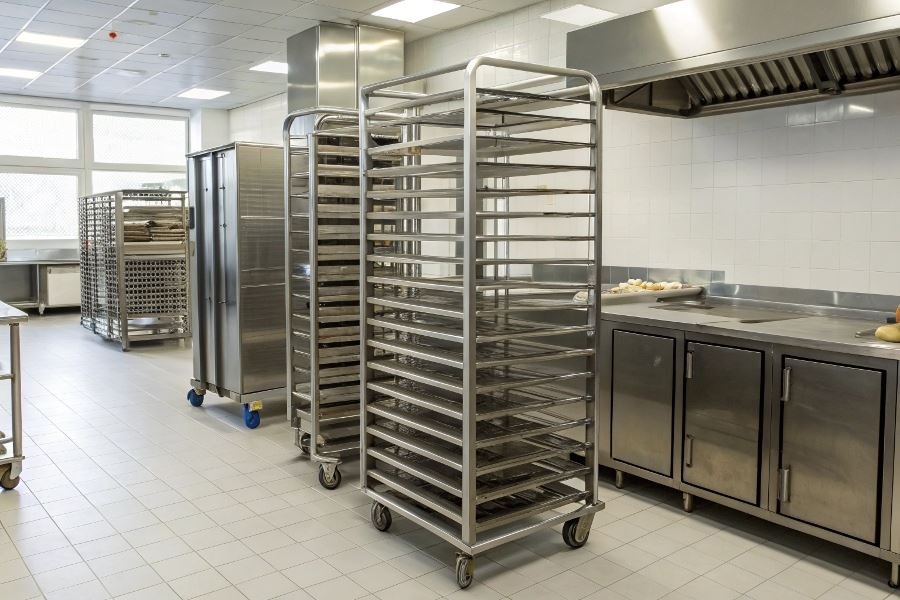
Mobile racks equipped with high-quality casters transform rigid storage systems into dynamic workstations. Prep cooks can wheel ingredients directly from refrigeration to their stations, eliminating unnecessary transfers and reducing contamination risks.
For operations with limited space, mobile racks provide the ultimate solution. During slow periods, these racks can be consolidated to open floor space, while peak times might see them strategically positioned throughout the kitchen to create efficient workflow stations.
The versatility of mobile systems extends beyond the kitchen. Catering operations rely heavily on these racks to transport prepared foods safely from commissary kitchens to event venues, maintaining food quality and temperature throughout the journey.
Specialized Racks That Transform Commercial Kitchens
Dunnage Racks: The Unsung Heroes of Floor Storage
Dunnage racks represent the foundation—quite literally—of smart kitchen organization. These low-profile workhorses elevate inventory 8-12 inches off the floor, creating an immediate defense against moisture, pests, and contaminants that can compromise food safety.
The efficiency impact is substantial: A standard 48″ x 24″ aluminum dunnage rack can support up to 2,000 pounds of goods while allowing air circulation that prevents spoilage. This translates to approximately 15-20% reduction in product loss compared to direct floor storage.
The versatility of dunnage racks extends beyond simple elevation:
- Material options matter: Aluminum racks offer lightweight corrosion resistance, while polypropylene models provide chemical resistance in wet environments.
- Configuration flexibility: Slotted tops facilitate drainage, while solid tops support smaller items that might fall through gaps.
One restaurant manager from Chicago reported: “After implementing a color-coded dunnage rack system, our inventory rotation improved by 30%, and we virtually eliminated instances of expired products.”
“The humble dunnage rack isn’t just storage—it’s your first line of defense in food safety compliance.”
For inventory management, these racks shine when incorporated into a FIFO (First-In-First-Out) system. By creating dedicated zones with clearly labeled racks, staff can instantly identify product categories and age, streamlining both restocking and usage.
Wall-Mounted Racks: Vertical Real Estate Maximizers
In commercial kitchens where every square foot represents potential profit, wall-mounted racks deliver exceptional ROI. These systems transform unused vertical space into functional storage, freeing up valuable counter and floor areas.
Space efficiency metrics are impressive: A 48″ wall-mounted pot rack can store 15-20 pots and pans that would otherwise consume approximately 12 square feet of cabinet space—effectively “creating” usable kitchen area.
Wall-mounted options have evolved significantly:
| Rack Type | Best Application | Weight Capacity | Installation Complexity |
|---|---|---|---|
| Grid Panel Systems | Utensils & small tools | 50-75 lbs | Low |
| Pot & Pan Rails | Heavy cookware | 100-200 lbs | Medium |
| Shelving Units | Dry goods & equipment | 150-300+ lbs | High |
The accessibility factor cannot be overstated. Wall-mounted systems place frequently used items within immediate reach, reducing motion waste and improving workflow efficiency. Studies show this can save kitchen staff up to 30 minutes per shift in retrieval time.
Maximizing Rack Lifespan Through Strategic Maintenance
Even the highest quality racks require proper maintenance to deliver maximum ROI. The harsh environment of commercial kitchens—with temperature fluctuations, moisture, and food debris—creates unique challenges for storage equipment.
Preventative maintenance delivers measurable benefits: Regular cleaning and inspection can extend rack lifespan by 40-50% compared to reactive maintenance approaches.
Key maintenance protocols include:
- Weekly inspection of all mounting hardware and weight-bearing components
- Monthly deep cleaning with appropriate solutions based on rack material
- Quarterly load assessment to ensure racks aren’t exceeding capacity limits
For stainless steel racks, avoiding chlorine-based cleaners prevents pitting and corrosion. Aluminum racks benefit from mild detergents rather than caustic cleaners that can degrade protective oxidation layers.
The investment in proper maintenance pays dividends: A $2,000 high-quality rack system can deliver 7-10 years of service with proper care versus 3-4 years with neglect—effectively cutting your equipment cost-per-year by more than half.
Discover essential commercial kitchen rack types including wire, solid, mobile, dunnage, and wall-mounted options. Learn proper applications, selection criteria, and maintenance tips to optimize your food service storage solutions.
Discover essential commercial kitchen rack types including wire, solid, mobile, dunnage, and wall-mounted options. Learn proper applications, selection criteria, and maintenance tips to optimize your food service storage solutions.