Ever wondered what separates a world-class food facility from a mediocre one? The answer might be right under your ingredients.
Production tables form the critical foundation of any food processing operation, yet they remain one of the most overlooked components in facility design. These specialized work surfaces aren’t just furniture—they’re sophisticated tools engineered specifically for food handling, preparation, and packaging that directly impact both safety and efficiency.
What defines a true food-grade production table?
At their core, food industry tables must meet stringent NSF/ANSI standards established by the FDA. Unlike standard commercial furniture, these workstations feature non-porous, non-absorbent surfaces—typically 304 or 316 grade stainless steel—that prevent bacterial harborage and withstand rigorous sanitization protocols.
“The right production table isn’t a cost—it’s an investment in compliance, productivity, and brand protection.”
The evolution of these essential workstations tells a fascinating story. Early wooden tables used in the 1950s gave way to rudimentary metal surfaces, which have now transformed into sophisticated workstations with integrated technology, ergonomic design, and specialized features for specific food applications.
Regulatory landscape and material science
Today’s production tables must satisfy HACCP principles while offering cleanability that meets increasingly strict audit requirements. The materials science behind modern food-grade surfaces has advanced dramatically, with innovations in antimicrobial coatings and seamless construction techniques virtually eliminating the crevices where pathogens once thrived.
The Ultimate Guide to Food Production Tables
Stainless Steel: The Industry Workhorse
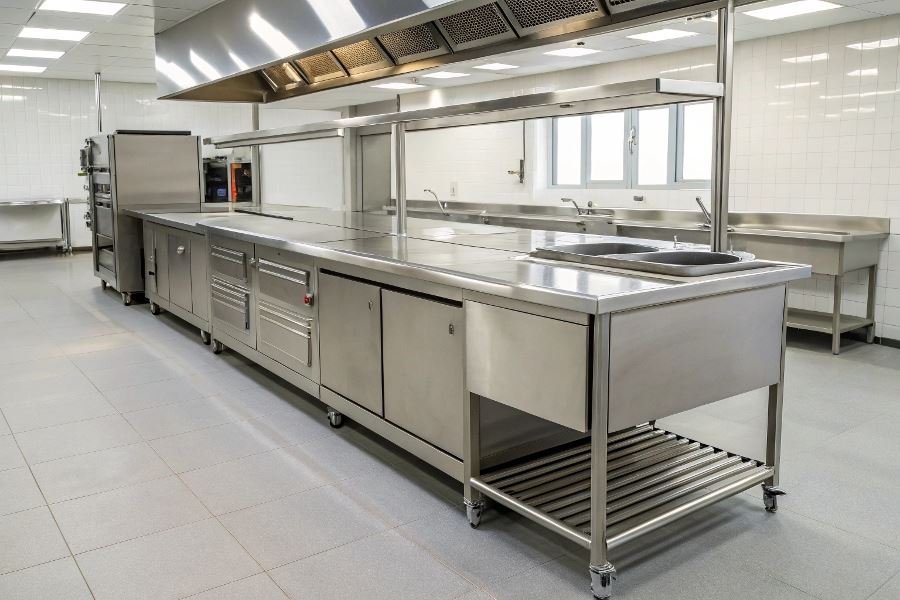
When it comes to food preparation environments, stainless steel tables reign supreme. These robust workstations combine durability with sanitation in a way that few other materials can match. The 304-grade stainless steel commonly used in premium models offers exceptional corrosion resistance while withstanding the daily assault of cleaning chemicals, food acids, and temperature fluctuations.
The various types of production tables for the food industry reflect the specialized needs of different processing environments. Stainless steel options typically feature seamless construction with coved corners that eliminate bacteria-harboring crevices. Many models incorporate adjustable undershelf storage, allowing facilities to maximize workspace efficiency without compromising on hygiene standards.
Key benefits of stainless steel tables include:
- Non-porous surface that prevents bacterial growth
- Temperature resistance from freezing to 800°F
- Chemical resistance to sanitizing agents
- Longevity often exceeding 30+ years with proper maintenance
- NSF certification for food safety compliance
Polyethylene and Composite Solutions
While stainless steel dominates many food production environments, polyethylene and composite material tables offer compelling advantages in specific applications. These lightweight alternatives deliver exceptional cutting surface performance while reducing knife wear—a significant consideration in high-volume processing facilities.
Polyethylene tables, particularly those using high-density polyethylene (HDPE), provide a softer work surface that’s gentle on knife edges while remaining impervious to moisture. Their non-conductive properties make them ideal for environments where temperature retention matters.
The color-coding potential of polyethylene tables adds another dimension to food safety protocols, allowing facilities to designate specific surfaces for different food types to prevent cross-contamination.
| Material | Weight | Knife-Friendly | Temperature Resistance | Chemical Resistance | Typical Lifespan |
|---|---|---|---|---|---|
| Stainless Steel | Heavy | No | Excellent (-40°F to 800°F) | Excellent | 30+ years |
| HDPE | Light | Yes | Good (up to 175°F) | Very Good | 10-15 years |
| Composite | Medium | Varies | Good (up to 350°F) | Good | 15-20 years |
Specialized Tables for Specific Food Sectors
Bakery Production Tables
Bakery operations demand specialized surfaces that can handle the unique requirements of dough preparation. Marble-topped tables provide the cool, non-stick surface essential for pastry work, while stainless steel tables with flour drawers offer practical functionality for bread production.
Bakery-specific features often include:
- Temperature-controlled surfaces for chocolate and pastry work
- Raised edges to contain flour and other ingredients
- Integrated scales for precise measurements
- Undershelf storage for baking sheets and tools
Meat Processing Workstations
Meat processing environments require heavy-duty construction capable of supporting substantial weight. These specialized tables frequently incorporate polyethylene cutting surfaces that can be removed for thorough sanitization or replacement when worn.
Advanced meat processing tables now feature integrated waste collection systems, reducing cross-contamination risk while improving workflow efficiency.
Seafood Preparation Stations
The corrosive nature of seafood processing demands exceptional material performance. Tables designed specifically for seafood preparation typically feature:
- Enhanced drainage systems with sloped surfaces
- Higher-grade 316 stainless steel for superior corrosion resistance
- Integrated ice beds for temperature control
- Specialized cutting surfaces with antimicrobial properties
The right production table isn’t merely a surface—it’s a critical tool that impacts productivity, food safety, and worker comfort. By selecting tables engineered specifically for your food production requirements, you’re investing in operational excellence that pays dividends through improved efficiency and product quality.
Selecting the Right Production Tables for Your Food Operation
When outfitting a food production facility, tables aren’t just furniture—they’re the foundation of your operation’s efficiency, safety, and compliance. The right production table can streamline workflows, while the wrong choice can create bottlenecks and sanitation nightmares.
Material matters more than you think
In food production environments, material selection isn’t just about durability—it’s about food safety. Stainless steel reigns supreme in this arena, particularly 304-grade stainless for most applications and 316-grade for environments with heavy exposure to salt or acidic ingredients.
The difference between 304 and 316 stainless isn’t just technical jargon—it can mean the difference between a table that lasts 5 years versus 15 years in challenging environments.
Alternative materials include:
| Material | Best For | Limitations |
|---|---|---|
| HDPE (High-Density Polyethylene) | Cutting surfaces, seafood processing | Less durable than steel, can develop grooves |
| Galvanized Steel | Dry storage areas | Not suitable for direct food contact |
| Aluminum | Mobile applications where weight matters | Less durable, can react with certain foods |
Dimensions that drive productivity
Size selection should be driven by your specific production processes. A table that’s too small creates bottlenecks; too large wastes valuable floor space. Standard depths range from 24″ to 36″, with lengths typically available from 48″ to 96″.
Height considerations are frequently overlooked but critically important for worker ergonomics:
- Standard working height: 34″-36″ for general food prep
- Lower heights (30″-32″) for tasks requiring downward force
- Higher positions (38″-40″) for detailed inspection work
Many manufacturers now offer adjustable-height tables that can accommodate different workers and tasks throughout the day.
Load capacity calculations
Underestimating load requirements is a common and costly mistake. Modern stainless tables typically offer capacities between 300-1000 pounds, but specialty reinforced models can support significantly more.
Consider not just the weight of products, but also:
- Equipment that might be placed on the table
- Dynamic loads from processing activities
- Potential future needs as production scales
Customization that transforms workflows
The days of one-size-fits-all tables are long gone. Today’s food production tables offer modular components that can transform basic surfaces into specialized workstations:
- Backsplashes and side splashes for containing liquids
- Integrated sinks for washing components
- Undershelf storage for tools and supplies
- Casters for mobility between production areas
- Cutouts for waste management
Modular solutions allow for reconfiguration as production needs evolve, potentially saving thousands in equipment costs over time.
Maintenance requirements that protect your investment
Even the highest quality tables require proper maintenance. Establish cleaning protocols specific to your table materials—stainless steel requires different care than HDPE surfaces.
Look for design features that simplify maintenance:
- Seamless construction that eliminates bacterial hiding spots
- Rounded corners that prevent food particle accumulation
- Removable components for thorough cleaning
The longevity of your tables depends largely on preventative maintenance. Tables with proper care can remain in service for 15+ years, making them one of the best long-term investments in your production facility.
Discover the essential types of food industry production tables, from stainless steel to specialized bakery and meat processing surfaces. Learn key selection criteria for durability, compliance, and efficiency in commercial food preparation environments.
Discover the essential types of food industry production tables, from stainless steel to specialized bakery and meat processing surfaces. Learn key selection criteria for durability, compliance, and efficiency in commercial food preparation environments.