Ever walked through a bustling factory floor and noticed those sturdy workstations where everything seems perfectly within reach? That’s no accident—it’s intelligent design at work.
Production tables with shelves represent the unsung heroes of manufacturing environments, serving as command centers where precision work happens day in and day out. At their core, these specialized workstations combine a flat, durable work surface with integrated storage shelving, creating a self-contained productivity zone that keeps tools, components, and materials organized and accessible.
Unlike standard tables, production workstations are built to withstand industrial demands—featuring heavy-gauge steel frames, chemical-resistant surfaces, and weight capacities often exceeding 1,000 pounds. The integrated shelving systems transform what could be merely a flat surface into a three-dimensional workspace that maximizes vertical space while minimizing worker movement.
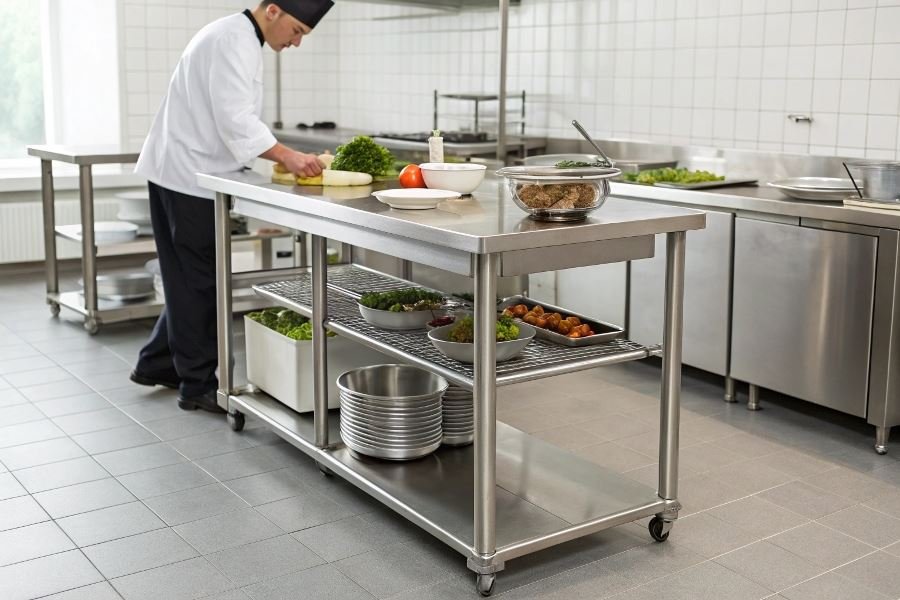
These workhorses shine in environments ranging from electronics assembly, where technicians need immediate access to tiny components, to food processing facilities where stainless steel variants offer both functionality and compliance with stringent sanitation requirements. Automotive manufacturing, pharmaceutical production, and fulfillment centers have all embraced these versatile stations as essential infrastructure.
The evolution of these tables mirrors manufacturing’s broader transformation. What began as simple metal benches in early 20th century factories has evolved into modular, ergonomically designed systems. Today’s production tables feature adjustable heights, integrated lighting, power distribution, and even data connectivity—reflecting how manufacturing has progressed from purely mechanical processes to sophisticated, technology-driven operations.
When Production Tables With Shelves Become Essential
In manufacturing environments, the right workstation can dramatically impact productivity, organization, and worker satisfaction. Production tables with shelves represent a specialized solution that addresses multiple workplace challenges simultaneously. Understanding when these ergonomic workstations become necessary rather than optional can transform cluttered, inefficient spaces into streamlined production powerhouses.
Assembly line managers frequently discover that production tables with shelves: when they are necessary becomes apparent as component counts increase and workspace organization deteriorates. These purpose-built stations create vertical storage opportunities while maintaining horizontal work surfaces—essentially doubling usable space without expanding footprint.
Assembly Line Component Organization
Assembly operations thrive on organization. When workers must assemble products from multiple components, shelving becomes critical infrastructure.
Real-world application: Electronics manufacturers utilizing Treston workstations report up to 37% reduction in assembly time when components are arranged on accessible shelves rather than stored in bins beneath tables.
The ideal assembly station configuration includes:
- Upper shelves for rarely-used components
- Mid-level shelves for frequently-accessed parts
- Integrated lighting beneath shelves
- Adjustable shelf heights to accommodate varying component sizes
Component accessibility directly correlates with assembly speed. When operators must search for parts or stretch to reach frequently-used items, micro-delays accumulate into significant productivity losses.
Quality Control Testing Efficiency
Quality control stations present unique challenges that shelved workstations elegantly solve.
Testing equipment requires:
- Protection from damage
- Accessibility during inspection processes
- Secure storage when not in use
- Cable management solutions
QC stations equipped with proper shelving systems from manufacturers like Lista provide dedicated spaces for testing equipment, reference materials, and documentation. The vertical organization ensures testers maintain clear work surfaces while keeping necessary tools within reach.
| Testing Station Type | Recommended Shelf Configuration |
|---|---|
| Electronics QC | ESD-safe shelves with power strips |
| Mechanical Parts | Heavy-duty shelves with bin rails |
| Food Processing | Stainless steel with washdown capability |
| Medical Devices | Cleanroom-compatible with documentation holders |
Maximizing Limited Floor Space
Perhaps nowhere are shelved production tables more valuable than in facilities with premium floor space.
Urban manufacturing facilities, particularly in cities like Boston, New York, and San Francisco, face space constraints that make traditional workstation expansion impossible. Vertical integration becomes the only viable solution.
Space optimization techniques include:
- Overhead tool suspension systems
- Retractable keyboard trays
- Monitor arms that swing away when not needed
- Under-shelf lighting to eliminate separate light fixtures
- Pegboard backing for frequently-used tools
Manufacturers like IAC Industries specialize in high-density workstations that maximize vertical space utilization while maintaining ergonomic working heights. Their systems can increase storage capacity by up to 65% compared to standard flat workbenches.
When production areas must accommodate multiple processes in limited square footage, shelved workstations transform from convenient options to operational necessities. The vertical integration of storage, tools, and work surfaces creates self-contained production cells that minimize worker movement while maximizing output.
Maximizing Efficiency with Production Tables with Shelves
The ROI of Quality Workstations
Investing in high-quality production tables with shelves delivers returns that extend far beyond the initial purchase. Premium workstations constructed from industrial-grade materials like 304 stainless steel or reinforced aluminum typically last 15-20 years with proper maintenance, compared to budget alternatives that often require replacement within 3-5 years. The mathematics is compelling: a $2,500 premium table amortized over 15 years costs just $166 annually—a fraction of what businesses spend replacing inferior equipment.
Beyond longevity, quality production tables drive measurable productivity improvements. Studies from manufacturing environments show workstations with optimized shelf configurations reduce motion waste by up to 22%, translating to approximately 53 minutes saved per 8-hour shift. For artisanal businesses, this efficiency compounds dramatically over time.
The true value proposition extends to workplace safety. Production tables engineered with ergonomic shelf placements reduce repetitive strain injuries and back complaints—issues that cost American businesses over $45 billion annually in workers’ compensation claims.
Selecting Your Perfect Production Solution
The selection process for production tables should begin with a thorough workflow analysis. Document the specific movements, tools, and materials your processes require before considering any purchase.
Height considerations remain paramount. The optimal working surface should position at elbow height for standing operations (typically 38-43 inches) or adjusted appropriately for seated tasks. Tables offering height adjustability of ±4 inches accommodate different operators and tasks without compromise.
When evaluating shelf configurations, consider these critical factors:
| Shelf Attribute | Optimal Specification | Application Benefit |
|---|---|---|
| Weight Capacity | 150-300 lbs per shelf | Supports heavy equipment and materials |
| Shelf Depth | 12-24 inches | Balances accessibility with storage capacity |
| Clearance | Minimum 14 inches between | Accommodates taller items and equipment |
| Adjustability | 1-inch increments | Allows precise configuration for specific needs |
Material selection should align with your specific industry requirements. While Uline offers excellent stainless steel options for food production, manufacturing environments might benefit from the durability of powder-coated steel tables from Global Industrial.
The Evolution of Production Workspaces
The production table landscape is undergoing significant transformation. Modular design philosophies now dominate the market, with manufacturers creating ecosystem-based approaches rather than standalone products. These systems allow businesses to expand capabilities incrementally as needs evolve.
Smart integration represents the most compelling development in workstation design. Production tables now incorporate power management systems, data ports, and IoT connectivity. Advanced models from Treston feature embedded sensors that track usage patterns and suggest layout optimizations based on actual workflow data.
Sustainability has become a non-negotiable aspect of production equipment. Manufacturers are responding with tables constructed from recycled materials and designed for eventual disassembly and material recovery. This circular approach reduces environmental impact while often improving durability through the use of advanced composite materials.
The most forward-thinking production tables now incorporate lighting systems calibrated to support circadian rhythms, contributing to worker alertness and precision throughout shifts. This human-centered design philosophy represents the convergence of productivity science and equipment engineering—a trend that will define workstation development for years to come.
Discover when production tables with shelves become essential workspace solutions for manufacturing efficiency. Learn key scenarios, benefits, and selection tips for optimizing your industrial workstation setup with proper component storage and space utilization.
Discover when production tables with shelves become essential workspace solutions for manufacturing efficiency. Learn key scenarios, benefits, and selection tips for optimizing your industrial workstation setup with proper component storage and space utilization.