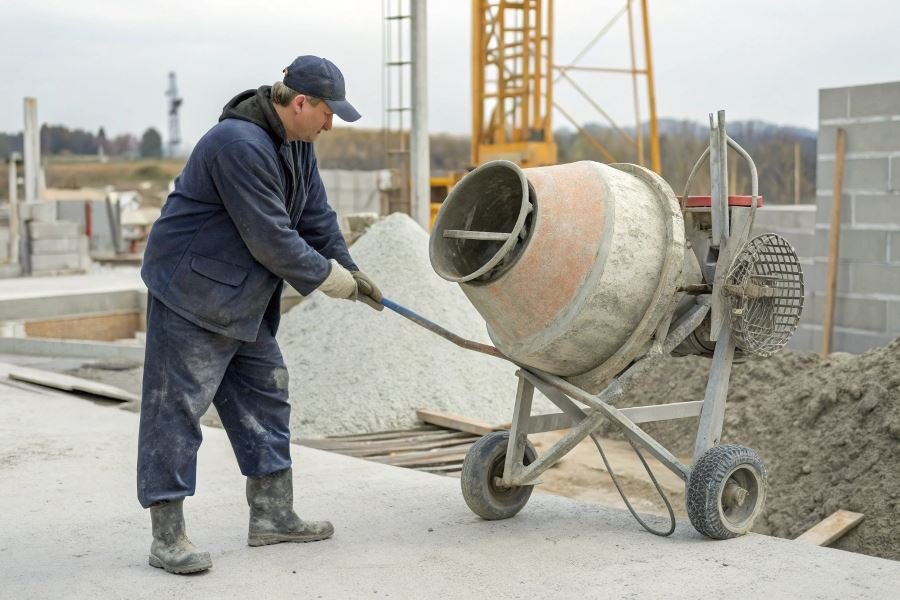
Ever watched a construction project grind to a halt because of equipment failure? The culprit is often hiding in plain sight: an inadequate concrete mixer.
When it comes to construction excellence, the concrete mixer you select isn’t just another equipment decision—it’s the heartbeat of your entire operation. The criteria for choosing a professional concrete mixer for a construction company extend far beyond price tags and brand names. They touch every aspect of your project’s success, from timeline adherence to structural integrity.
Quality concrete production isn’t accidental—it’s engineered through proper equipment selection. Construction companies that invest time in mixer selection typically report up to 30% improvements in operational efficiency and significant reductions in material waste.
“The mixer you choose today determines the structures you’ll build tomorrow—and how long they’ll stand.”
Efficiency ripple effects
Your mixer choice creates a domino effect throughout your entire operation. A properly sized mixer prevents bottlenecks, while appropriate mixing action ensures consistent batches that meet strength specifications. This consistency translates directly to fewer rejected pours and reduced rework—saving both time and materials.
Quality foundations
The relationship between mixer selection and concrete quality cannot be overstated. Proper mixing action ensures complete cement hydration and aggregate distribution, directly affecting:
- Compressive strength development
- Workability at the pour site
- Long-term durability of finished structures
As we explore the key decision factors in the selection process, remember that the right mixer isn’t just equipment—it’s your competitive advantage in concrete.
Technical Essentials for Professional Concrete Mixers
When investing in professional concrete mixing equipment, the technical specifications become the foundation of your decision-making process. Construction professionals understand that the right mixer doesn’t just blend materials—it becomes the heartbeat of efficient project execution, directly impacting timelines and quality outcomes.
Selecting appropriate concrete mixers requires careful evaluation of technical criteria that align with your specific construction needs. The criteria for choosing a professional concrete mixer for a construction company should prioritize operational efficiency, durability, and performance reliability across various job conditions. Let’s examine the critical technical factors that separate adequate mixers from exceptional ones.
Capacity and Output: Matching Your Project Scale
The mixer’s capacity represents perhaps the most fundamental consideration in your selection process. Professional mixers typically range from 1 to 12 cubic yards, with each size category serving distinct project requirements:
| Mixer Size | Ideal Project Type | Approximate Output |
|---|---|---|
| 1-3 cubic yards | Residential foundations, small commercial work | 15-45 cubic yards per hour |
| 4-7 cubic yards | Mid-size commercial projects, medium infrastructure | 60-105 cubic yards per hour |
| 8-12 cubic yards | Large infrastructure, industrial facilities | 120-180 cubic yards per hour |
Undersizing your mixer creates bottlenecks and extends project timelines, while oversizing wastes capital and reduces operational efficiency. The key is matching capacity to your typical project scale while allowing headroom for occasional larger jobs.
Power Source Options: Making the Right Energy Choice
The power source you select dramatically impacts operational flexibility, running costs, and environmental considerations:
Electric mixers offer lower operational costs and zero on-site emissions, making them ideal for indoor work or environmentally sensitive areas. Modern Liebherr electric models deliver impressive torque while maintaining quieter operation—a significant advantage in noise-restricted zones.
Diesel-powered options from manufacturers like Caterpillar provide unmatched mobility and performance in remote locations without reliable power infrastructure. Their higher initial cost is often offset by superior durability and independence from external power sources.
Gasoline alternatives typically serve as middle-ground solutions, offering reasonable portability without the higher acquisition costs of diesel equipment. However, they generally deliver less torque and higher fuel consumption than their diesel counterparts.
Drum Design and Mixing Efficiency
The drum’s engineering fundamentally determines mixing quality and material handling:
-
Blade configuration affects mixing thoroughness and discharge speed. SCHWING Stetter mixers feature spiral blade designs that provide exceptional material movement while minimizing dead zones.
-
Drum material thickness directly correlates with service life. Premium mixers use 3/16″ to 1/4″ steel plate with reinforced wear zones at high-impact points.
-
Drum rotation speed must balance thorough mixing with energy efficiency. The optimal range typically falls between 12-15 RPM for most professional applications.
-
Discharge mechanisms vary from simple gravity systems to hydraulically assisted options that provide greater control over concrete placement.
The most efficient drums incorporate variable pitch blades that thoroughly mix materials during rotation in one direction while efficiently discharging when reversed. This design principle, pioneered by McNeilus, has become an industry standard for high-performance mixers.
By carefully evaluating these technical criteria against your specific operational requirements, you’ll identify the concrete mixer that delivers optimal performance for your construction company’s unique project portfolio.
Making the Smart Investment: Long-term Value in Mixer Selection
When selecting a professional concrete mixer, looking beyond the sticker price reveals the true value proposition. Smart construction company owners understand that initial purchase cost represents just one piece of a complex financial puzzle that unfolds over years of operation.
Purchase price vs lifetime operational costs
The total cost of ownership (TCO) framework transforms how we evaluate equipment investments. A mixer priced at $15,000 might actually cost less over five years than one priced at $10,000 when all factors are considered.
Operational costs typically include:
- Fuel/electricity consumption (often 30-40% of lifetime costs)
- Regular maintenance expenses
- Operator labor efficiency
- Downtime costs
- Residual value at replacement
The most efficient mixers may command premium prices but can reduce operational costs by up to 25% annually.
Consider this comparison of two hypothetical mixer options:
| Cost Factor | Economy Model ($10,000) | Premium Model ($15,000) |
|---|---|---|
| Annual fuel | $3,200 | $2,100 |
| Maintenance | $1,800 | $900 |
| Downtime losses | $2,500 | $800 |
| 5-year TCO | $47,500 | $35,000 |
Built to last: durability and maintenance realities
Durability directly impacts your bottom line. Construction environments punish equipment mercilessly, making structural integrity and component quality non-negotiable considerations.
Key durability indicators include:
- Drum material thickness and reinforcement
- Drive system engineering (planetary vs. chain drive)
- Frame construction (welded vs. bolted)
- Bearing and seal quality
Maintenance accessibility dramatically affects long-term costs. Models from Liebherr and SANY feature swing-out engines and hydraulic systems that reduce service time by up to 60% compared to conventional designs.
Wisdom nugget: The availability of parts five years from now matters more than saving 5% today. Always investigate the manufacturer’s parts distribution network before purchase.
Regional parts availability creates significant hidden value. A mixer that requires imported components with two-week lead times can create catastrophic project delays compared to models with same-day parts availability.
Reputation and warranty: the safety nets
Manufacturer reputation serves as a powerful predictor of equipment performance. Companies like Schwing and McNeilus have multi-decade track records that provide confidence in their engineering standards and business longevity.
Warranty considerations should include:
- Coverage duration for major components
- Powertrain-specific protection
- Transferability to subsequent owners
- Dealer vs. manufacturer support responsibilities
The fine print matters enormously. Some warranties exclude wear items like drums and paddles, while others provide comprehensive coverage including labor costs for repairs.
Manufacturers confident in their product quality typically offer more generous warranty terms without requiring expensive extended coverage packages.
Construction companies that methodically evaluate these long-term value factors consistently report higher equipment satisfaction and lower lifetime operating costs. The professional concrete mixer that truly delivers value isn’t necessarily the cheapest—it’s the one that continues performing reliably year after year while minimizing unexpected expenses and downtime.
Discover the 7 essential criteria for selecting professional concrete mixers that maximize efficiency and concrete quality. Learn how capacity, power options, and long-term value impact your construction company's bottom line.
Discover the 7 essential criteria for selecting professional concrete mixers that maximize efficiency and concrete quality. Learn how capacity, power options, and long-term value impact your construction company's bottom line.