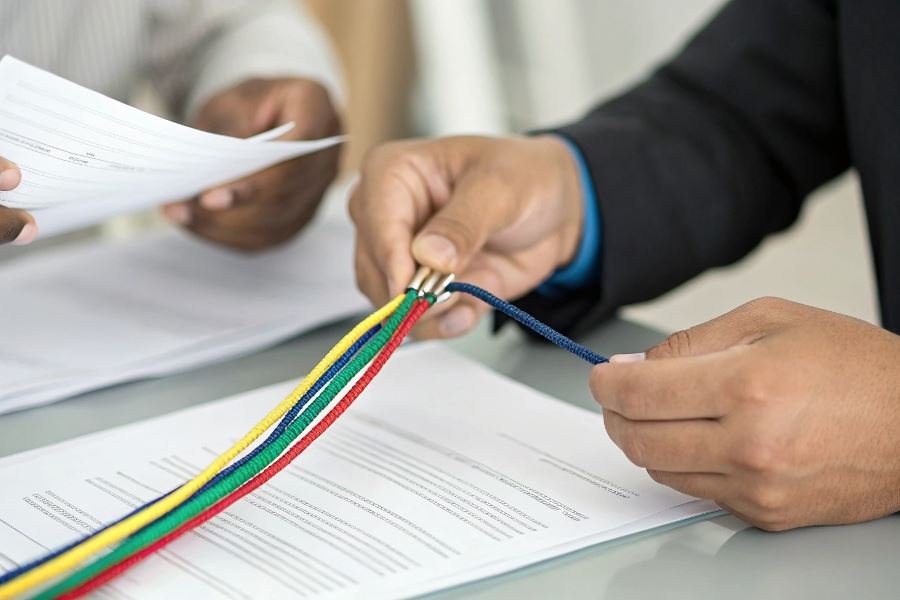
Ever wondered what stands between your financial data and potential fraud? It’s not just digital encryption or vault doors—it’s often a simple thread woven through paper documents that forms the first line of defense in banking security.
Sealing threads are specialized security elements embedded within critical banking documents to prevent tampering, unauthorized alterations, and counterfeiting. These seemingly modest components play a crucial role in maintaining document integrity across the financial sector. The Federal Reserve and Office of the Comptroller of the Currency established comprehensive standards for these security features following the Banking Secrecy Act of 1970, with significant updates implemented after the financial crisis of 2008.
“Document security isn’t just about compliance—it’s about maintaining the foundation of trust that our entire financial system depends on.” — American Bankers Association Security Report
For banks and credit unions, compliance with sealing thread regulations isn’t optional—it’s essential. Financial institutions face potential penalties up to $25,000 per violation when failing to implement proper document security measures. Beyond avoiding fines, proper implementation protects against fraud that costs the industry billions annually.
The regulatory landscape continues evolving, with new specifications addressing both physical and hybrid documentation systems. As financial institutions balance traditional documentation with digital transformation, these unassuming threads remain critical guardians of banking integrity and customer trust.
The Regulatory Backbone of Banking Security
Federal Standards That Define Excellence
The banking industry operates under stringent regulatory requirements for sealing threads for bank documentation that ensure the integrity of financial records. The Federal Reserve, alongside the Office of the Comptroller of the Currency (OCC), has established comprehensive standards that leave nothing to chance. These regulations specify that sealing threads must withstand environmental stressors for a minimum of seven years—the standard retention period for most banking documents.
Material specifications are particularly exacting. Banking institutions must implement threads composed of synthetic fibers with tensile strength exceeding 15 pounds per linear inch. Cotton-polyester blends, once common in the industry, have largely been phased out since the Federal Financial Institutions Examination Council updated their guidance in 2018. The current standards favor aramid fibers similar to those used in bulletproof vests, offering superior resistance to tampering attempts.
Color requirements deserve special attention. Regulatory bodies mandate that threads must incorporate at least two distinct, non-commercially available pigments. This seemingly small detail creates a significant barrier against counterfeit attempts, as these specialized dyes are tightly controlled and nearly impossible to replicate without sophisticated equipment.
Authentication Features That Matter
The authentication landscape for sealing threads has evolved dramatically in recent years. Current regulations require multi-layered security features that go far beyond the visible spectrum.
Fluorescent markers have become standard practice, with threads required to display specific patterns under ultraviolet light. These patterns must be documented in secure institutional records and changed at predetermined intervals—typically every 18-24 months.
Tamper-evident properties represent perhaps the most critical aspect of thread security. The FDIC guidelines specifically require:
| Feature | Requirement | Verification Method |
|---|---|---|
| Break Pattern | Irregular fracture lines when tampered | Visual inspection |
| Color Change | Chemical reactivity to tampering attempts | UV light examination |
| Microprinting | Embedded text visible at 10x magnification | Specialized magnification |
| Traceable Elements | Rare earth elements in specific ratios | Spectroscopic analysis |
These features ensure that any attempt to remove and replace a security thread leaves unmistakable evidence, protecting the integrity of financial documentation from sophisticated fraud attempts.
Documentation Protocols That Protect Institutions
The implementation of security threads comes with substantial record-keeping obligations. Banking institutions must maintain detailed logs documenting the exact specifications of threads used, including lot numbers, installation dates, and verification testing results.
Chain of custody documentation has become increasingly important. Each thread batch must be traceable from manufacturer to implementation, with records of handling personnel maintained for a minimum of five years. These records must be available for regulatory inspection with 48 hours’ notice—a requirement that has prompted many institutions to implement specialized tracking software.
Perhaps most demanding are the quarterly verification requirements. Banking institutions must regularly test random samples of their sealed documents to ensure thread integrity remains uncompromised. These tests must follow procedures outlined in the American National Standards Institute (ANSI) guidelines for document security, with results documented and retained for regulatory review.
By adhering to these comprehensive requirements, financial institutions create a nearly impenetrable barrier against document fraud—protecting not just their operations, but the entire financial system’s integrity.
Mastering Compliance: Sealing Thread Implementation Strategies
Selecting the right thread system
Choosing the appropriate sealing thread system isn’t just about checking a regulatory box—it’s about implementing a security framework that protects your institution’s documentation integrity. The most successful banks don’t view compliance as a burden but as a competitive advantage.
When selecting compliant sealing thread systems, consider these critical factors:
-
Material durability – Premium threads manufactured by companies like Seal Security Solutions incorporate tamper-evident fibers that show clear evidence of manipulation attempts.
-
Color coding capabilities – Advanced systems offer proprietary color combinations that are nearly impossible to replicate, with some offering up to 16 distinct color patterns.
-
Integration with existing documentation – The thread system must work seamlessly with your current document formats without compromising structural integrity.
The difference between adequate and exceptional thread systems often comes down to microscopic details that become crucial during regulatory examinations.
Documentation maintenance that impresses auditors
Preparing for audits shouldn’t be a last-minute scramble. Forward-thinking financial institutions maintain comprehensive documentation systems that track every aspect of their sealing thread implementation.
A robust documentation maintenance procedure includes:
| Documentation Component | Update Frequency | Responsible Party |
|---|---|---|
| Thread Specification Records | Quarterly | Compliance Officer |
| Installation Verification Logs | Per Transaction | Operations Manager |
| Tampering Attempt Reports | As Needed | Security Team |
| Vendor Certification Documents | Annually | Procurement |
Pro tip: Create a centralized digital repository that maintains version control of all documentation while preserving physical samples of thread systems used throughout your organization’s history.
The evolving landscape of document security
The regulatory environment for document security isn’t static—it’s evolving at an unprecedented pace. Since the major financial regulation overhauls following the 2008 crisis, requirements for physical document security have become increasingly sophisticated.
“The most successful financial institutions don’t just comply with current regulations—they anticipate the next generation of security requirements.”
Emerging trends to monitor include:
-
Blockchain verification integration – Physical sealing threads with digital verification components that create immutable records of document authenticity.
-
Biometric thread components – Advanced systems from BioSeal Technologies are incorporating DNA-verification elements that provide unprecedented authentication capabilities.
-
Environmental sustainability requirements – Regulators are increasingly mandating that security features also meet environmental standards, with biodegradable options gaining traction.
The financial institutions that thrive will be those that view regulatory requirements not as obstacles but as opportunities to demonstrate their commitment to security excellence. By implementing robust selection criteria, maintaining meticulous documentation, and staying ahead of emerging trends, your organization can transform compliance from a checkbox exercise into a competitive advantage that builds client trust and institutional reputation.
Discover essential regulatory requirements for bank document sealing threads, including federal standards, authentication features, and compliance strategies. Your comprehensive guide to securing financial documentation and meeting industry regulations.
Discover essential regulatory requirements for bank document sealing threads, including federal standards, authentication features, and compliance strategies. Your comprehensive guide to securing financial documentation and meeting industry regulations.