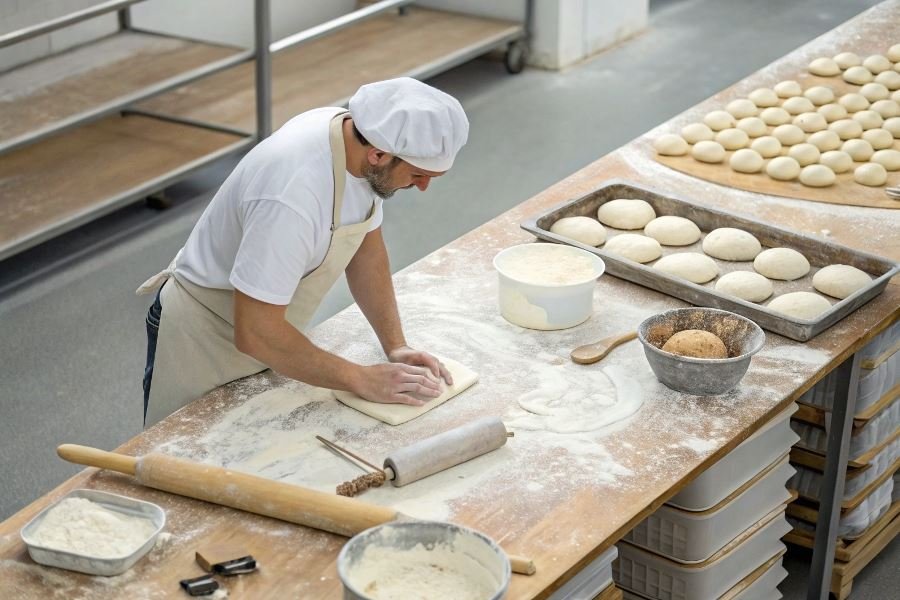
Ever watched a master baker transform raw ingredients into culinary masterpieces? Behind that seamless choreography lies an unsung hero: the production table. These workhorses aren’t just furniture—they’re the command centers where creativity meets precision.
At Breadsmith Artisanal Bakery in Portland, production tables helped increase output by 37% after a strategic reconfiguration. “It’s like we discovered extra hours in the day,” notes head baker James Morello. This isn’t unusual. The right table setup doesn’t just support your process—it revolutionizes it.
The foundation of efficiency
Production tables serve as the literal foundation for every step of the baking process. From kneading and shaping to decorating and packaging, these surfaces determine workflow efficiency, staff comfort, and ultimately, product quality. A poorly configured workspace can add hours to production time and compromise consistency.
Choosing your perfect match
When selecting production table configurations, three factors reign supreme:
- Space constraints – Your physical bakery footprint dictates possibilities
- Production volume – Higher output requires more specialized stations
- Product diversity – Varied offerings need adaptable workspaces
The evolution of bakery workspace design has moved from rigid, one-size-fits-all approaches to modular systems that adapt to changing needs. Modern bakeries increasingly favor stainless steel tables with adjustable heights, integrated storage, and specialized attachments that transform based on daily requirements.
“The best production table is one you never have to think about—it simply enables your craft.” — Culinary Institute of America
Strategic Table Layouts That Transform Bakery Production
The backbone of any successful bakery operation lies in its production workspace design. The most popular configurations of production tables for bakeries have evolved through decades of practical experience, with three layouts consistently proving their worth across operations of all sizes. Each configuration offers distinct advantages that can dramatically impact workflow efficiency, staff comfort, and ultimately, product quality.
L-shaped Configurations: Maximizing Corner Spaces
L-shaped table arrangements have become the go-to solution for bakeries with challenging spatial constraints. This configuration brilliantly transforms often-wasted corner areas into productive workstations.
Key advantages:
- Creates a natural workflow progression
- Reduces unnecessary movement between stations
- Allows one baker to oversee multiple processes simultaneously
The L-configuration typically positions the primary work surface along the longer segment, with specialized stations (like decorating or cooling) along the shorter segment. Modern Hobart and Baxter bakery tables designed specifically for L-configurations feature height-adjustable sections and integrated storage solutions.
“Our production speed increased by 22% after switching to an L-shaped configuration. The corner that once collected dust now houses our most profitable cake decorating station.” – Award-winning pastry chef
Island-style Central Arrangements: Collaboration Hubs
Island configurations place production tables in the center of the workspace, creating 360-degree access and fostering team collaboration. This arrangement has gained tremendous popularity in artisanal bakeries where multiple bakers work simultaneously on specialty products.
Implementation considerations:
- Requires minimum 4-foot clearance on all sides
- Benefits from overhead utility access (power, water)
- Works best with modular, movable components
| Island Configuration Type | Ideal Bakery Size | Staff Capacity | Best For |
|---|---|---|---|
| Single large island | 800-1200 sq ft | 3-5 bakers | Artisanal bread production |
| Dual islands with gap | 1200+ sq ft | 5-8 bakers | Mixed production |
| Modular islands | Variable | 2-10 bakers | Seasonal operations |
Island configurations excel in environments where cross-training and knowledge sharing are priorities. The Vollrath modular island systems have become particularly popular for their reconfigurable nature.
Linear Setups: Assembly-line Efficiency
Linear production table arrangements remain the efficiency champion for high-volume bakeries. This traditional configuration places tables in straight lines, creating clear production pathways that minimize confusion and maximize output.
Productivity benefits:
- Streamlines product flow from raw ingredients to finished goods
- Creates dedicated stations for specialized tasks
- Simplifies cleaning and maintenance procedures
Linear setups work exceptionally well for bakeries producing consistent product lines in significant volume. The straight-line workflow reduces errors and creates natural checkpoints for quality control. Metro stainless steel production tables with integrated conveyor systems represent the gold standard for linear bakery setups.
Each configuration offers distinct advantages, and many successful bakeries implement hybrid approaches that combine elements from multiple layouts. The key is aligning your production table configuration with your specific product mix, staff size, and available space.
Crafting Your Ideal Bakery Workspace
Matching Tables to Your Production Reality
The perfect production table isn’t universal—it’s the one that transforms your specific bakery operation. Artisan bread bakeries thrive with solid maple or stainless steel tables featuring integrated proofing drawers, while high-volume pastry operations demand modular configurations with refrigerated sections and multiple workstations.
The decision matrix comes down to three critical factors: production volume, product diversity, and available space. A small-batch specialty bakery producing 200 loaves daily needs fundamentally different setups than industrial operations handling 10,000+ units.
Space optimization becomes the invisible ingredient in your production recipe. Corner-configured L-shaped tables can increase workspace by up to 40% in tight quarters, while peninsula-style configurations create natural workflow divisions between preparation and finishing.
“The right production table doesn’t just support your work—it actively participates in your creation process.”
For multi-product bakeries, consider hybrid configurations featuring adjustable-height sections (28-36 inches) that accommodate both bread and pastry work. Hobart and Vollrath offer customizable systems where marble pastry sections can be integrated alongside standard stainless workspaces.
Tomorrow’s Bakery Workspaces
The evolution of production tables is accelerating beyond mere surfaces to become intelligent workstations. Smart integration is the defining trend, with tables incorporating:
- Digital scale systems with recipe memory
- Temperature-controlled surfaces for butter-based pastry work
- Embedded tablet mounts for digital recipe access
- Modular power systems for portable equipment
Materials science is revolutionizing traditional surfaces. New composite materials offer the temperature stability of marble with improved durability and significantly reduced weight. Antimicrobial copper-infused stainless steel surfaces are gaining traction for their ability to reduce bacterial contamination by up to 99.9%.
The sustainability factor can’t be overlooked. Reclaimed wood tables with food-safe finishes are becoming signature elements in artisan bakeries, while tables manufactured from recycled materials earn valuable certification points for businesses pursuing green credentials.
Implementation Without Disruption
Upgrading your production table configuration requires strategic planning to minimize operational impact. The transition process typically follows this pattern:
| Implementation Phase | Duration | Key Considerations |
|---|---|---|
| Assessment | 1-2 weeks | Workflow analysis, space measurement, budget planning |
| Design | 2-4 weeks | Configuration selection, material choices, customization |
| Installation | 1-3 days | Scheduling during off-hours, temporary workspace setup |
| Adaptation | 1-2 weeks | Staff training, workflow adjustments, efficiency monitoring |
Phased implementation offers the least disruptive path forward. Begin with core workstations while maintaining legacy tables, then gradually replace secondary stations as budget allows. This approach typically adds only 15-20% to total project costs while maintaining continuous production.
Consider the ergonomic impact of new configurations. Tables at proper working heights (typically 34-36 inches for most baking tasks) can reduce staff fatigue by up to 30% and increase productivity. Ergonomics Plus offers specialized assessment services for food production environments.
The financial calculation extends beyond the initial investment. Premium stainless configurations from manufacturers like John Boos may command 40-60% higher prices than basic models but offer 2-3 times longer operational lifespans and significantly improved resale value.
Your production table configuration isn’t just equipment—it’s the foundation upon which your bakery’s efficiency, product quality, and staff satisfaction are built.
Discover the most efficient bakery production table configurations that maximize workflow and space utilization. From L-shaped layouts to island-style arrangements, learn how to select the perfect setup for your bakery's specific production needs.
Discover the most efficient bakery production table configurations that maximize workflow and space utilization. From L-shaped layouts to island-style arrangements, learn how to select the perfect setup for your bakery's specific production needs.