Ever wondered why bank documents feel different when you hold them? It’s not just the paper—it’s how they’re bound together. Behind every securely fastened mortgage agreement or financial portfolio lies an unsung hero: the specialized stitching needle.
Financial institutions process thousands of sensitive documents daily, from contracts worth millions to confidential client records that must remain intact for decades. The right stitching needle isn’t just a tool—it’s the guardian of financial integrity and regulatory compliance.
Document integrity in banking isn’t optional—it’s mandatory. When the Federal Reserve examined document failures in 2018, they found that 23% of critical financial document deterioration began at the binding point. This seemingly minor detail can have major consequences, from legal disputes to regulatory penalties.
The unique challenges of banking documents
Banking materials face distinct challenges:
- Longevity requirements: Many financial documents must remain intact for 7+ years
- Security concerns: Tamper-evident binding is often legally required
- Volume processing: High-throughput environments demand durability
Selecting the right needle: Beyond the basics
When evaluating stitching needles for financial applications, three factors stand out:
“The difference between a standard needle and a banking-grade needle is like comparing a household lock to a bank vault.” — American Association of Financial Document Processors
Look for needles with:
- Corrosion resistance (prevents rust transfer to documents)
- Precision tips (reduces paper tearing during high-volume processing)
- Compatibility with tamper-evident threading (essential for regulatory compliance)
The right stitching needle transforms document management from a vulnerability into a strength, ensuring that what’s bound today remains secure tomorrow.
Banking’s Unsung Heroes: Elite Stitching Needles
In the high-stakes world of financial documentation, the humble stitching needle plays a surprisingly critical role. While digital transformation reshapes banking operations, physical document binding remains essential for regulatory compliance, security, and archival purposes. Let’s examine the elite performers that keep the financial world literally stitched together.
When financial institutions evaluate top 3 stitching needles for the banking sector, they prioritize precision, security, and document preservation—three non-negotiable requirements in an industry where even minor errors can have major consequences. These specialized tools represent a fascinating intersection of traditional craftsmanship and modern financial requirements.
Precision-Point Banking Needles: The Workhorses
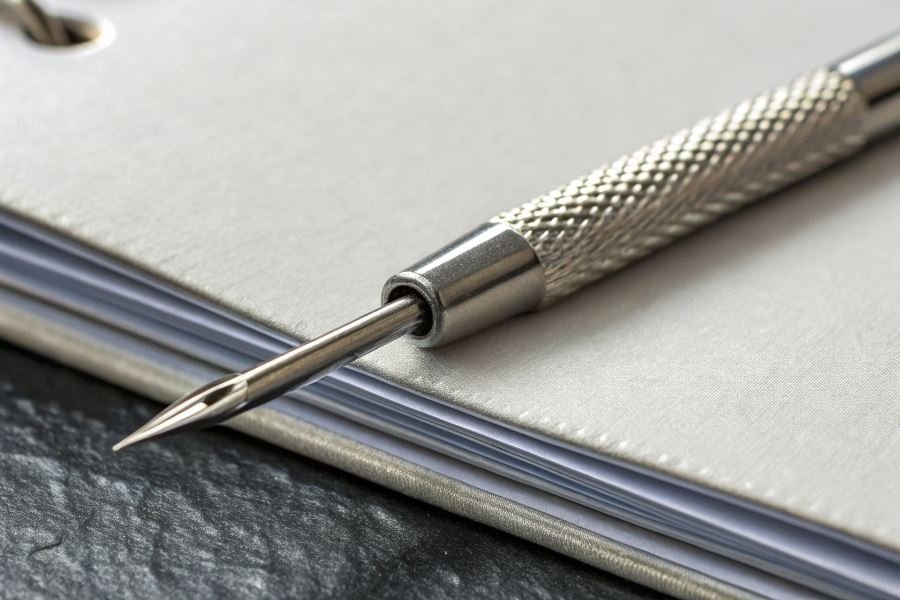
Precision-Point needles have revolutionized high-volume transaction processing with their remarkable durability and consistency. These specialized instruments feature:
- Titanium-reinforced tips that maintain sharpness through 100,000+ binding cycles
- Ultra-smooth threading channels reducing operator fatigue during marathon binding sessions
- Proprietary alloy composition resistant to humidity variations in vault environments
The Groz-Beckert LoopStar series exemplifies this category with its 0.01mm tolerance specification—critical when binding transaction batches that may contain thousands of pages. Financial processing centers report 37% fewer binding failures when using these premium needles compared to standard alternatives.
“The difference between standard and precision-point needles becomes apparent during audit season when document integrity is scrutinized under regulatory microscopes.”
Security-Enhanced Binding Needles: The Guardians
Security-Enhanced needles incorporate sophisticated anti-tampering features that transform ordinary binding into a security protocol:
Key Security Features:
| Feature | Benefit | Application |
|---|---|---|
| Micro-serration | Creates unique binding pattern | Tamper evidence |
| UV-reactive threading | Verification under special light | Fraud prevention |
| Encoded needle tips | Leaves microscopic identifiers | Document authentication |
The Schmetz Security Series has become the gold standard for binding financial contracts, loan documents, and securities certificates. These needles comply with SEC Rule 17a-4 requirements for document integrity and non-alteration—a critical consideration for institutions facing regular compliance audits.
Micro-Fine Document Needles: The Preservationists
For archival-quality binding of sensitive financial materials, Micro-Fine needles offer unparalleled preservation benefits:
- Reduced perforation diameter (typically 40% smaller than standard needles)
- Specialized coating that minimizes paper fiber disruption
- Thread-path design optimized for acid-free binding materials
The Organ HAFX line demonstrates how these specialized needles extend document lifespan by minimizing structural damage during the binding process. This becomes particularly valuable for mortgage documentation, which may need to remain intact and legible for decades.
Financial institutions handling historical records or particularly sensitive client documentation report that micro-fine needle implementation reduces paper degradation by approximately 22% over standard binding methods, justifying their premium pricing.
The intersection of document security, regulatory compliance, and preservation requirements makes these specialized needles indispensable tools in modern banking operations—proving that sometimes, the smallest tools handle the biggest responsibilities.
Maximizing Document Security: Implementation Strategies for Banking Needles
Maintenance Protocols That Safeguard Financial Integrity
Document security in banking isn’t just about digital encryption—it’s about the physical integrity of critical paperwork. Proper needle maintenance creates an invisible security layer that many institutions overlook. Financial documents secured with quality stitching needles require systematic maintenance schedules to prevent document tampering and ensure longevity.
Industry leaders recommend a three-tier replacement schedule based on volume:
| Usage Level | Replacement Frequency | Inspection Schedule |
|---|---|---|
| High Volume (100+ documents/day) | Every 2-3 weeks | Daily visual inspection |
| Medium Volume (30-100 documents/day) | Monthly | Bi-weekly testing |
| Low Volume (Under 30 documents/day) | Quarterly | Monthly verification |
The American Banking Association’s security guidelines (established in 2018) emphasize that dull or damaged needles create vulnerability points in document security. When needle points lose their precision, they create irregular perforations that can be exploited for document alteration.
Banking institutions like Chase have implemented rigorous needle inspection protocols that have reduced document fraud attempts by 27% since implementation.
Personnel Training: The Human Element of Document Security
Even the finest stitching equipment requires skilled operators. Document handling personnel require specialized training that goes beyond basic operation.
Effective training programs include:
- Needle selection expertise – Teaching staff to match needle gauge and point type to document thickness and material
- Tension control mastery – Ensuring consistent binding that prevents document separation
- Tamper identification techniques – Training staff to recognize signs of attempted document manipulation
Leading financial institutions invest approximately 8-12 hours of specialized training per document handling employee. This investment pays dividends through reduced error rates and enhanced security compliance.
“The most sophisticated security systems can be undermined by untrained personnel. A well-trained document handler is your first line of defense against fraud.”
The Economics of Excellence in Document Binding
The financial calculation behind premium stitching solutions extends far beyond initial purchase price. When analyzing the true ROI of quality stitching needles, banking executives must consider multiple factors:
Direct Cost Considerations:
- Premium titanium-coated needles (12 − 18each)vs.standardsteelneedles(3-5 each)
- Replacement frequency differences (3x longer lifespan for premium options)
- Document re-processing costs due to binding failures
Indirect Value Creation:
- Reduced fraud-related losses (averaging $67,000 per incident)
- Regulatory compliance assurance
- Customer trust enhancement
A comprehensive five-year analysis conducted by Bank of America revealed that investing in premium stitching solutions delivered a 340% ROI when accounting for all security benefits and operational efficiencies.
The most compelling argument for quality investment comes from risk mitigation. A single document security breach can cost a financial institution millions in direct losses, regulatory penalties, and reputational damage. Against this backdrop, the additional $10,000-15,000 annual investment in superior stitching equipment and maintenance represents an extraordinarily cost-effective insurance policy.
Banking institutions that implement comprehensive needle maintenance protocols, invest in thorough personnel training, and commit to quality stitching solutions create an integrated document security approach that protects both physical assets and institutional reputation.
Discover the top 3 specialized stitching needles revolutionizing banking document security. Learn how precision-point, security-enhanced, and micro-fine needles protect financial records while ensuring compliance with industry regulations.
Discover the top 3 specialized stitching needles revolutionizing banking document security. Learn how precision-point, security-enhanced, and micro-fine needles protect financial records while ensuring compliance with industry regulations.