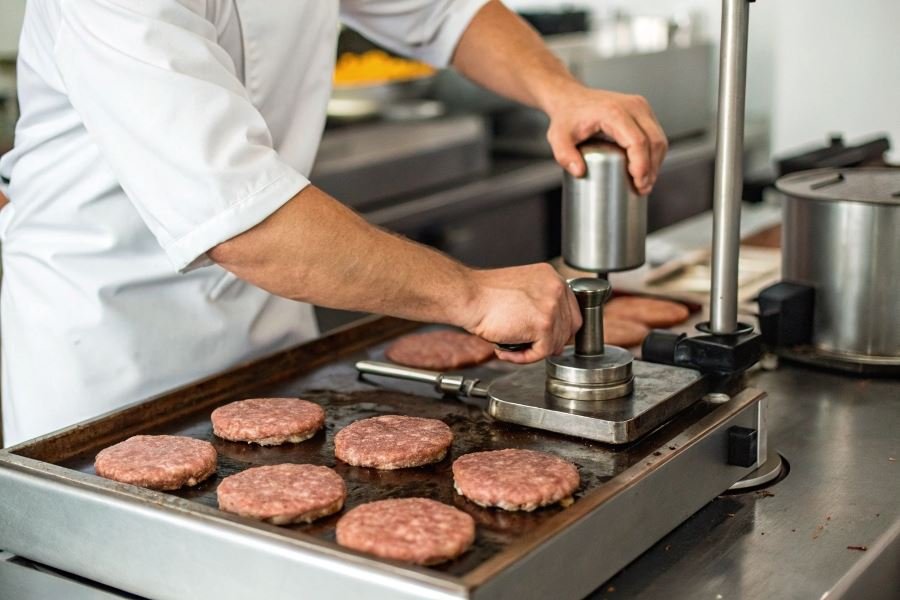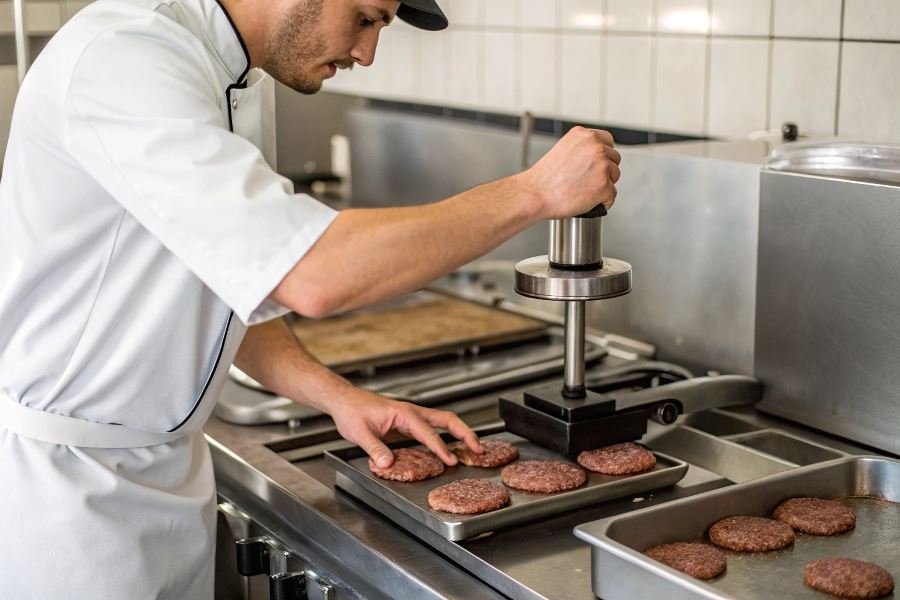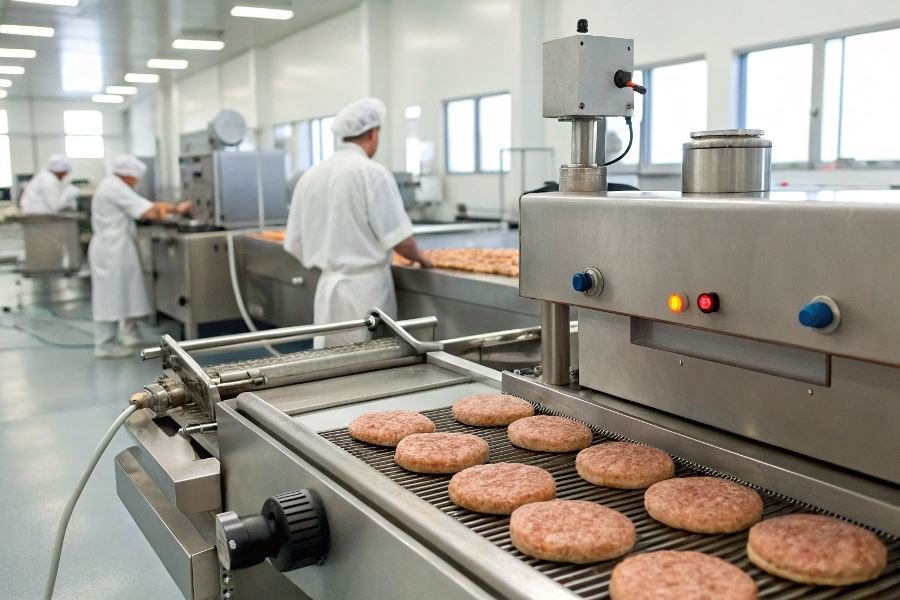
Ever watched a lunch rush at a busy burger joint? Those perfectly formed, identical patties hitting the grill in rapid succession aren’t happening by accident. Behind every successful fast food operation lies a critical piece of equipment that rarely gets the spotlight: the hamburger patty maker.
The humble patty maker stands as the unsung hero in the fast food ecosystem. When McDonald’s revolutionized the industry with their Speedee Service System in 1948, consistent patty production became the foundation of their success. Today, that principle remains unchanged—your patty maker directly influences your restaurant’s throughput, food quality, and ultimately, your bottom line.
The numbers tell the story: A quality patty maker can produce up to 2,000 perfectly uniform burgers per hour, while manual forming might yield just 200 with significant variations. This 10x productivity difference translates directly to serving capacity and revenue potential.
Beyond speed, your choice of patty maker affects three critical business factors:
- Food consistency – Uniform thickness ensures even cooking and consistent customer experience
- Operational efficiency – Reduced labor costs and increased production capacity
- Product quality – Proper density control prevents tough, overworked meat
When selecting the right patty maker, you’ll need to evaluate production volume requirements, available kitchen space, meat handling preferences, and maintenance considerations. The perfect machine balances these factors against your specific operational needs.
“The patty maker you choose today will shape thousands of customer experiences tomorrow.”
Essential Factors for Selecting the Perfect Hamburger Patty Maker
When efficiency meets quality in your fast food operation, the right patty maker becomes your kitchen’s MVP. Let’s dive into what separates exceptional hamburger patty makers from mediocre ones—because in the high-volume world of fast food, these details translate directly to your bottom line.
Production Capacity That Matches Your Rush Hours
The cornerstone of selecting a hamburger patty maker for a fast food restaurant lies in understanding your peak-hour demands. A neighborhood burger joint serving 200 patties daily needs vastly different equipment than a highway-adjacent location pumping out 1,000+ burgers.
Production metrics to consider:
- Hourly output capacity (typically 500-2,000 patties per hour)
- Cycle time between patties (3-8 seconds for high-volume operations)
- Continuous run capability (how long before cooling is required)
The Hollymatic Super Patty Machine delivers up to 2,000 uniform patties hourly—perfect for high-volume operations—while smaller establishments might find the 800 patty-per-hour ProProcessor P180 more appropriate and budget-friendly.
Customization Flexibility That Defines Your Brand
Your patty’s dimensions aren’t just specifications—they’re your signature.
The ability to adjust thickness from 1/4″ to 1″ can be the difference between a forgettable burger and a memorable dining experience.
Modern patty makers offer:
| Feature | Entry-Level | Mid-Range | Premium |
|---|---|---|---|
| Size variations | 1-2 fixed molds | 3-5 interchangeable | Fully adjustable |
| Shape options | Round only | Round, square | Custom shapes available |
| Weight precision | ±10% variance | ±5% variance | ±2% variance |
| Texture control | None | Basic | Advanced (for smash burgers, etc.) |
The Formax F-26 stands out with its interchangeable mold plates that allow you to switch between classic rounds, squares, and even custom shapes that can become your restaurant’s trademark.
Durability That Withstands the Daily Grind
Food-grade stainless steel components should be non-negotiable. The difference between 304-grade and 316-grade stainless can mean years of additional service life, especially in humid kitchen environments.
Consider these material factors:
- Frame construction (welded vs. bolted)
- Motor quality (look for sealed, commercial-grade motors)
- Bearing quality (sealed bearings prevent food contamination)
- Forming plate thickness (thicker plates resist warping)
Maintenance Requirements That Won’t Halt Production
The best patty maker becomes the worst investment if it requires excessive downtime for cleaning.
The average fast food restaurant loses $175 per hour of equipment downtime during peak periods.
Look for:
- Tool-free disassembly for daily cleaning
- Dishwasher-safe removable components
- Smooth surfaces without food-trapping crevices
- Accessible internal components for maintenance
The Ross TC700 features a 10-minute complete breakdown process—a feature that pays for itself during health inspections and shift changes.
Space Efficiency That Respects Your Kitchen Layout
Kitchen real estate is precious. Modern patty makers come in configurations that maximize output while minimizing footprint:
- Vertical feed systems for smaller footprints
- Under-counter models for space-constrained kitchens
- Combination units that integrate forming and pressing
- Mobile units with locking casters for flexible positioning
The compact Univex FP300 requires just 2.5 square feet of counter space while still delivering 900 patties per hour—ideal for kitchens where every inch matters.
By prioritizing these essential factors, you’ll select equipment that not only meets your current production needs but scales with your business growth, ultimately delivering the consistency that builds customer loyalty.
The Ultimate Patty Maker Showdown
When production efficiency meets burger perfection, your patty-making equipment becomes the unsung hero of your fast food operation. Let’s dive into the three game-changing categories of hamburger patty makers that could revolutionize your kitchen workflow and product consistency.
Manual presses deliver hands-on control
Manual patty presses represent the entry point for many burger operations, offering tactile control that artisanal burger joints particularly appreciate. These mechanical workhorses require physical effort but deliver surprising benefits:
Precision without programming: Each press allows for direct operator control over density and thickness, perfect for specialty burgers that require a specific texture profile.
The learning curve is minimal – most staff can master manual presses within a single shift, reducing training costs and complexity.
The true value of manual presses lies in their reliability during power outages and their ability to handle small-batch specialty burgers without reconfiguring expensive equipment.
Manual presses typically handle 100-200 patties per hour, making them ideal for:
- Small-scale operations producing under 300 burgers daily
- Specialty burger concepts with multiple patty formulations
- Restaurants with limited capital (units typically range from 200−1,500)
Their primary limitations include operator fatigue during high-volume periods and potential inconsistency between staff members.
Semi-automatic formers balance efficiency with flexibility
The middle ground between manual labor and full automation, semi-automatic patty formers dramatically increase production capacity while maintaining operational flexibility.
These systems typically feature:
Motorized compression mechanisms that maintain consistent density while reducing operator strain
Adjustable thickness controls allowing quick transitions between different burger specifications
Production capacity jumps significantly – most semi-automatic systems handle 500-1,200 patties hourly, a 5x improvement over manual methods.
| Feature | Typical Specifications | Operational Impact |
|---|---|---|
| Production Rate | 500-1,200 patties/hour | Handles medium-volume operations |
| Power Requirements | 110V standard outlet | No special electrical needed |
| Footprint | 2-3 square feet | Fits on standard prep tables |
| Price Range | 3, 000−12,000 | 1-3 year ROI for most operations |
Semi-automatic systems from manufacturers like Hollymatic and ProProcessor typically pay for themselves within 12-18 months through labor savings and portion control.
Fully automated systems transform production economics
For high-volume operations, fully automated patty production systems represent a quantum leap in capability, handling thousands of perfectly uniform patties hourly with minimal supervision.
These industrial powerhouses deliver:
Complete production line integration – from meat grinding to forming, stacking, and even packaging
Programmable recipe management allowing instant switching between different burger specifications
The consistency advantage cannot be overstated – automated systems eliminate virtually all human variability, ensuring every patty meets exact weight, density, and diameter specifications.
The investment analysis reveals compelling economics for operations producing over 1,000 burgers daily:
- Initial investment typically ranges from 30, 000−150,000
- Labor requirements drop by 60-80% compared to manual production
- Waste reduction typically saves 3-5% on meat costs through precision portioning
- ROI timelines average 24-36 months for most high-volume operations
Industry leaders like Formax and Provisur offer systems that can transform production economics while maintaining product quality that rivals hand-formed patties.
The automation investment delivers its greatest returns in consistency, labor savings, and the ability to scale production instantly during peak periods without additional staffing.
Discover how to select the perfect commercial hamburger patty maker for your fast food business. Compare manual presses, semi-automatic formers, and fully automated systems to maximize efficiency, consistency, and profitability in your restaurant operations.
Discover how to select the perfect commercial hamburger patty maker for your fast food business. Compare manual presses, semi-automatic formers, and fully automated systems to maximize efficiency, consistency, and profitability in your restaurant operations.