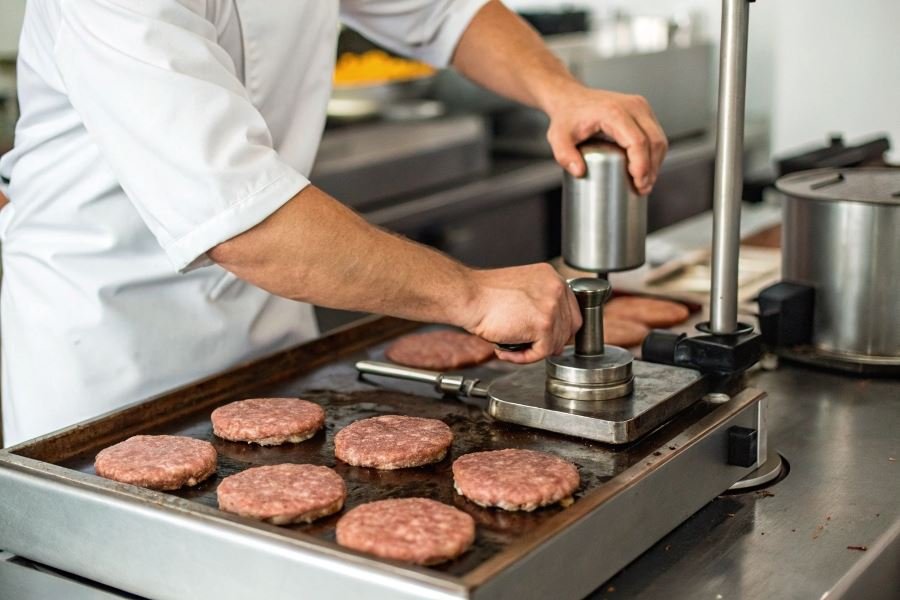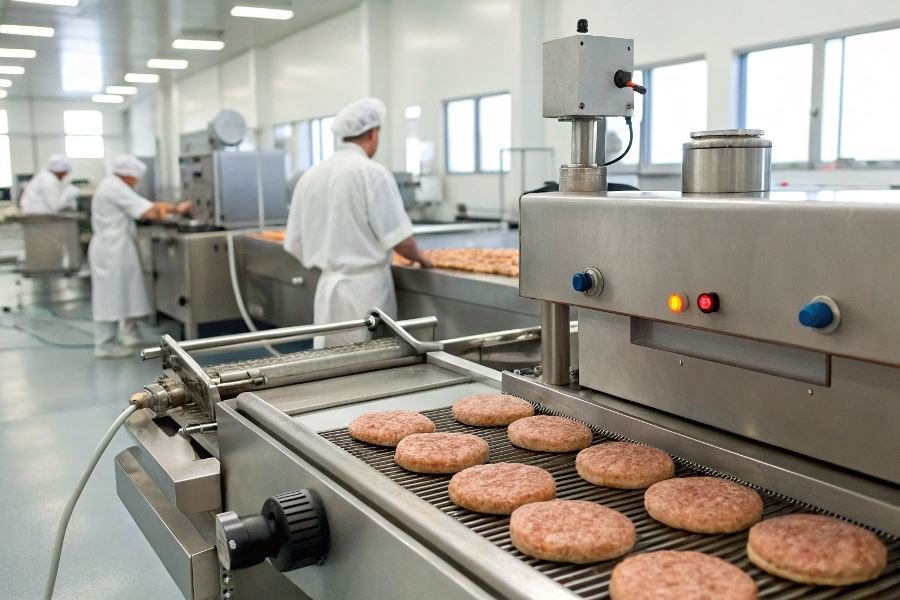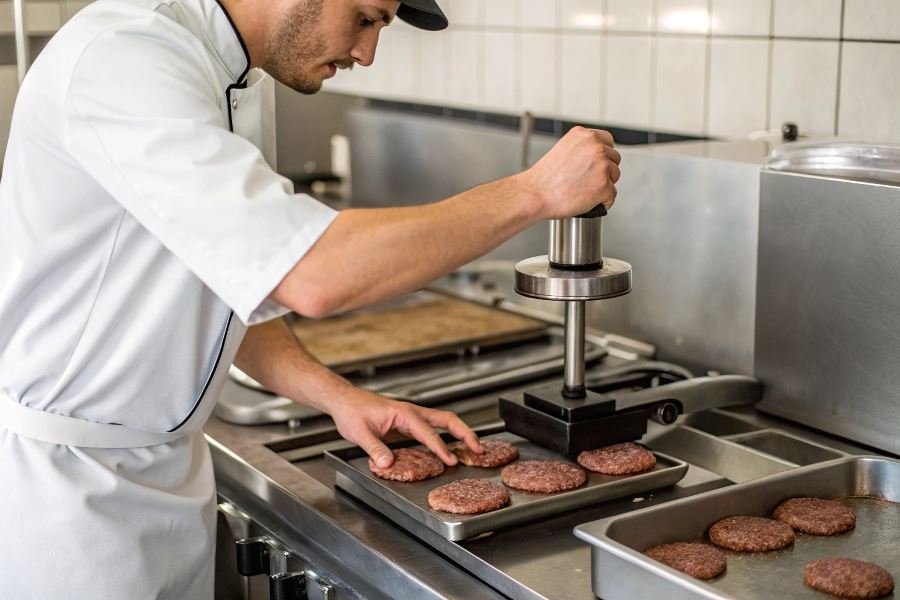
Ever watched a perfectly formed patty drop from a commercial hamburger molder and wondered what magic makes some machines churn out 2,000 consistent burgers per hour while others struggle to hit half that rate? The difference isn’t just in the price tag—it’s in understanding the critical productivity factors that separate high-performing equipment from expensive paperweights.
Hamburger molders represent the beating heart of any serious meat processing operation. These specialized machines transform bulk ground meat into uniform patties with consistent weight, thickness, and density—qualities impossible to achieve at scale through manual forming. But their true value extends far beyond simple shape-making.
The productivity of your hamburger molder directly impacts your bottom line in ways that aren’t immediately obvious. A high-efficiency molder doesn’t just produce more patties—it reduces labor costs, minimizes waste, maintains product consistency, and ultimately determines whether your operation can meet demand during peak periods.
Consider this: A mere 5% improvement in molder efficiency can translate to thousands of additional patties per shift. For a medium-sized operation, this could mean $10,000+ in additional monthly revenue without increasing labor or raw material costs. The most successful food producers understand that molder productivity isn’t just about speed—it’s about optimizing the delicate balance between throughput, quality, and operational costs.
Three key factors ultimately determine your molder’s productivity: mechanical efficiency (how the machine physically handles meat), operational parameters (settings and configurations), and maintenance practices. Getting these elements right transforms your molder from a simple forming tool into a profit-generating powerhouse.
Technical Factors That Make or Break Hamburger Molders
When investing in commercial hamburger molding equipment, understanding the technical specifications that drive productivity isn’t just helpful—it’s essential for your bottom line. The difference between an average and exceptional hamburger molder can mean thousands of additional patties per hour with less downtime and higher quality.
Evaluating the productivity of hamburger molders requires attention to several critical factors that directly impact your operation’s efficiency, consistency, and ultimately, profitability. The right machine doesn’t just form patties—it becomes the heartbeat of your production line, maintaining rhythm even during peak demand periods.
Machine Capacity and Throughput Metrics
The raw numbers tell an important story when comparing hamburger molders. Top-tier commercial models from manufacturers like Hollymatic can produce anywhere from 2,000 to 4,000 patties per hour, while industrial-grade systems may reach outputs exceeding 10,000 patties hourly.
However, throughput specifications require context:
| Capacity Metric | What It Means | Why It Matters |
|---|---|---|
| Patties per hour | Maximum production rate | Determines peak output capability |
| Hopper capacity | Amount of meat processed before refilling | Affects continuous operation time |
| Cycle time | Seconds required to form each patty | Impacts overall efficiency |
| Changeover time | Minutes needed to switch patty specifications | Critical for menu variety |
The relationship between these metrics matters more than any single number. A machine with slightly lower patties-per-hour but faster changeover times might deliver superior overall productivity in operations requiring frequent recipe switches.
Patty Formation Precision and Quality Control
The consistency of your patties directly impacts customer satisfaction and operational efficiency. Modern hamburger molders from companies like Formax incorporate sophisticated quality control features that maintain uniform weight, thickness, and density.
The most advanced systems employ pressure sensors that adjust in real-time to variations in meat temperature and fat content.
Key quality control features to evaluate include:
- Paper interleaving systems that prevent patties from sticking together
- Portion weight accuracy (typically ±1-2% on premium models)
- Density control mechanisms that prevent overworking the meat
- Edge formation technology that eliminates cracking and splitting
These features not only ensure consistent cooking times but also reduce waste—a critical factor when processing thousands of pounds of meat daily.
Maintenance Requirements and Operational Longevity
The true cost of a hamburger molder extends far beyond the purchase price. Maintenance requirements significantly impact long-term productivity and operational costs.
When evaluating durability considerations, focus on:
- Component materials – Food-grade stainless steel components from manufacturers like Ross Industries typically offer superior corrosion resistance and longevity
- Cleaning accessibility – Machines designed with tool-free disassembly can reduce daily cleaning time by 30-45 minutes
- Replacement part availability – Industry leaders maintain robust parts inventories with 24-48 hour shipping
- Service intervals – Premium models often extend routine maintenance schedules to 500-1000 operating hours
The most productive operations typically select equipment with modular designs that allow for rapid component replacement rather than extended downtime.
By carefully evaluating these technical factors—throughput capabilities, quality control features, and maintenance requirements—you’ll identify hamburger molding equipment that delivers maximum productivity for your specific production environment.
Operational Strategies to Maximize Hamburger Molder Productivity
When your hamburger molder isn’t performing at peak efficiency, you’re literally watching money disappear with every underutilized minute. The difference between average and exceptional productivity often comes down to three critical factors: workflow integration, staff expertise, and long-term operational planning.
Workflow integration that actually works
The positioning of your hamburger molder within your production line can make or break your efficiency metrics. Top-performing operations place molders directly between meat preparation stations and cooking areas, minimizing transit time to under 10 seconds.
“The most productive hamburger operations we’ve analyzed maintain less than 4 feet of distance between critical stations, resulting in 23% higher hourly output.”
Consider these setup configurations that have proven successful:
| Configuration | Best For | Productivity Boost |
|---|---|---|
| Linear Flow | High-volume operations | 15-20% |
| Island Setup | Limited space kitchens | 10-12% |
| Dual-station | Peak rush periods | 25-30% |
Temperature control systems integrated with your Patty-Pro 3000 or similar commercial molder can maintain optimal meat temperature (36-38°F), reducing waste from 12% to under 3% while improving consistency.
The most overlooked aspect? Cleaning access points. Models with tool-free disassembly features save an average of 17 minutes per cleaning cycle—translating to approximately 85 additional hours of operational time annually.
Staff mastery drives measurable results
Even the most sophisticated hamburger molding equipment requires skilled operators to reach its potential. Comprehensive training programs should focus on:
- Calibration procedures – Teaching staff to adjust for different meat compositions can improve portion accuracy by up to 98%
- Troubleshooting skills – Reducing downtime from an industry average of 42 minutes to under 15 minutes per incident
- Cross-functional knowledge – Enabling any team member to perform basic maintenance tasks
Documented procedures accessible via QR codes placed strategically near equipment have shown to reduce operational errors by 34% in busy kitchen environments.
The most successful operations implement a “train-the-trainer” approach, where experienced staff members become certified to onboard new employees, maintaining consistent standards even during periods of high turnover.
ROI analysis beyond the purchase price
The true productivity value of a hamburger molder emerges through comprehensive ROI analysis. Forward-thinking operators look beyond the initial investment to consider:
- Energy efficiency ratings – Modern molders consume 30-40% less electricity than models manufactured before 2018
- Maintenance schedules – Preventative maintenance every 500 hours extends equipment lifespan by approximately 3.2 years
- Upgrade pathways – Modular systems that allow component upgrades rather than full replacement offer 22% better lifetime value
When calculating productivity, factor in opportunity costs of downtime. A single hour of equipment failure during peak service can cost between 300−1,200 in lost revenue, depending on your operation’s volume.
The most sophisticated operations implement performance tracking software that integrates with their Kitchen Management System to provide real-time productivity metrics, allowing for immediate operational adjustments when efficiency dips below established thresholds.
By implementing these strategies systematically, hamburger molding productivity improvements of 35-40% are achievable within the first six months—transforming this critical equipment from a necessary expense into a genuine competitive advantage.
Discover the critical factors that drive hamburger molder productivity in commercial kitchens. Learn how machine capacity, patty consistency, and operational strategies impact efficiency and profitability in food production.
Discover the critical factors that drive hamburger molder productivity in commercial kitchens. Learn how machine capacity, patty consistency, and operational strategies impact efficiency and profitability in food production.