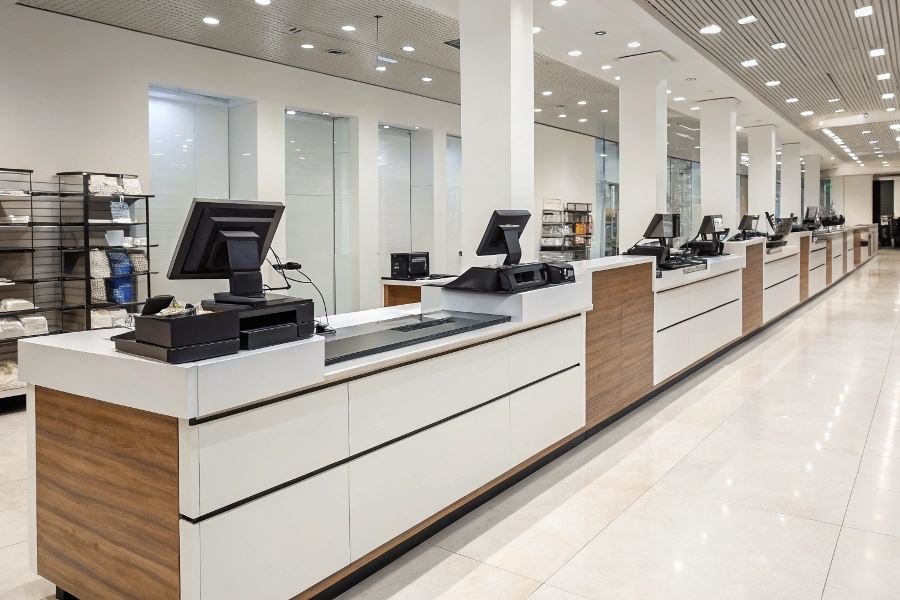
Remember when a cash register was just a glorified calculator with a cash drawer? Those days are long gone. Today’s point-of-sale systems are sophisticated business command centers that can transform how you operate.
The humble cash register has undergone a remarkable transformation since its invention by James Ritty in 1879. What began as a mechanical device to prevent employee theft has evolved into cloud-connected hubs that integrate inventory management, customer loyalty programs, and detailed analytics. Modern POS systems don’t just record transactions—they provide business intelligence that can dramatically impact your bottom line.
When evaluating cash register systems, three factors should top your priority list:
- Functionality alignment with your specific business model
- Total cost of ownership (not just upfront price)
- Scalability potential as your business grows
“The right POS system isn’t about having the most features—it’s about having the right features for your specific operation.”
The shifting POS landscape
The market is experiencing a decisive shift toward cloud-based systems that offer subscription pricing models rather than hefty upfront investments. Traditional cash registers typically cost 200−1,000, while comprehensive POS systems range from 1, 000−5,000 plus monthly software fees.
What’s driving this evolution? Mobile payment integration, inventory management demands, and the need for real-time data access from anywhere. The most successful businesses are choosing systems that balance robust functionality with intuitive interfaces that minimize training time and human error.
The ideal cash register system isn’t necessarily the most expensive or feature-rich—it’s the one that solves your specific pain points while providing room to grow.
Finding Your Perfect Cash Register: The Ultimate Price-Feature Breakdown
When selecting a cash register for your business, the comparison of cash registers by functionality and price reveals a clear pattern: as investment increases, so do capabilities and customization options. Let’s dive into what you can expect at each price point to help you make an informed decision that balances your budget with your operational needs.
Entry-Level Systems: The Essentials (200−500)
Entry-level cash registers deliver fundamental transaction processing without breaking the bank. These systems typically offer:
- Basic sales tracking and receipt printing
- Simple inventory management (usually limited to 1,000-3,000 items)
- Standard cash drawer functionality
- Basic reporting capabilities
The Square Stand (169plusiPad)exemplifiesthiscategory, turningyourtabletintoafunctionalPOSwithminimalinvestment.Similarly, the[CasioPCR − T280](https : //www.casio.com/us/electronic − registers/)(299) provides reliable performance for small retailers with straightforward needs.
These systems excel in environments with predictable inventory and modest transaction volumes, but they typically lack advanced features like:
- Employee management tools
- Customer relationship management
- Detailed analytics
- Third-party software integration
The value proposition: Maximum functionality per dollar for businesses with basic needs.
Mid-Range Solutions: Balancing Power and Price (500−1,500)
Mid-range cash registers represent the sweet spot where functionality meets affordability. These systems introduce:
- Expanded inventory management (5,000+ items)
- Employee time tracking and performance metrics
- Customer database capabilities
- Basic loyalty program support
- Cloud-based reporting and management
The Clover Station Solo ($1,349) offers impressive versatility with its app marketplace and integrated payment processing. The Toast Starter Kit (starting at $799) delivers restaurant-specific features that entry-level systems simply can’t match.
These systems typically support:
| Feature | Capability |
|---|---|
| Inventory | 5,000-25,000 items with categories |
| Reporting | Daily, weekly, monthly sales analysis |
| Integration | Limited API access for key third-party tools |
| Hardware | Support for multiple peripherals (scanners, scales) |
Premium POS Powerhouses: Enterprise Capabilities ($1,500+)
For businesses requiring comprehensive management tools, premium POS systems deliver enterprise-grade functionality:
- Unlimited inventory with complex variant tracking
- Advanced customer relationship management
- Sophisticated loyalty and marketing tools
- Detailed analytics and forecasting
- Extensive customization options
- Multi-location synchronization
The Lightspeed Retail (starting at $1,800 with hardware) offers industry-specific configurations for retailers with complex inventory needs. The NCR Counterpoint system (starting around $3,000) provides extensive customization for specialty retailers.
Premium systems distinguish themselves through:
- Open APIs for unlimited integration possibilities
- Advanced inventory forecasting and automated purchasing
- Comprehensive customer journey tracking
- Enterprise-level security features
- Dedicated account management and support
The investment delivers scalability that grows with your business, preventing costly system migrations as your operation expands.
When evaluating systems across these price categories, prioritize features that directly impact your operational efficiency rather than being swayed by flashy but unnecessary capabilities. The ideal system should solve your current challenges while accommodating your growth trajectory for the next 2-3 years.
Making the Smart Cash Register Decision
Aligning Business Needs with Register Capabilities
The perfect cash register isn’t universal—it’s the one that solves your specific business challenges. A boutique clothing store with limited inventory might thrive with a simple tablet-based Square system, while a high-volume restaurant requires the robust inventory tracking and kitchen display integration of an NCR Aloha solution.
Start by mapping your daily operations: How many transactions do you process hourly? Do you need complex inventory management? Will multiple employees access the system simultaneously? These questions create your functionality blueprint.
The most expensive register isn’t always the right choice—but neither is the cheapest.
For small businesses processing under 50 transactions daily, a mid-tier system with basic inventory tracking typically suffices. Businesses handling 200+ daily transactions should invest in enterprise-grade solutions with redundancy features and advanced reporting capabilities.
Beyond Sticker Price: The True Cost Equation
The initial purchase price represents just 40-60% of your total cash register investment over a five-year period. A $2,000 system often becomes a $4,500 commitment when you factor in:
| Cost Component | Typical Range | Often Overlooked? |
|---|---|---|
| Monthly Software Fees | 30−150 | Yes |
| Payment Processing | 1.5-3.5% per transaction | Yes |
| Hardware Maintenance | $200-500 annually | Yes |
| Staff Training | $300-1,000 initially | Almost Always |
| System Updates | $100-300 annually | Yes |
Many businesses focus exclusively on hardware costs while underestimating recurring expenses. Clover systems, for instance, offer attractive hardware pricing but require ongoing software subscriptions that can exceed $1,500 annually for advanced features.
Future-Proofing Your Investment
The retail and restaurant landscapes evolve rapidly. Your cash register should grow with you rather than becoming an operational bottleneck.
Scalability indicators to evaluate before purchase:
- API availability for third-party integrations
- Modular hardware design allowing component upgrades
- Cloud-based architecture supporting remote management
- Subscription tiers that enable feature expansion without system replacement
Toast POS exemplifies scalable design—restaurants can start with basic functionality and activate advanced inventory management, loyalty programs, and online ordering as they grow, all without replacing their core hardware.
The most valuable upgrade path isn’t the one that adds the most features—it’s the one that solves tomorrow’s problems before they arise.
Consider your three-year business plan when selecting a cash register. If you anticipate opening additional locations, prioritize systems with multi-site management. If expanding your product line is the goal, robust inventory capabilities become essential.
The optimal cash register balances your current operational requirements with reasonable future-proofing, all while maintaining a sustainable total cost of ownership. By methodically evaluating these factors rather than focusing solely on upfront price or feature lists, you’ll select a system that drives business efficiency rather than creating technological debt.
Discover the perfect POS system for your business with our comprehensive cash register comparison guide. From budget-friendly options to premium systems, learn how to balance functionality and price for the optimal investment in your retail operations.
Discover the perfect POS system for your business with our comprehensive cash register comparison guide. From budget-friendly options to premium systems, learn how to balance functionality and price for the optimal investment in your retail operations.