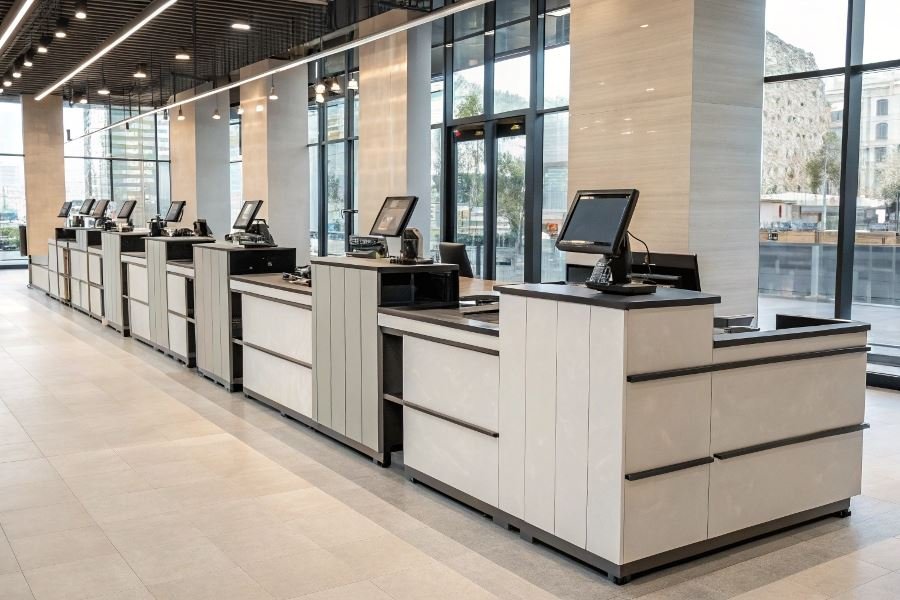
Ever stood in a grocery line watching items glide toward the cashier, wondering how this elegant solution came to be? The humble conveyor belt cash register represents one of retail’s most significant operational innovations—a perfect marriage of mechanical ingenuity and customer service practicality.
Before the 1940s, grocery checkout was a tedious affair. Cashiers manually handled each item, creating bottlenecks that frustrated customers and limited store throughput. Everything changed when Sylvan Goldman and Fred Young pioneered the first conveyor belt checkout systems in Oklahoma supermarkets. Their innovation addressed a critical pain point: the need to process more customers without sacrificing accuracy.
From mechanical counters to digital powerhouses
The core functionality of conveyor belt registers has evolved dramatically since those early days. Modern systems combine three essential elements:
- Automated product movement – Belts that operate at variable speeds, often with photocell technology to detect items
- Integrated scanning systems – From early barcode readers to today’s image recognition technology
- Customer/cashier interface zones – Carefully designed spaces that facilitate smooth handoffs
Today’s market adoption varies significantly across retail segments. While nearly 95% of large supermarkets employ conveyor systems, specialty retailers have been more selective implementers. The decision typically hinges on transaction volume, average basket size, and physical space constraints.
These systems shine in high-volume environments where customers purchase multiple items. However, they represent significant investments—both in equipment costs and floor space—making them impractical for smaller operations with limited transaction volumes or physical footprints.
Revolutionizing Checkout Efficiency
The modern retail landscape demands solutions that balance operational efficiency with exceptional customer experiences. Cash registers with conveyor belts represent a significant advancement in checkout technology, transforming what was once a bottleneck into a streamlined process. When examining cash registers with conveyor belts: advantages and disadvantages become apparent across multiple dimensions of the retail operation, with the efficiency benefits being particularly compelling for high-volume businesses.
Lightning-fast transaction processing
The primary advantage of conveyor belt systems is their remarkable impact on checkout speed. Traditional stationary checkout stations require cashiers to handle each item individually, creating a stop-and-start rhythm that slows the entire process. Conveyor systems, by contrast, create a continuous flow of products that dramatically increases throughput.
Statistical evidence tells the story: Retailers implementing NCR conveyor belt systems report processing up to 40% more items per minute compared to traditional setups. This translates to handling approximately 60-75 items per minute versus the 35-45 items possible with conventional registers.
The mathematics of improved efficiency becomes particularly compelling during peak shopping periods:
| Checkout Type | Items Per Minute | Customers Per Hour | Wait Time Reduction |
|---|---|---|---|
| Traditional | 35-45 | 20-25 | Baseline |
| Conveyor Belt | 60-75 | 35-40 | Up to 45% |
This acceleration doesn’t just benefit retailers—customers experience significantly reduced wait times, directly enhancing satisfaction metrics and potentially increasing return visits.
Ergonomic excellence for cashier wellbeing
The physical toll on cashiers represents an often-overlooked aspect of checkout operations. Repetitive motion injuries and fatigue significantly impact employee satisfaction, productivity, and retention.
Conveyor belt systems from manufacturers like Datalogic incorporate ergonomic design principles that reduce physical strain through:
- Optimized scanning angles that minimize wrist rotation and extension
- Reduced reaching distances that prevent shoulder and back strain
- Consistent product positioning that eliminates awkward movements
These ergonomic benefits translate into measurable outcomes for retailers:
- Decreased absenteeism due to repetitive strain injuries
- Extended cashier productivity during long shifts
- Improved employee retention in front-line positions
The investment in conveyor technology often pays dividends through reduced training costs and workers’ compensation claims—a win-win for both operations and human resources.
Precision inventory management
Beyond speed and ergonomics, conveyor belt systems elevate inventory management precision. The controlled product flow enables integration with advanced scanning technologies from providers like Zebra Technologies, resulting in:
- 99.8% scanning accuracy compared to 97.5% with traditional systems
- Real-time inventory updates that prevent stockouts and overstock situations
- Improved loss prevention through consistent scanning protocols
The enhanced scanning accuracy stems from the predictable presentation of products on the belt, allowing optimal scanner positioning and reducing the likelihood of missed items. This precision ripples throughout the supply chain, improving ordering accuracy and reducing inventory carrying costs.
For retailers managing thousands of SKUs, even a 1% improvement in inventory accuracy can represent tens of thousands of dollars in recovered margin—making conveyor systems a strategic investment rather than merely an operational expense.
The Hidden Costs of Conveyor Belt Registers
When we marvel at the efficiency of conveyor belt checkout systems in bustling supermarkets, we rarely consider the trade-offs retailers make to implement these systems. While the advantages are significant, the disadvantages deserve equal attention—especially for businesses considering this investment.
The financial reality check
The initial investment for conveyor belt register systems typically ranges from $5,000 to $20,000 per lane—significantly higher than standard point-of-sale systems. This price tag includes not just the belt mechanism, but also specialized scanning equipment, integrated scales, and customized counter spaces.
The true cost of ownership extends far beyond purchase price—maintenance contracts alone can represent 15-20% of the initial investment annually.
Maintenance isn’t optional. These systems contain more moving parts than traditional registers, creating multiple potential failure points. Belt replacements ($300-500 each), motor repairs, and sensor calibrations add up quickly. Most retailers report spending $1,200-2,500 annually per lane on maintenance—an expense that continues throughout the system’s 5-7 year average lifespan.
Physical footprint considerations
Standard conveyor belt checkout lanes require approximately 50-75 square feet of floor space—roughly double what traditional registers need. This spatial requirement creates a domino effect throughout store design:
- Reduced selling space (directly impacting revenue per square foot)
- Wider aisles needed for customer queuing
- Less flexibility for seasonal layout changes
For smaller retailers, this space premium often forces difficult choices between checkout efficiency and merchandise display. A mid-sized specialty retailer recently shared that installing just two conveyor lanes reduced their display capacity by nearly 200 square feet—space that previously generated approximately $1,200 in weekly sales.
The human element challenges
Employee training requirements increase substantially with conveyor systems. New hires typically need 8-12 hours of specialized training compared to 3-5 hours for standard registers. This training must cover:
| Training Component | Standard Register | Conveyor System |
|---|---|---|
| Basic operation | 1-2 hours | 2-3 hours |
| Troubleshooting | 1 hour | 3-4 hours |
| Maintenance | Minimal | 2-3 hours |
| Safety protocols | 1 hour | 2 hours |
Technical challenges extend beyond training. When systems malfunction, the entire lane becomes inoperable—unlike simpler registers where workarounds often exist. Retailers report that conveyor-related technical issues take 2.7 times longer to resolve than standard register problems.
The complexity also creates a steeper learning curve for seasonal or part-time employees. During high-volume periods like holidays, this can create bottlenecks precisely when efficiency is most critical.
Many retailers using NCR or IBM systems report that technical support for conveyor components often requires specialized technicians, extending downtime and increasing service costs by 30-40% compared to standard register repairs.
While conveyor belt registers remain the gold standard for high-volume retailers, these considerations highlight why many businesses—particularly those with space constraints or tighter capital budgets—might benefit from exploring alternative checkout technologies that offer efficiency without these specific drawbacks.
Discover the complete pros and cons of conveyor belt checkout systems for retail operations. Learn how these cash registers impact efficiency, customer experience, costs, and store layout in modern retail environments.
Discover the complete pros and cons of conveyor belt checkout systems for retail operations. Learn how these cash registers impact efficiency, customer experience, costs, and store layout in modern retail environments.