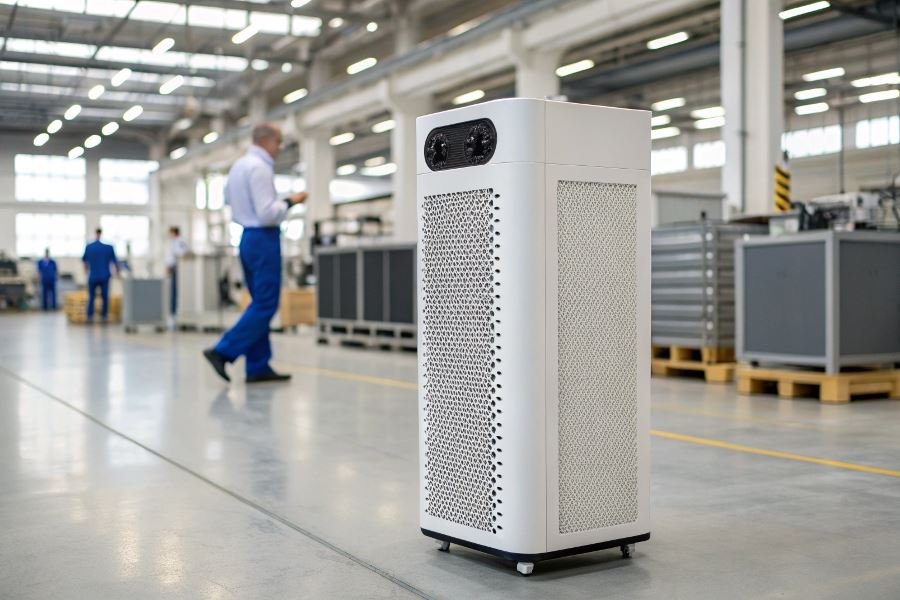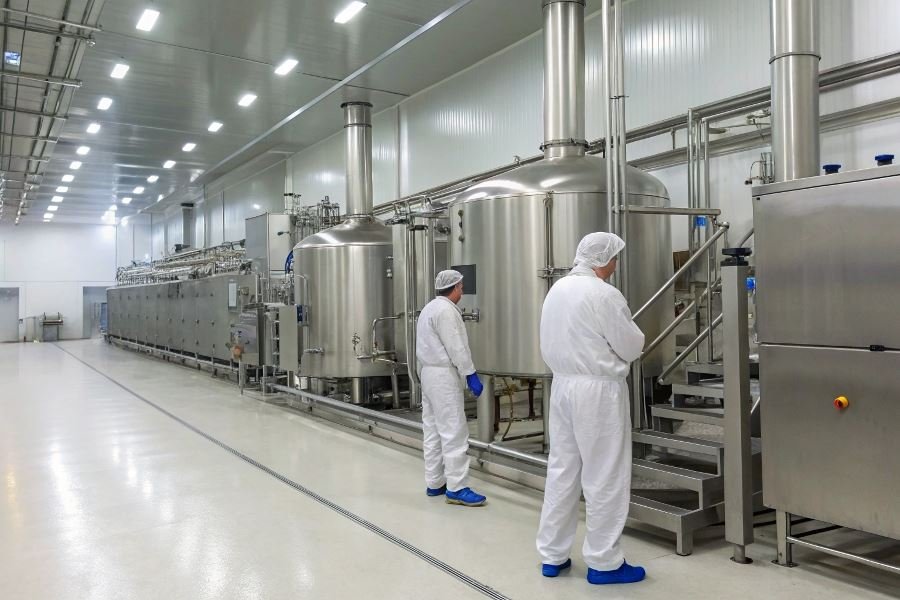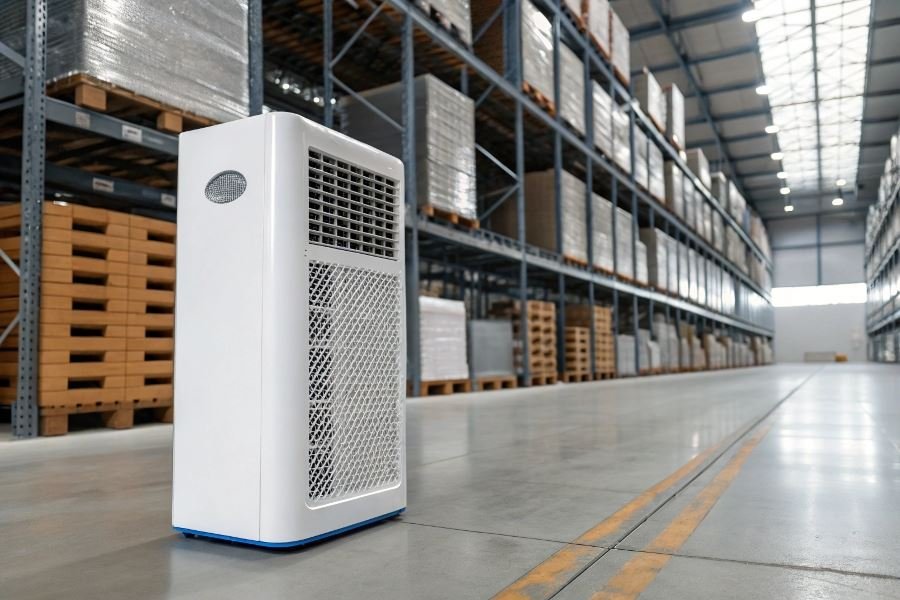
What’s the true cost of poor air quality in your warehouse? Beyond the visible dust, it’s measured in worker sick days, damaged inventory, and equipment failures.
Warehouse air quality management isn’t just about comfort—it’s a critical business investment. Every cubic foot of warehouse space contains thousands of airborne particles that can compromise operations, product integrity, and worker health. The massive volume of these industrial environments creates unique challenges that standard office solutions simply can’t handle.
The invisible threat in warehouse environments
Warehouses face distinct air quality challenges: high ceilings that trap pollutants, constant movement stirring up particles, and frequent opening of loading docks introducing outside contaminants. According to the National Institute for Occupational Safety and Health, workers in poorly ventilated industrial spaces experience 40% more respiratory issues than those in properly filtered environments.
Purifiers vs. ionizers: Understanding the fundamental difference
Air purifiers and ionizers approach the same problem with different technologies:
- Air purifiers physically trap particles using filtration systems (typically HEPA filters), removing contaminants from circulation
- Ionizers release negatively charged ions that cause airborne particles to become electrically charged and stick to surfaces or each other, falling out of the air
The distinction matters tremendously in warehouse applications, where the sheer volume of air requires strategic approaches rather than one-size-fits-all solutions.
Scale challenges: Why warehouse spaces demand specialized solutions
Standard residential or small office air purification systems fail in warehouse environments due to:
- Volume limitations – Consumer units typically clean 300-500 square feet; warehouses often exceed 100,000 square feet
- Contaminant diversity – Warehouses contain unique pollutants including diesel exhaust, packaging particulates, and industry-specific chemicals
- Airflow patterns – High ceilings, shelving configurations, and constant movement create complex air circulation challenges
Selecting the right air quality solution requires understanding these warehouse-specific factors to ensure both effectiveness and operational efficiency.
Essential Factors for Warehouse Air Purification
Selecting the right air purification system for warehouse environments requires careful consideration of several critical factors. When facility managers approach the challenge of maintaining clean air throughout vast storage spaces, they must balance effectiveness with operational practicality. Air purifiers and ionizers for warehouse spaces: what to pay attention to involves a comprehensive assessment of technical specifications, ongoing costs, and compatibility with existing operations.
Coverage Area and Airflow Capacity
The foundation of effective warehouse air purification begins with proper sizing. Coverage capacity must match your specific square footage with room to spare.
For warehouses, the calculation is straightforward but crucial:
| Warehouse Size (sq ft) | Recommended CADR (CFM) | Units Typically Required |
|---|---|---|
| Under 10,000 | 300-500 per unit | 2-4 |
| 10,000-25,000 | 500-800 per unit | 4-8 |
| 25,000-50,000 | 800+ per unit | 8-12 |
Airflow patterns matter just as much as raw capacity. Consider ceiling height, shelving configuration, and activity zones when positioning units. The BlueAir Pro XL and Austin Air HM450 offer industrial-grade coverage with customizable placement options.
Filtration Technology and Efficiency
Not all filtration systems are created equal, especially for warehouse environments that may contain unique particulate challenges.
HEPA filtration remains the gold standard, capturing 99.97% of particles as small as 0.3 microns. For warehouses storing chemicals, paper products, or food items, activated carbon filters provide essential odor and VOC removal.
The efficiency rating hierarchy:
- True HEPA (H13-H14)
- Medical-grade HEPA (H10-H12)
- HEPA-type filters
- Electrostatic precipitators
- Basic mechanical filters
Warehouses with specific contaminant concerns should consider multi-stage systems like the IQAir GC MultiGas that combine HEPA with specialized media.
Energy Consumption and Operational Costs
The financial equation extends far beyond purchase price. Energy efficiency directly impacts your bottom line when operating multiple high-capacity units continuously.
Modern commercial purifiers typically consume between 50-200 watts per unit, translating to 100−400 annually per unit at average electricity rates. Look for ENERGY STAR certified models and variable speed motors that adjust to air quality conditions.
Consider these operational cost factors:
- Initial purchase price
- Energy consumption (kWh)
- Filter replacement costs
- Maintenance requirements
- Expected lifespan
The Medify MA-112 offers exceptional energy efficiency for its coverage capacity, potentially saving thousands in operational costs over its lifetime.
Noise Levels and Operational Impact
Warehouse operations already contend with significant ambient noise. Adding purification systems shouldn’t compound communication challenges or create worker discomfort.
Industrial units typically operate between 45-70 dB, with higher settings producing more noise. Strategic placement and timing can mitigate noise concerns without sacrificing air quality.
For context, every 10 dB increase represents a doubling of perceived loudness:
| Decibel Level | Comparable Sound | Impact on Operations |
|---|---|---|
| 40-50 dB | Quiet library | Minimal impact |
| 50-60 dB | Normal conversation | Noticeable but not disruptive |
| 60-70 dB | Business office | May affect communication |
| 70+ dB | Vacuum cleaner | Potentially disruptive |
Maintenance Requirements
The most powerful purifier becomes useless without proper maintenance. Filter replacement schedules directly impact performance and efficiency over time.
Commercial-grade units typically require:
- Pre-filter cleaning: 2-4 weeks
- HEPA replacement: 6-12 months
- Carbon filter replacement: 3-6 months
Consider accessibility for maintenance staff and the simplicity of filter replacement procedures. The Rabbit Air MinusA2 features tool-free filter access and clear replacement indicators that minimize maintenance downtime.
By carefully evaluating these five essential factors, warehouse managers can implement air purification systems that effectively address air quality concerns while integrating seamlessly with existing operations.
Turning Strategy into Action: Implementing Air Purification in Warehouses
Strategic placement maximizes purification impact
Optimal placement of air purifiers and ionizers transforms warehouse air quality from concept to reality. Position units strategically near known pollution sources—loading docks, high-traffic aisles, and processing stations. The 5-10-5 rule works exceptionally well: install primary units within 5 feet of major contaminant sources, secondary units every 10 feet along main corridors, and supplemental units every 5 feet in areas with stagnant air.
Height matters tremendously. Mount ceiling units at 12-15 feet for warehouses with high ceilings, ensuring downward airflow patterns that capture rising particulates. For facilities with standard heights, position floor-standing Blueair Pro XL or wall-mounted IQAir systems at 4-6 foot elevations to maximize circulation without creating disruptive air currents.
Installation tip: Ensure 3-4 feet of clearance around each unit to prevent airflow obstruction. Position ionizers away from metal shelving that can neutralize ion distribution, and always verify electrical requirements match your facility’s capacity before installation.
Measuring what matters in air quality
Implementing without measuring is guesswork. Deploy air quality monitoring systems throughout your warehouse to establish baseline readings before installation and track improvements after. The AirVisual Pro and Awair Element provide real-time PM2.5, VOC, and CO2 readings that validate purification effectiveness.
Track these critical metrics for comprehensive assessment:
| Metric | Target Reduction | Measurement Frequency |
|---|---|---|
| PM2.5 | 80-90% | Daily |
| VOCs | 70-85% | Weekly |
| Microbial count | 90%+ | Monthly |
| Dust accumulation | 60-75% | Bi-weekly |
Document air quality improvements with before/after comparisons using particle counters like the TSI DustTrak. Many warehouse managers report seeing visible differences within 72 hours, but quantifiable improvements typically manifest within 2-3 weeks of proper implementation.
The most successful implementations include quarterly professional assessments to recalibrate systems based on seasonal changes and shifting inventory profiles.
The financial upside of cleaner warehouse air
Air purification represents an investment with measurable returns. Initial implementation costs typically range from $5-15 per square foot depending on warehouse complexity and contamination levels. However, the ROI timeline is compelling:
Short-term gains (3-6 months):
- 15-30% reduction in surface cleaning requirements
- 8-12% decrease in product returns due to contamination
- 10-25% reduction in visible dust on inventory
Long-term benefits (12-24 months):
- 20-35% extension of HVAC system lifespan
- 12-18% reduction in employee sick days
- 30-45% decrease in equipment maintenance costs due to reduced dust infiltration
Warehouse operations in pharmaceutical and electronics sectors report the most dramatic ROI, with complete system cost recovery often achieved within 18-24 months. Even standard distribution centers typically see full payback within 30-36 months.
Beyond financial metrics, implementing comprehensive air purification creates a competitive advantage. Cleaner facilities attract premium clients, particularly those with stringent quality requirements. The investment transforms air quality from a compliance checkbox into a strategic business asset that delivers ongoing operational benefits for years to come.
Discover the essential factors for selecting effective warehouse air purification systems. Learn about coverage requirements, filtration technologies, energy efficiency, and strategic implementation to improve air quality and operational performance.
Discover the essential factors for selecting effective warehouse air purification systems. Learn about coverage requirements, filtration technologies, energy efficiency, and strategic implementation to improve air quality and operational performance.