Ever walked up to a door, waved a card, and stepped inside without fumbling for keys? That seamless moment represents decades of security evolution packed into a split-second interaction. Contactless key readers have quietly transformed how we enter our spaces, with the global access control market now exceeding $10 billion annually.
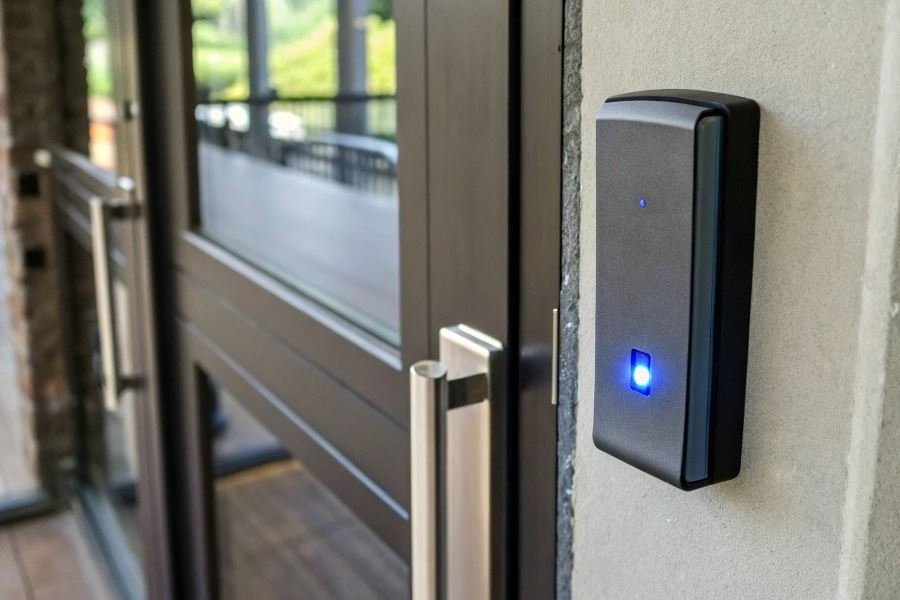
Contactless key readers are electronic devices that authenticate users without physical contact, using radio frequency identification (RFID) or near-field communication (NFC) technology. These systems detect and verify credentials stored on cards, fobs, or even smartphones, granting access when authorized identities are confirmed—all without inserting or swiping anything.
The journey from mechanical locks to today’s sophisticated contactless systems spans centuries. Traditional keys date back thousands of years, but electronic access control emerged in the 1960s with keypads and magnetic stripe cards. RFID technology gained commercial traction in the 1990s, while NFC capabilities expanded dramatically after 2010, enabling smartphone integration and multi-credential functionality.
Why businesses are embracing contactless technology
The benefits extend far beyond convenience:
- Enhanced security: Unlike physical keys that can be copied, contactless credentials can be instantly deactivated if lost
- Detailed access logs: Systems track who entered where and when, creating accountability
- Scalability: Adding or removing users takes seconds instead of distributing physical keys
- Touchless operation: Particularly valuable in high-traffic areas where hygiene matters
When selecting a contactless reader system, consider compatibility with existing infrastructure, encryption standards, and whether you need multi-technology readers that can handle various credential types simultaneously. The best systems balance robust security with frictionless user experience—protecting assets without creating bottlenecks.
The Invisible Handshake: How Contactless Readers Work
RFID and NFC: The Silent Communicators
At their core, contactless key readers represent a fascinating intersection of convenience and security technology. These devices operate on electromagnetic fields that create a wireless dialogue between your credential and the access point. The principle of operation and selection features of contactless key readers revolve around two primary technologies: RFID (Radio-Frequency Identification) and NFC (Near Field Communication).
RFID systems operate across various frequencies—low (125-134 kHz), high (13.56 MHz), and ultra-high (860-960 MHz)—each offering different read ranges and applications. Low-frequency systems typically work within inches, making them ideal for door access, while UHF readers can detect tags from up to 30 feet away, perfect for parking gates and vehicle identification.
The magic happens in milliseconds: when you wave your key fob or card near a reader, the reader emits an electromagnetic field that momentarily powers the passive chip in your credential. This chip then transmits its unique identifier back to the reader—all without batteries in your credential.
Encryption: The Digital Fortress
Modern contactless readers don’t just read data—they engage in sophisticated cryptographic conversations.
The days of simple proximity cards with static IDs are rapidly disappearing.
Today’s systems employ multi-layered encryption protocols like:
| Protocol | Security Level | Key Features |
|---|---|---|
| DESFire EV2 | Very High | 128-bit AES encryption, mutual authentication |
| MIFARE Plus | High | AES encryption, backward compatibility |
| HID iCLASS SE | High | SIOs (Secure Identity Objects), multi-layered security |
| BLE Secure | High | Rolling codes, smartphone integration |
The most advanced readers use mutual authentication—not only does the reader verify the credential, but the credential also verifies the reader is legitimate. This prevents man-in-the-middle attacks and credential cloning, issues that plagued earlier generations of contactless technology.
Seamless Integration: Building the Security Ecosystem
The true power of contactless readers emerges when they’re integrated into broader security frameworks. Modern readers from companies like HID Global and Allegion are designed with open architecture principles, allowing them to communicate with:
- Access control management systems
- Video surveillance platforms
- Visitor management software
- Time and attendance tracking
- Building automation systems
Integration capabilities extend beyond security, with API-driven designs enabling contactless readers to interface with HR databases, elevator controls, and even cashless payment systems. The most sophisticated installations use OSDP (Open Supervised Device Protocol) rather than legacy Wiegand interfaces, providing bidirectional communication, supervision, and encryption between the reader and the control panel.
Many enterprise-grade readers now support multiple credential technologies simultaneously, allowing organizations to transition gradually from older technologies to newer, more secure standards without replacing every credential overnight. This backward compatibility, combined with forward-looking features like mobile credential support, makes today’s contactless readers remarkably versatile security components.
Making the Right Choice: Evaluating Contactless Key Readers
When investing in access control technology, the difference between adequate and exceptional performance often comes down to how well you evaluate your options. Contactless key readers represent a significant security investment—one that demands careful consideration of several critical factors.
Read range, speed, and reliability matter most
The triumvirate of performance metrics that separate premium contactless readers from basic models begins with read range. Top-tier systems from manufacturers like HID Global offer consistent read distances between 2-24 inches depending on the technology, while budget options might struggle to maintain reliability beyond 2-3 inches.
The practical difference? Employees can keep credentials in wallets or bags rather than fumbling to present them directly to the reader.
Processing speed creates the second critical distinction. Enterprise-grade readers from Allegion process credentials in under 0.5 seconds, while economy models might require 1-2 seconds—a small difference that multiplies into significant frustration when hundreds of employees access a building daily.
The third pillar, reliability, manifests in first-read success rates. Premium readers boast 99.9% first-read success rates, while budget alternatives might achieve only 95-97%. This seemingly small difference translates to 30-50 times more failed reads in high-traffic environments.
| Performance Factor | Premium Readers | Economy Readers | Impact |
|---|---|---|---|
| Read Range | 2-24 inches | 1-3 inches | Convenience, throughput |
| Processing Speed | <0.5 seconds | 1-2 seconds | User satisfaction, traffic flow |
| First-Read Success | 99.9% | 95-97% | Security confidence, maintenance calls |
Environmental considerations shape installation success
Contactless readers face environmental challenges that directly impact longevity and performance. IP ratings provide the clearest indicator of environmental durability, with outdoor installations requiring minimum IP65 protection against dust and water jets.
Temperature tolerance represents another critical specification, particularly for exterior installations. Premium readers from Kisi operate reliably from -40°F to 150°F, while standard models typically function within a narrower -10°F to 120°F range.
Installation requirements vary significantly between models:
- Power requirements: 12-24V DC standard, with Power-over-Ethernet options reducing installation complexity
- Mounting surfaces: Metal surfaces can interfere with RF signals, requiring specialized readers or installation techniques
- Wiring needs: Cat5e/Cat6 for networked systems versus traditional Wiegand wiring for legacy installations
The true cost equation extends beyond purchase price
Initial acquisition costs represent just 15-30% of the total lifetime expense of contactless readers. A comprehensive cost-benefit analysis must consider:
- Installation expenses: Professional installation averages $150-300 per reader
- Maintenance requirements: Premium readers typically require service every 3-5 years versus 1-2 years for economy models
- Integration capabilities: Forward-compatible readers support multiple credential technologies simultaneously, protecting your investment as standards evolve
The most expensive reader is the one you have to replace before its time.
Long-term value assessment should factor in credential management costs, which often exceed hardware expenses over a 5-year period. Systems from Brivo that offer cloud-based credential management can reduce these ongoing expenses by 40-60% compared to traditional systems requiring dedicated servers and specialized IT knowledge.
When evaluating total cost of ownership, the premium for higher-quality readers typically pays for itself within 24-36 months through reduced maintenance, fewer replacements, and enhanced security capabilities.
Discover how contactless key readers work and learn essential selection criteria for optimal security. Our comprehensive guide covers RFID technology, encryption protocols, and key performance factors to help you make an informed investment decision.
Discover how contactless key readers work and learn essential selection criteria for optimal security. Our comprehensive guide covers RFID technology, encryption protocols, and key performance factors to help you make an informed investment decision.