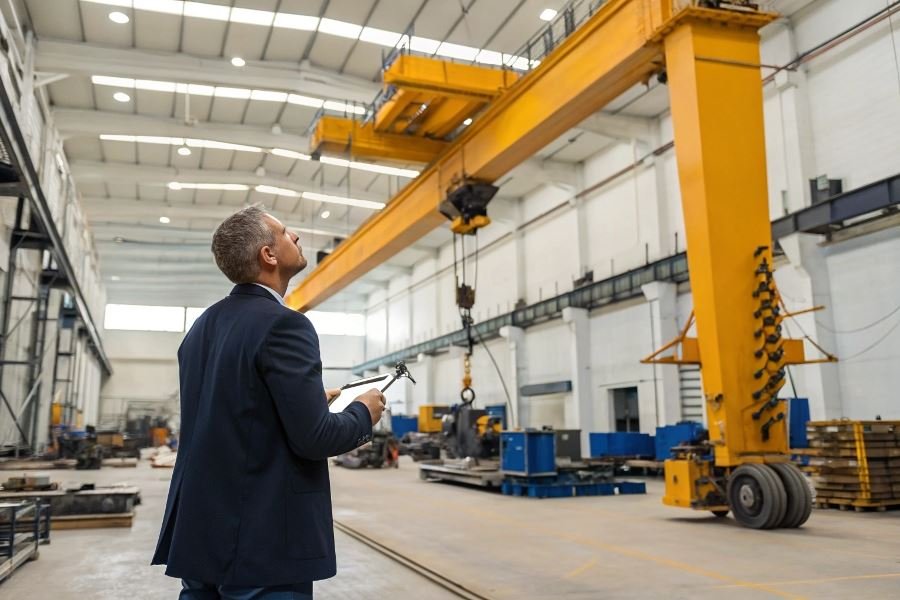
A single equipment failure can cost $3.8 million in damages and lost productivity—not counting the human cost that no dollar amount can measure.
When a two-ton steel beam dangles 40 feet above a construction site, the difference between disaster and routine operation comes down to one thing: the quality of your lifting equipment. This isn’t just about compliance or checking boxes—it’s about creating an environment where workers return home safely every night.
Safety criteria for lifting equipment isn’t merely a technical consideration—it’s the foundation of operational excellence. The Occupational Safety and Health Administration (OSHA) reports that improper lifting operations contribute to nearly 5% of workplace fatalities annually, with equipment failure being a leading cause. These aren’t just statistics; they represent real people and preventable tragedies.
The regulatory landscape: More than just red tape
Federal standards established by OSHA, along with industry-specific guidelines from organizations like ASME (American Society of Mechanical Engineers), create a comprehensive framework for equipment safety. These aren’t arbitrary rules—they’re battle-tested protocols developed from decades of incident analysis and engineering advancement.
The true cost of cutting corners
When companies prioritize initial purchase price over safety criteria, the consequences cascade beyond the immediate incident:
- Legal liability that can bankrupt even established businesses
- Insurance premium increases that continue for years after an incident
- Productivity losses from work stoppages and investigations
- Reputational damage that can permanently affect client relationships
The most successful operations understand that safety criteria aren’t obstacles to efficiency—they’re enablers of it. When your team trusts their equipment, productivity naturally follows.
The Engineering Behind Safe Lifting Operations
When lives hang in the balance, technical specifications transform from mundane numbers into critical safety parameters. The difference between a routine lift and a catastrophic failure often comes down to understanding the essential technical criteria for safety when choosing lifting equipment. Smart operators know that safety margins aren’t suggestions—they’re non-negotiable requirements that protect both assets and human lives.
Load Capacity: The Foundation of Safe Lifting
Load capacity ratings represent the maximum weight a piece of equipment can safely handle under ideal conditions. However, experienced professionals understand that real-world conditions rarely match testing environments. This is why safety factors exist—they provide crucial buffer zones against unexpected stresses.
| Safety Factor | Application | Real-World Meaning |
|---|---|---|
| 3:1 | General industrial | Equipment rated for 1 ton can safely handle 667 lbs |
| 5:1 | Personnel lifting | Equipment rated for 1 ton can safely handle 400 lbs |
| 10:1 | Critical operations | Equipment rated for 1 ton can safely handle 200 lbs |
The American Society of Mechanical Engineers (ASME) and the Occupational Safety and Health Administration (OSHA) mandate minimum safety factors for different applications. These aren’t arbitrary numbers—they’re calculated thresholds based on decades of engineering data and incident analysis.
Never select equipment based solely on the weight being lifted. Factor in dynamic loading, environmental conditions, and potential shock loads that can multiply forces exponentially.
Material Integrity: The Invisible Safety Component
Material quality determines how equipment responds to stress, fatigue, and environmental factors. High-grade alloy steels used in premium hoists and cranes from manufacturers like Konecranes contain precise metallurgical compositions that resist deformation under load.
Key material considerations include:
- Tensile strength – Resistance to breaking under tension
- Yield point – When permanent deformation begins
- Fatigue resistance – Performance under repeated loading cycles
- Corrosion resistance – Particularly critical in marine or chemical environments
Material certificates should trace components back to their foundry heats, providing verification of chemical composition and mechanical properties. This documentation forms part of the equipment’s pedigree and should be maintained throughout its service life.
Standards Compliance: The Safety Guarantee
Certification isn’t bureaucratic paperwork—it’s documented proof that equipment meets minimum safety thresholds. The landscape of lifting standards is comprehensive:
- ASME B30 series covers different lifting equipment types
- OSHA 1910.179 regulates overhead and gantry cranes
- ANSI/ITSDF B56 addresses powered industrial trucks
- EN 13155 (European standard) specifies requirements for lifting attachments
Third-party certification from organizations like UL or DNV provides independent verification that equipment meets or exceeds these standards. This certification process involves rigorous testing under controlled conditions, destructive testing of samples, and thorough documentation review.
Equipment that lacks proper certification isn’t just non-compliant—it’s a liability waiting to manifest. The modest premium paid for properly certified equipment pales in comparison to the potential costs of equipment failure, which can include property damage, production losses, injuries, and even fatalities.
When evaluating lifting equipment, these technical criteria form the three-legged stool of safety. Compromise on any one aspect, and the entire operation becomes unstable.
Operational Safety Beyond the Specs
When lives hang in the balance, choosing lifting equipment demands more than checking load capacities and technical specifications. The human-machine interface becomes the critical frontier where safety truly lives or dies. Let’s dive into the operational elements that separate merely adequate lifting equipment from truly exceptional safety performers.
Ergonomics that prevent human error
The most sophisticated safety systems can be undermined by poor ergonomic design. Operator fatigue and discomfort directly correlate with accident rates. Modern lifting equipment should feature:
- Adjustable control stations that accommodate operators from the 5th to 95th percentile in height
- Anti-vibration mounts that reduce operator fatigue during extended operations
- High-contrast displays visible in varying light conditions
- Intuitive control layouts that follow established patterns across the industry
The Occupational Safety and Health Administration reports that ergonomic factors contribute to approximately 33% of workplace injuries. Equipment from manufacturers like Konecranes now incorporates features like adaptive joysticks that require 40% less force to operate compared to traditional controls, dramatically reducing repetitive strain injuries.
Maintenance protocols that prevent catastrophic failures
Even the safest lifting equipment becomes dangerous when improperly maintained. Effective maintenance isn’t just about schedules—it’s about systems.
The difference between mediocre and excellent maintenance protocols:
| Basic Approach | Advanced Safety Protocol |
|---|---|
| Annual inspections | Predictive maintenance with real-time monitoring |
| Paper logbooks | Digital tracking with automated alerts |
| Visual checks | Non-destructive testing (NDT) for hidden flaws |
| Reactive repairs | Scheduled component replacement before failure |
Columbus McKinnon and other industry leaders now offer IoT-enabled lifting systems that track usage patterns and stress loads, predicting potential failures before they occur. These systems can extend equipment life by up to 27% while dramatically improving safety margins.
Training systems that create safety culture
The most overlooked aspect of operational safety is comprehensive training. Equipment is only as safe as the people operating it.
Effective training programs must include:
- Equipment-specific certification that covers both standard and emergency operations
- Refresher training at regular intervals (typically every 6-12 months)
- Documentation systems that track operator qualifications and experience
- Scenario-based training for emergency situations
Manitowoc has pioneered virtual reality training systems that allow operators to practice critical lifts in a zero-risk environment. Their data shows a 64% reduction in operator errors when VR training supplements traditional methods.
“The most expensive training program costs pennies compared to the financial and human cost of a single catastrophic lifting accident.” – National Safety Council
Documentation requirements have evolved significantly as well. Modern safety standards require not just maintenance records but also:
- Operator qualification tracking
- Pre-lift planning documentation
- Near-miss reporting
- Root cause analysis for any operational issues
When selecting lifting equipment, demand access to comprehensive training materials, including digital resources that can be easily updated as procedures evolve. The best manufacturers partner with customers through the equipment lifecycle, providing ongoing training support rather than one-time instruction.
Discover the critical safety criteria for selecting industrial lifting equipment, from load capacity ratings to compliance standards. Learn how proper equipment selection protects workers and prevents costly accidents in high-risk environments.
Discover the critical safety criteria for selecting industrial lifting equipment, from load capacity ratings to compliance standards. Learn how proper equipment selection protects workers and prevents costly accidents in high-risk environments.