The humble dumpling—a simple pocket of dough filled with savory ingredients—has sparked a technological revolution worth billions.
Behind every perfectly pleated dumpling in restaurants and grocery freezers stands an increasingly sophisticated production system. What began as hand-rolling operations has transformed into precision engineering marvels capable of producing thousands of dumplings hourly. The journey from manual folding to today’s high-speed automatic systems represents one of food manufacturing’s most fascinating technological evolutions.
The market speaks volumes: dumpling consumption has skyrocketed globally, with the frozen dumpling segment alone projected to reach $5.8 billion by 2026. This surge demands production solutions that balance efficiency with quality—a challenge manufacturers face daily.
When choosing between automatic and semi-automatic dumpling machines, three factors prove critical:
- Production volume requirements – Are you producing 500 or 5,000 dumplings hourly?
- Labor considerations – Will you benefit from reduced staffing or prefer maintaining human oversight?
- Investment capacity – Can your operation absorb the 15, 000−75,000 difference between semi-automatic and fully automatic systems?
“The right machine isn’t necessarily the most expensive one—it’s the one that aligns with your production goals, workforce structure, and growth trajectory.”
Semi-automatic machines offer an appealing middle ground—maintaining quality control while boosting output beyond manual production. Meanwhile, fully automatic systems deliver unmatched efficiency for operations ready to scale significantly.
Your choice ultimately shapes not just production capacity, but product consistency, labor requirements, and long-term operational flexibility.
Production Powerhouses: Automatic vs Semi-Automatic Dumpling Machines
When scaling your food production operation, the choice between automatic and semi-automatic dumpling machines becomes a critical business decision that affects everything from your bottom line to product consistency. The difference between these systems goes far beyond simple automation levels.
Manufacturers often struggle with determining whether automatic or semi-automatic dumpling machines would better serve their production needs. The decision requires careful analysis of output capabilities, labor requirements, spatial considerations, and ongoing operational costs. Each system presents distinct advantages depending on your specific production goals and business model.
Output That Drives Profit
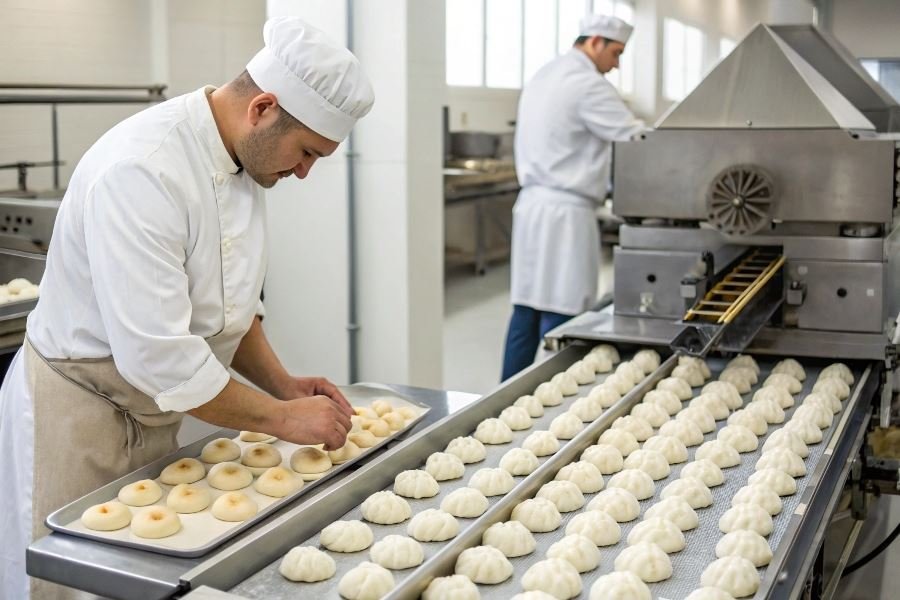
Automatic dumpling machines deliver impressive production capacity, typically ranging from 4,800 to 6,000 dumplings per hour for standard commercial models. High-end industrial automatic systems from manufacturers like Anko Food Machine can reach outputs exceeding 12,000 units hourly. This represents a 3-4x increase over semi-automatic alternatives.
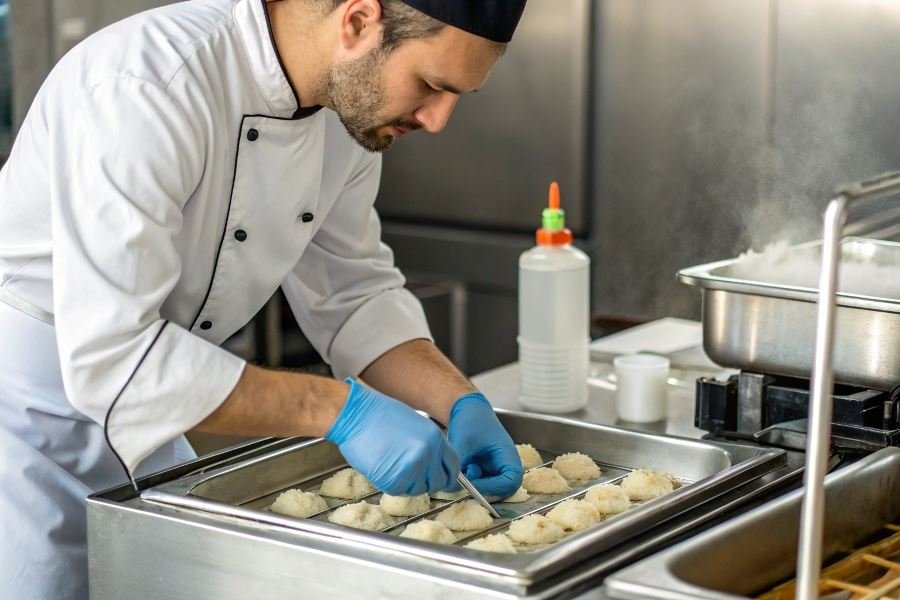
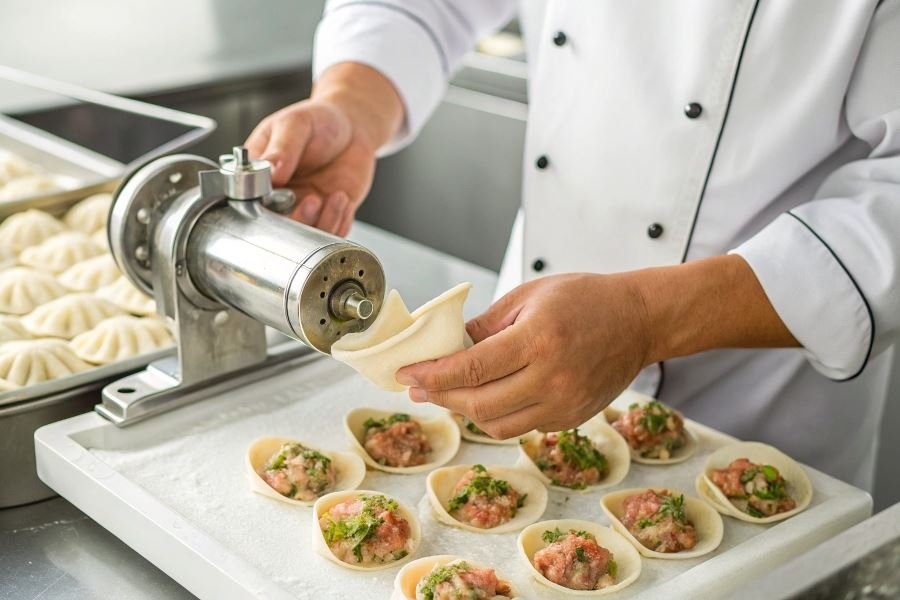
Semi-automatic machines generally produce 1,200 to 2,400 dumplings hourly, requiring operator intervention for dough feeding and product collection. While this may seem modest compared to fully automatic systems, it offers significant advantages for smaller operations prioritizing product customization.
| Machine Type | Average Output (units/hour) | Ideal Production Scale |
|---|---|---|
| Automatic | 4,800-12,000+ | Large-scale commercial |
| Semi-automatic | 1,200-2,400 | Small to medium batch |
Labor Economics and Operational Efficiency
Labor requirements create one of the starkest contrasts between these systems. Automatic machines typically require only 1-2 operators for monitoring and occasional intervention, reducing labor costs by up to 75% compared to semi-automatic alternatives that need 3-4 workers for continuous operation.
The math becomes compelling when calculating annual labor savings:
- Automatic: ~$62,400 (2 workers × $15/hr × 2,080 hrs)
- Semi-automatic: ~$187,200 (6 workers × $15/hr × 2,080 hrs)
However, semi-automatic systems offer greater flexibility for product variation and can be ideal for operations producing multiple dumpling styles or requiring frequent recipe changes.
Spatial Considerations and Setup Requirements
Footprint differences between these systems can significantly impact facility planning. Automatic dumpling machines typically require 25-40 square feet of floor space plus clearance zones, while semi-automatic units need only 10-15 square feet.
Installation complexity also varies dramatically:
- Automatic systems often require specialized electrical connections (typically 220V/three-phase), water hookups, and sometimes compressed air
- Semi-automatic machines generally operate on standard 110V power with minimal installation requirements
For operations with limited space or leased facilities, the compact footprint and simpler installation of semi-automatic machines can represent substantial advantages despite lower production capacity.
Energy Consumption and Maintenance Realities
The long-term operational costs extend beyond the initial investment. Automatic dumpling machines consume 3-5 kW/hour on average, while semi-automatic alternatives typically use 0.75-1.5 kW/hour—a significant difference for continuous production environments.
Maintenance requirements follow a similar pattern:
- Automatic systems require scheduled professional maintenance every 500-750 production hours
- Semi-automatic machines typically need attention every 1,000-1,500 hours
The annual maintenance cost difference can reach 3, 000−7,000, with automatic systems requiring more specialized technicians and proprietary parts from manufacturers like Sammic or Rheon.
When calculating total ownership costs, these operational factors often outweigh the initial price difference, making semi-automatic systems more economical for operations producing under 5,000 units daily despite their lower hourly output.
Making the Final Decision: Automatic vs Semi-Automatic Dumpling Machines
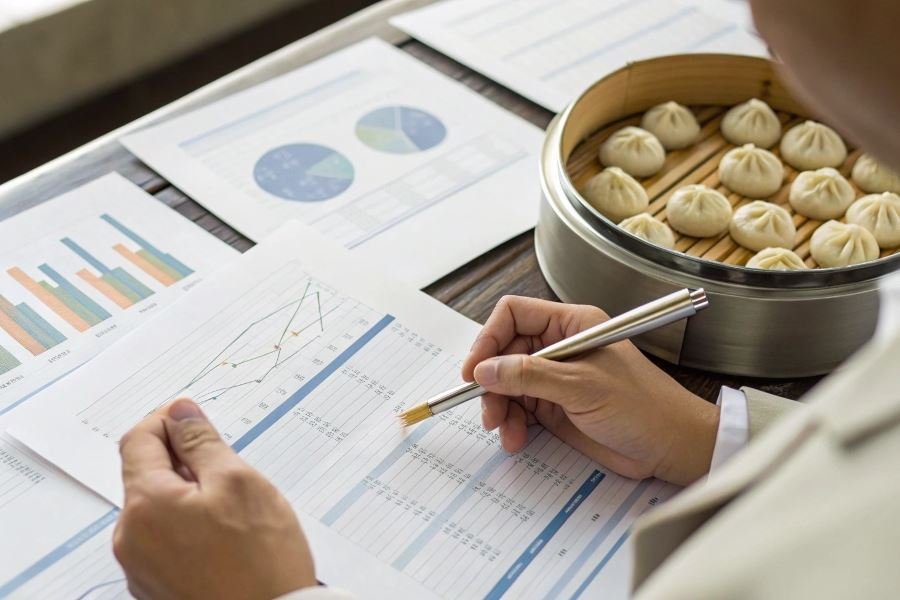
ROI analysis across business scales
The investment return timeline varies dramatically between machine types. For small operations producing under 5,000 dumplings daily, semi-automatic machines typically achieve ROI within 8-12 months. The Sammic TGF-4400 at $7,500 can pay for itself after just 9 months of consistent production.
Automatic systems require deeper pockets initially but deliver compelling economics at scale. The Anko Food Machine RY2000 priced at $45,000 reaches breakeven at approximately 18 months for operations exceeding 15,000 units daily.
The crossover point where automatic machines become more economical typically occurs at 8,000-10,000 dumplings per day production volume.
Consider this comparative analysis:
| Production Scale | Semi-Auto ROI | Auto ROI | 5-Year TCO Difference |
|---|---|---|---|
| Small (<5K/day) | 8-12 months | 24+ months | Semi-auto saves $32,000+ |
| Medium (5-15K/day) | 12-18 months | 18-24 months | Roughly equivalent |
| Large (>15K/day) | 18+ months | 12-18 months | Auto saves $75,000+ |
Labor costs represent the critical variable. Automatic systems require 1 operator per 20,000 units, while semi-automatic machines need 1 operator per 3,000-5,000 units.
Quality control and consistency factors
Consistency becomes the defining advantage of automatic systems. The Rheon Cornucopia delivers a remarkable 99.7% consistency in filling weight with just ±0.3g variance. Semi-automatic alternatives typically achieve 95-97% consistency with ±1.2g variance.
However, quality control isn’t just about precision. Semi-automatic machines allow operators to make real-time adjustments to:
- Wrapper thickness
- Filling distribution
- Pleating patterns
- Sealing pressure
This human oversight can be crucial for artisanal products where slight variations contribute to authentic appeal. Automatic systems excel in standardization but sacrifice some adaptability.
Flexibility for product variety and customization
Semi-automatic machines shine brightest when product diversity matters. The Yamato DPX-100 can transition between different dumpling styles in under 5 minutes with minimal tooling changes.
Automatic systems have historically struggled with flexibility, but newer models have narrowed this gap. The Hundred Machinery HDM-868 now offers 12 product presets with changeover times of approximately 15-20 minutes.
The flexibility equation ultimately depends on your product mix:
- Single product focus: Automatic machines deliver superior economics
- Diverse menu (4+ varieties): Semi-automatic systems maintain advantage
- Seasonal rotation: Semi-automatic provides adaptability
Long-term scalability and future-proofing
Future-proofing your production requires anticipating tomorrow’s demands. Automatic systems offer clearer upgrade paths through modular expansion. The Dumpling Master Pro-5000 can increase capacity by 40% through add-on modules without replacing the core system.
Semi-automatic machines typically require complete replacement when outgrown, though their lower initial investment mitigates this disadvantage.
Consider these scalability factors:
- Space efficiency – Automatic systems produce 3-5× more output per square foot
- Energy consumption – Newer automatic models use 30% less energy per unit than five years ago
- Maintenance complexity – Semi-automatic machines remain simpler to maintain with fewer specialized parts
- Integration capability – Automatic systems offer superior connectivity with production management software
The ultimate decision hinges on your growth trajectory. Operations expecting 25%+ annual growth should strongly consider automatic systems despite higher upfront costs, while businesses with stable production volumes often benefit from semi-automatic flexibility.
Discover which dumpling machine maximizes your ROI: compare automatic vs semi-automatic options based on production capacity, labor costs, and scalability. Make an informed investment for your food business's growth and efficiency.
Discover which dumpling machine maximizes your ROI: compare automatic vs semi-automatic options based on production capacity, labor costs, and scalability. Make an informed investment for your food business's growth and efficiency.