What if your laundry operation could slash energy costs by 60% while processing more loads? This isn’t wishful thinking—it’s the reality for businesses embracing the latest energy-efficient washing machines.
Commercial laundries across America are witnessing a remarkable transformation. The industrial washing machine, once notorious for its voracious appetite for resources, has evolved into a sophisticated ecosystem of efficiency. Modern energy-efficient commercial washers don’t just clean—they conserve water, electricity, and ultimately, your bottom line.
The market has responded dramatically to this shift. Major manufacturers like Speed Queen, Electrolux, and Dexter have developed machines that use advanced load-sensing technology to optimize water usage and high-speed extraction to reduce drying time. These innovations aren’t merely incremental—they represent a fundamental rethinking of the laundry process.
“The return on investment for upgrading to energy-efficient machines typically occurs within 18-24 months, after which the savings go straight to your profit margin.” — American Laundry Association
The triple-bottom-line advantage
Upgrading your laundry operation delivers benefits across three critical dimensions:
-
Financial efficiency: Expect 30-50% reductions in water consumption and 15-40% in energy usage, translating to thousands of dollars saved annually.
-
Operational excellence: Shorter cycle times mean increased throughput—process more loads with fewer machines.
-
Environmental leadership: Reduced resource consumption positions your business as environmentally responsible, increasingly important to commercial clients.
The most successful laundry operations understand that energy efficiency isn’t just about cost-cutting—it’s about creating competitive advantage in a resource-conscious marketplace.
Game-Changing Washing Machine Technologies for Commercial Laundries
The commercial laundry industry is experiencing a remarkable transformation as manufacturers introduce increasingly sophisticated energy-efficient solutions. These innovations aren’t just reducing utility bills—they’re revolutionizing how laundry businesses operate while minimizing environmental impact.
For laundry facility managers seeking to upgrade their operations, energy-efficient washing machines for laundries represent the perfect intersection of cost savings and sustainability. The latest generation of commercial washers delivers exceptional cleaning performance while dramatically reducing water, electricity, and detergent consumption—a true win-win for businesses and the planet.
Front-Loading Efficiency Champions
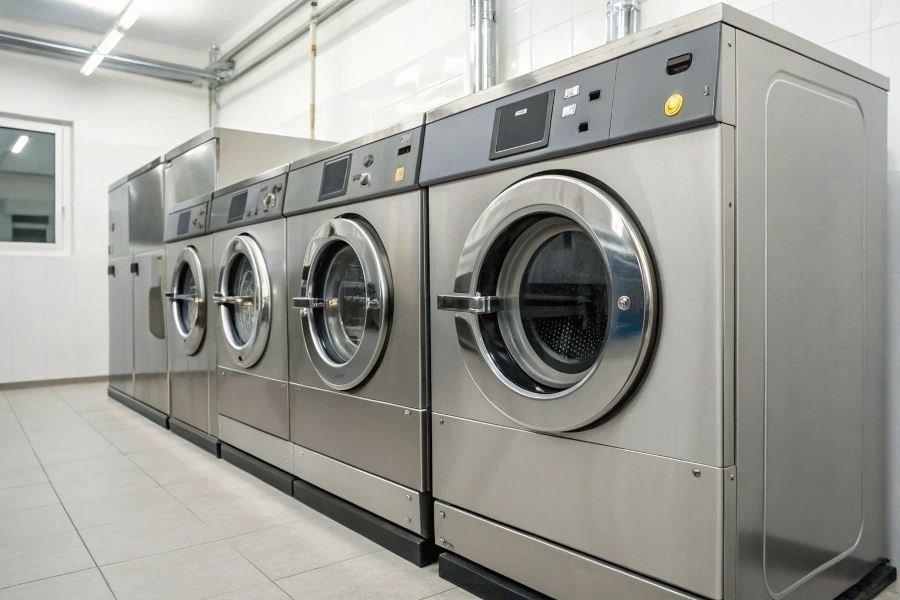
High-efficiency front-loading washers have become the gold standard in commercial laundry operations. These powerhouses extract more water during spin cycles, resulting in shorter drying times and lower energy consumption downstream.
The most advanced models now incorporate water recycling systems that can reduce water usage by up to 70% compared to traditional machines. The Speed Queen Quantum Touch series, for example, features multi-stage filtration that allows water from final rinse cycles to be captured, treated, and reused in the pre-wash phase of subsequent loads.
Key advantages include:
- Lower water consumption (1.5-2.5 gallons per pound vs. 3-5 gallons in conventional washers)
- Reduced hot water heating costs
- Decreased detergent usage (30-50% less)
- Shorter cycle times through improved extraction
AI-Powered Optimization
Smart washing machines with artificial intelligence capabilities represent the cutting edge of laundry technology. These systems continuously analyze operational data to optimize every aspect of the washing process.
The Electrolux Line 6000 series exemplifies this approach with its Automatic Savings feature that adjusts water levels, temperature, and mechanical action based on load weight and fabric type. The system even learns from previous cycles to further refine its efficiency algorithms.
These intelligent machines can identify when a load is unbalanced before problems occur, preventing unnecessary stops and restarts that waste energy and time.
| Feature | Benefit | Typical Savings |
|---|---|---|
| Load sensing | Optimizes water based on actual load weight | 15-25% water reduction |
| Predictive maintenance | Prevents energy-wasting malfunctions | 5-10% energy savings |
| Remote monitoring | Allows real-time performance tracking | Varies by implementation |
| Dynamic cycle adjustment | Minimizes resource use in real-time | 10-20% overall efficiency gain |
Heat Pump Revolution
Perhaps the most exciting development in commercial laundry technology is the integration of heat pump systems into washing machines. This technology, borrowed from the HVAC industry, represents a fundamental shift in how energy is managed within the washing process.
Heat pump washing machines like the Miele ProfiLine series capture thermal energy that would normally be lost in wastewater and recycle it to heat incoming water. This closed-loop approach dramatically reduces the energy required for water heating—typically the most energy-intensive aspect of the washing process.
The efficiency gains are remarkable:
- Energy consumption reductions of 40-60% compared to conventional heating methods
- Decreased carbon emissions
- Lower peak electricity demand
- Consistent water temperatures for superior cleaning results
These heat pump systems work particularly well in continuous batch washers for high-volume operations, where the constant flow of laundry maximizes the technology’s efficiency potential.
For laundry businesses looking to reduce operational costs while enhancing their sustainability credentials, these three technologies offer compelling pathways to a more efficient future. The initial investment may be higher than standard equipment, but the long-term savings and environmental benefits make them increasingly essential in today’s competitive marketplace.
Maximizing ROI with Energy-Efficient Laundry Equipment
Energy-efficient washing machines represent more than just a green initiative for commercial laundries—they’re a strategic business investment with measurable returns. Let’s dive into the financial implications, practical considerations, and emerging innovations that make these machines a cornerstone of modern laundry operations.
The dollars and sense of efficiency upgrades
The upfront cost of energy-efficient commercial washers can cause sticker shock—premium models from manufacturers like Speed Queen or Electrolux may command $15,000-30,000 per unit. However, the ROI calculation reveals a different story:
| Investment Factor | Conventional Machine | Energy-Efficient Model | Difference |
|---|---|---|---|
| Water usage per load | 4.5 gallons/lb | 1.8 gallons/lb | 60% reduction |
| Energy consumption | 2.5 kWh/load | 0.9 kWh/load | 64% reduction |
| Annual utility savings | – | $3,800-7,200 | Direct to bottom line |
| Average payback period | – | 2.3-4.1 years | Varies by usage volume |
Most commercial laundries processing 500+ loads weekly can expect complete investment recovery within 3 years. Factor in utility rebates—which can offset 15-30% of equipment costs—and the financial equation becomes even more compelling.
The hidden ROI accelerators extend beyond utility bills. Energy-efficient machines typically extract more water during spin cycles, reducing dryer time by up to 35% and extending linen life by 25% due to gentler mechanical action.
Smart implementation strategies
Installation of energy-efficient washing machines demands thoughtful planning beyond simply swapping equipment. Key considerations include:
-
Infrastructure assessment: Many high-efficiency front-loaders require reinforced flooring and specific plumbing configurations. Conduct structural evaluations before purchase.
-
Staff training protocols: Advanced machines with programmable cycles deliver maximum efficiency only when operators understand optimal load sizes and cycle selection. Comprehensive training reduces the “efficiency gap” between theoretical and actual savings.
-
Preventive maintenance scheduling: While energy-efficient machines typically feature superior build quality, their sophisticated systems require consistent maintenance. Establish quarterly service protocols focusing on:
- Water inlet valve inspection
- Drum bearing lubrication
- Control system diagnostics
- Water reclamation system cleaning
Preventive maintenance costs average 4-7% of the machine purchase price annually but extend operational life by 30-40%.
Tomorrow’s laundry innovations
The commercial laundry equipment landscape continues evolving with several transformative technologies on the horizon:
Artificial intelligence load sensing is revolutionizing water and detergent dosing. Advanced systems from Alliance Laundry Systems can detect fabric type, soil level, and load weight, automatically adjusting cycle parameters for optimal efficiency.
Heat pump technology integration is reducing energy consumption by an additional 35% compared to current high-efficiency models by recapturing thermal energy from both the washing and drying processes.
Water recycling systems are becoming increasingly sophisticated, with closed-loop setups capable of filtering and reusing up to 85% of water through advanced membrane filtration.
IoT-enabled predictive maintenance allows machines to self-diagnose potential failures before they occur, dramatically reducing downtime and extending equipment lifespan.
The most forward-thinking laundry operations are already implementing modular designs that allow for component upgrades rather than complete system replacements—ensuring adaptability as technology advances.
Energy-efficient washing machines represent not merely an environmental choice but a strategic business decision with compelling financial returns, practical implementation pathways, and continuous innovation potential.
Discover the top commercial washers that slash energy costs while boosting performance. Our guide covers advanced water recycling systems, AI optimization, and heat pump technology for maximum laundry efficiency and ROI.
Discover the top commercial washers that slash energy costs while boosting performance. Our guide covers advanced water recycling systems, AI optimization, and heat pump technology for maximum laundry efficiency and ROI.