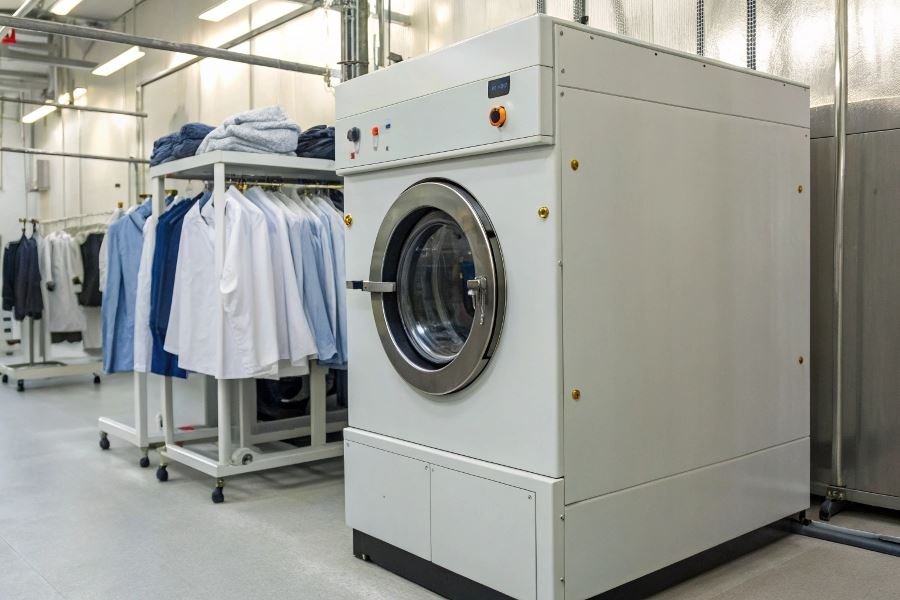
Did you know that commercial dryers can consume up to 15% of a laundry facility’s total energy budget? For businesses processing thousands of pounds of laundry daily, this translates to tens of thousands of dollars annually—money that could be reinvested elsewhere.
The landscape of commercial laundry equipment has transformed dramatically since the early 2010s. Today’s most innovative dryers don’t just dry clothes—they intelligently manage energy consumption while delivering superior performance. These technological marvels represent the pinnacle of efficiency, offering business owners the rare opportunity to simultaneously reduce operational costs and environmental impact.
Why energy efficiency matters in commercial laundry
Energy efficiency isn’t just about lower utility bills (though that’s certainly a compelling benefit). It’s about:
- Reduced carbon footprint: Modern energy-efficient dryers can cut greenhouse gas emissions by up to 30% compared to standard models
- Extended equipment lifespan: Less energy consumption often correlates with reduced mechanical stress
- Enhanced drying quality: Contrary to popular belief, energy-efficient models often provide more consistent drying results
Essential selection criteria for your next dryer
When evaluating energy-efficient commercial dryers, focus on these critical factors:
- Heat recovery systems: Look for models that capture and reuse exhaust heat
- Moisture sensing technology: Advanced sensors that prevent over-drying
- Programmable controls: Customizable cycles for different fabric types
- Maintenance requirements: Some high-efficiency models require more specialized maintenance
The efficiency leaders: Three standout performers
The market’s top performers combine innovative technology with practical design. The best energy-efficient commercial dryers balance initial investment against long-term operational savings, typically achieving ROI within 18-36 months depending on usage volume.
The Ultimate Dryer Showdown: Commercial Efficiency Champions
Heat Pump Technology: The Capacity Revolution
Commercial laundry operations face a constant battle between energy consumption and performance. Heat pump dryers have emerged as frontrunners in this arena, offering remarkable efficiency without sacrificing drying power. The Miele PT 8337 WP exemplifies this technology with its closed-loop system that recirculates heated air instead of venting it outside. This engineering marvel reduces energy consumption by up to 60% compared to conventional dryers.
When evaluating the top 3 energy-efficient dryers for commercial laundries, heat pump models consistently demonstrate superior performance metrics. The technical specifications tell the story: these units typically operate at temperatures between 122°F and 158°F, gentler than traditional dryers yet equally effective at moisture removal.
Key specifications worth noting:
- Load capacity: 25-35 pounds per cycle
- Energy consumption: 1.8-2.5 kWh per cycle
- Moisture extraction rate: 12-15 gallons per hour
- Expected ROI timeframe: 18-24 months
The Electrolux Professional Line 6000 heat pump dryer deserves special mention for its adaptive fan speed technology that automatically adjusts based on load size and fabric type, further optimizing energy usage while maintaining a 30-minute cycle time for standard loads.
Gas-Powered Efficiency: Maximum Output, Minimal Input
Gas dryers continue to dominate many commercial settings due to their rapid heating capabilities and lower operational costs in regions with favorable natural gas pricing. The UniMac UU Series represents the pinnacle of gas-powered efficiency with its precisely calibrated burner system and axial airflow design.
| Model | BTU Rating | Cycle Time | Energy Star Rating | Annual Operating Cost |
|---|---|---|---|---|
| UniMac UU75 | 165,000 BTU | 28 min | ★★★★☆ | $1,850 |
| ADC EcoDry 65 | 150,000 BTU | 32 min | ★★★★★ | $1,680 |
| Huebsch Galaxy 600 | 175,000 BTU | 25 min | ★★★☆☆ | $2,100 |
The efficiency secret lies in advanced heat exchangers that capture and redistribute thermal energy that would otherwise escape. Modern gas dryers incorporate variable frequency drives that maintain precise drum speeds, optimizing the balance between drying time and gas consumption.
The most impressive advancement comes from modulating gas valves that adjust flame intensity in real-time, eliminating the energy waste of traditional on/off cycling.
Electric Precision: The Moisture Sensing Revolution
Electric commercial dryers have undergone a technological renaissance with the integration of advanced moisture sensing capabilities. Unlike timer-based systems that often over-dry garments (wasting energy) or under-dry them (requiring additional cycles), these intelligent systems know exactly when to stop.
The Speed Queen Quantum employs multiple moisture sensors positioned throughout the drum to create a comprehensive moisture map of the entire load. This data feeds into a microprocessor that:
- Calculates optimal drying parameters
- Adjusts heating element output in real-time
- Modifies airflow patterns based on load density
- Terminates the cycle at precisely the right moment
Energy efficiency gains from advanced moisture sensing:
- Reduction in over-drying: 22-28%
- Overall electricity consumption decrease: 15-20%
- Extended fabric lifespan: 30% improvement
- Decreased cycle times: Average 7-minute reduction
The Dexter T-50×2 takes this concept further with its Moisture Detection Auto Dry technology that can distinguish between different fabric types within the same load, applying variable heat levels to different sections of the drum—a game-changer for mixed-load commercial operations.
These technological advancements represent not just incremental improvements but fundamental shifts in how commercial laundry operations can balance performance demands with energy conservation imperatives.
Maximizing Your Commercial Dryer Investment
The ROI equation for energy efficiency
When calculating return on investment for energy-efficient commercial dryers, the numbers tell a compelling story. A premium Speed Queen commercial dryer typically costs 3, 000−5,000 more upfront than standard models, but delivers 30-40% energy savings annually. For a medium-sized laundromat processing 500 loads weekly, this translates to approximately $4,200 in utility savings per year.
The math becomes even more favorable when factoring in utility rebates. Many energy providers offer incentives ranging from 500−2,500 for qualifying commercial equipment upgrades. The American Gas Association reports that businesses implementing energy-efficient gas dryers recoup their investment in just 18-24 months on average.
Real-world ROI calculation:
Initial premium: $4,000
Annual energy savings: $4,200
Utility rebate: $1,500
Payback period: 7 months
5-year savings: $21,000
This doesn’t even account for reduced maintenance costs and extended equipment lifespan, which can add thousands more to your bottom line.
Beyond purchase price
Installation of commercial energy-efficient dryers requires careful planning. Most high-efficiency models need:
- Proper ventilation systems (minimum 8-inch diameter ducts)
- Dedicated electrical circuits (typically 208-240V)
- Adequate gas line capacity for gas models
- Level flooring with reinforcement for heavier units
Installation costs vary significantly based on your facility’s existing infrastructure. Budget 800−1,500 per unit for professional installation if significant modifications are needed.
Maintenance considerations differ substantially between standard and energy-efficient models. While high-efficiency dryers incorporate more sophisticated components, they typically require:
| Maintenance Task | Frequency | Approximate Cost |
|---|---|---|
| Lint system cleaning | Weekly | In-house |
| Airflow verification | Monthly | In-house |
| Moisture sensor calibration | Quarterly | $150-200 |
| Full preventative service | Annually | $350-500 |
Dexter Laundry recommends establishing a maintenance contract, which typically reduces service costs by 15-20% while extending equipment lifespan by up to 40%.
Right-sizing your efficiency investment
For small operations (under 100 loads daily):
- Focus on stack units with moisture sensing technology
- Consider Huebsch 30lb models with reversing cylinders
- Prioritize models with programmable controls for varied load types
For medium operations (100-300 loads daily):
- Invest in dedicated high-capacity units (50-75lb)
- Look for heat reclamation systems
- Prioritize models with advanced airflow management
For large operations (300+ loads daily):
- Tunnel dryers offer maximum efficiency at scale
- UniMac industrial models with integrated fire suppression
- Consider hybrid heating systems (gas/electric) for operational flexibility
The most overlooked factor in dryer selection is load composition analysis. Facilities processing primarily lightweight items benefit most from infrared drying technology, while those handling dense materials should prioritize extended airflow systems.
Remember that energy efficiency isn’t just about utility bills—it’s about throughput capacity, labor reduction, and fabric preservation. The most efficient dryer for your operation is one that balances all these factors against your specific business model.
Discover the top 3 commercial dryers that dramatically reduce energy costs while maintaining performance. Compare heat pump, gas, and electric models with advanced efficiency features to maximize ROI for your commercial laundry operation.
Discover the top 3 commercial dryers that dramatically reduce energy costs while maintaining performance. Compare heat pump, gas, and electric models with advanced efficiency features to maximize ROI for your commercial laundry operation.