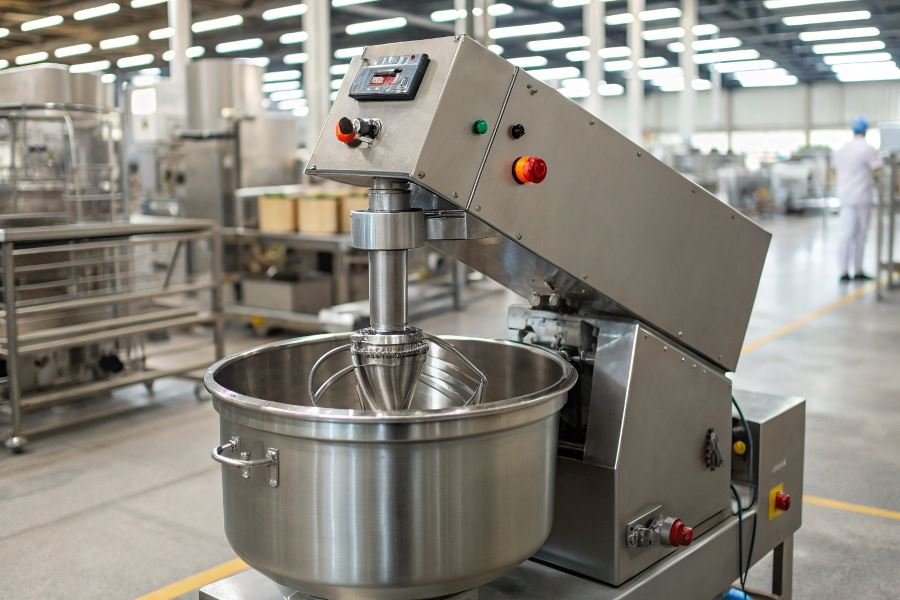
What if I told you that one of the most overlooked pieces of equipment in manufacturing could be your biggest opportunity for cost savings?
Behind every quality product—from pharmaceuticals to food, cosmetics to chemicals—industrial mixers work tirelessly, blending, homogenizing, and emulsifying raw materials into finished goods. These workhorses consume significant energy, often operating 24/7 in production facilities across America. Yet many manufacturers overlook their potential for efficiency gains.
Energy-efficient industrial mixers represent a remarkable intersection of sustainability and profitability. These advanced systems deliver the same (or better) mixing performance while consuming up to 30% less electricity than conventional models. The beauty lies in their precision: optimized blade designs, variable frequency drives, and intelligent control systems that adjust power consumption based on actual mixing requirements rather than running at full capacity regardless of need.
“The mixer is the heart of our production line. When we upgraded to energy-efficient models, we saw immediate savings without any compromise in product consistency.” — Production Manager at a leading food manufacturer
Manufacturing facilities face mounting pressure to reduce their carbon footprint while maintaining competitive pricing. Energy costs typically represent 15-30% of operational expenses in processing industries, making efficiency improvements a strategic priority.
The transformation goes beyond simple energy reduction. Modern energy-efficient mixers offer:
- Precision control that ensures consistent product quality
- Reduced maintenance requirements and longer equipment lifespan
- Lower heat generation, critical for temperature-sensitive products
- Smaller motor requirements without sacrificing torque or mixing capability
For manufacturers seeking both sustainability and profitability, these innovations deliver the rare promise of savings without sacrifice.
The Engineering Marvel Behind Efficient Industrial Mixing
Industrial mixing technology has undergone a remarkable transformation. Today’s energy-efficient industrial mixers deliver substantial operational savings without compromising on mixing quality or production output. This evolution represents one of manufacturing’s most significant efficiency breakthroughs, combining advanced engineering with smart technology to revolutionize mixing operations across industries.
The pursuit of energy-efficient industrial mixers: savings without loss of quality has become a central focus for forward-thinking manufacturers. With energy costs continuing to rise and sustainability targets becoming more stringent, these advanced mixing systems offer a compelling solution that addresses both economic and environmental concerns while maintaining—and often improving—product consistency.
Motor Innovation Drives Efficiency Forward
At the heart of modern mixer efficiency lies revolutionary motor design. The shift from standard AC motors to premium efficiency IE3 and IE4 motors has delivered immediate energy reductions of 10-15% in typical applications. When paired with Variable Frequency Drives (VFDs), these systems achieve even greater savings by precisely matching motor output to process requirements.
Key efficiency advantages include:
- Dynamic speed adjustment based on real-time mixing needs
- Elimination of energy-wasting fixed-speed operation
- Reduced mechanical stress during startup and operation
- Extended equipment lifespan through optimized performance profiles
A 2022 study by the American Council for an Energy-Efficient Economy found that VFD implementation in industrial mixing applications typically delivers ROI within 12-18 months, with energy savings continuing for the equipment’s operational life.
Impeller Design: Where Physics Meets Efficiency
The humble impeller has undergone a remarkable transformation through computational fluid dynamics (CFD) modeling and advanced materials science.
Modern impeller designs create optimal flow patterns with significantly less energy input than their predecessors.
| Impeller Type | Energy Efficiency | Application Strength |
|---|---|---|
| Hydrofoil | Excellent | Low-viscosity mixing |
| Helical | Very Good | High-viscosity fluids |
| High-Shear | Good | Emulsification |
| Pitched-Blade | Very Good | Solids suspension |
Alfa Laval and other industry leaders have developed impellers that reduce power consumption by up to 30% while maintaining—or even improving—mixing effectiveness. These designs leverage principles like:
- Optimized blade angles that minimize turbulence while maximizing flow
- Multi-stage configurations that create complementary mixing zones
- Self-cleaning geometries that prevent buildup and maintain efficiency
- Material selections that reduce friction and resist corrosion
Smart Control Systems: The Digital Efficiency Multiplier
The integration of intelligent control systems represents perhaps the most transformative advancement in mixer efficiency. These systems leverage real-time data to optimize performance continuously.
“Smart mixing technology doesn’t just save energy—it fundamentally transforms how we approach process optimization.” – Chemical Processing Magazine
Modern mixers equipped with Siemens or similar automation platforms deliver:
Adaptive mixing profiles that automatically adjust to changing batch conditions, viscosity variations, and temperature fluctuations
Predictive maintenance capabilities that identify potential issues before they impact efficiency or cause downtime
Process integration with upstream and downstream equipment to synchronize operations and eliminate wasteful idle time
Data analytics that continuously refine mixing parameters based on historical performance
The combination of these core technologies—advanced motors, optimized impellers, and intelligent controls—has transformed industrial mixing from an energy-intensive necessity to a model of efficient manufacturing. Companies implementing these technologies typically report energy savings of 30-50% compared to legacy systems, with improved product consistency and reduced maintenance requirements as valuable secondary benefits.
Maximizing ROI with Energy-Efficient Industrial Mixers
The dollars and sense of efficiency upgrades
When calculating the long-term cost benefits of energy-efficient industrial mixers, the numbers tell a compelling story. Modern energy-efficient mixers typically deliver 30-45% energy savings compared to conventional models, translating to substantial operational cost reductions. A medium-sized manufacturing facility operating mixers for 6,000 hours annually can expect to save 12, 000−18,000 per year on energy costs alone.
The ROI calculation extends beyond mere energy savings:
| Benefit Category | Typical Annual Savings | 10-Year Projection |
|---|---|---|
| Energy costs | 12, 000−18,000 | 120, 000−180,000 |
| Maintenance reduction | 3, 000−5,000 | 30, 000−50,000 |
| Downtime prevention | 8, 000−15,000 | 80, 000−150,000 |
| Extended equipment life | N/A | 40, 000−60,000 |
The payback period for most energy-efficient industrial mixers ranges from 14-24 months, depending on usage intensity and local energy costs. After this threshold, the equipment becomes a profit-generating asset rather than an expense.
Real-world success stories across industries
The proof is in the implementation. Consider these transformative case studies:
A Pennsylvania food processing plant replaced eight conventional mixers with Silverson high-efficiency models in 2022, reducing energy consumption by 38% while increasing production throughput by 12%. Their annual savings exceeded $95,000, with complete ROI achieved in just 19 months.
In the chemical manufacturing sector, a Texas-based polymer producer upgraded to Ekato energy-efficient mixing systems, resulting in 42% energy reduction and improved product consistency. The unexpected benefit? Their carbon footprint reduction qualified them for sustainability tax incentives worth an additional $32,000 annually.
Perhaps most impressive is the pharmaceutical company that implemented IKA energy-efficient mixers across their production line. Beyond the expected energy savings of $120,000 annually, they documented a 9% improvement in product quality metrics and reduced batch rejection rates by 14%.
Quality preservation through strategic implementation
The difference between mediocre and exceptional ROI often comes down to implementation practices. Industry leaders recommend:
-
Comprehensive energy auditing before selection to establish accurate baseline measurements and identify specific efficiency opportunities
-
Right-sizing equipment to application needs—oversized mixers waste energy while undersized units compromise quality and extend processing time
-
Prioritizing variable frequency drives (VFDs) which allow precise control of mixing speeds, reducing energy consumption by up to 60% during low-intensity mixing phases
-
Implementing predictive maintenance protocols using vibration analysis and power consumption monitoring to detect issues before they impact quality or efficiency
-
Training operators specifically on energy-efficient operation techniques, as human factors can impact efficiency by 15-20%
The most successful implementations pair technological upgrades with process optimization. A well-calibrated energy-efficient mixer operating within an optimized process can deliver up to 65% total efficiency improvements compared to conventional systems.
“The greatest ROI comes not from the equipment itself, but from the synergy between advanced technology and optimized operational practices.”
By approaching energy-efficient mixer implementation as a comprehensive system rather than a simple equipment swap, manufacturers across industries are discovering that efficiency and quality aren’t competing priorities—they’re complementary outcomes of thoughtful modernization.
Discover how cutting-edge industrial mixers reduce energy consumption while maintaining product quality. Learn about advanced motor designs, optimized impellers, and smart controls that deliver substantial ROI for manufacturing operations.
Discover how cutting-edge industrial mixers reduce energy consumption while maintaining product quality. Learn about advanced motor designs, optimized impellers, and smart controls that deliver substantial ROI for manufacturing operations.