Ever wondered why store-bought mayonnaise achieves that perfect consistency while your homemade version separates after a day? The secret lies not just in ingredients, but in the mixing technology that transforms raw components into culinary masterpieces.
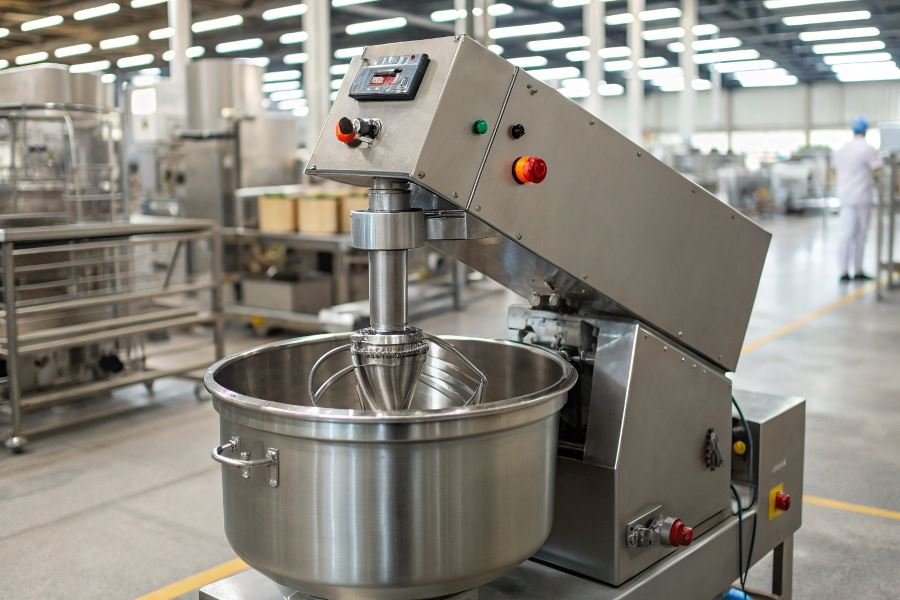
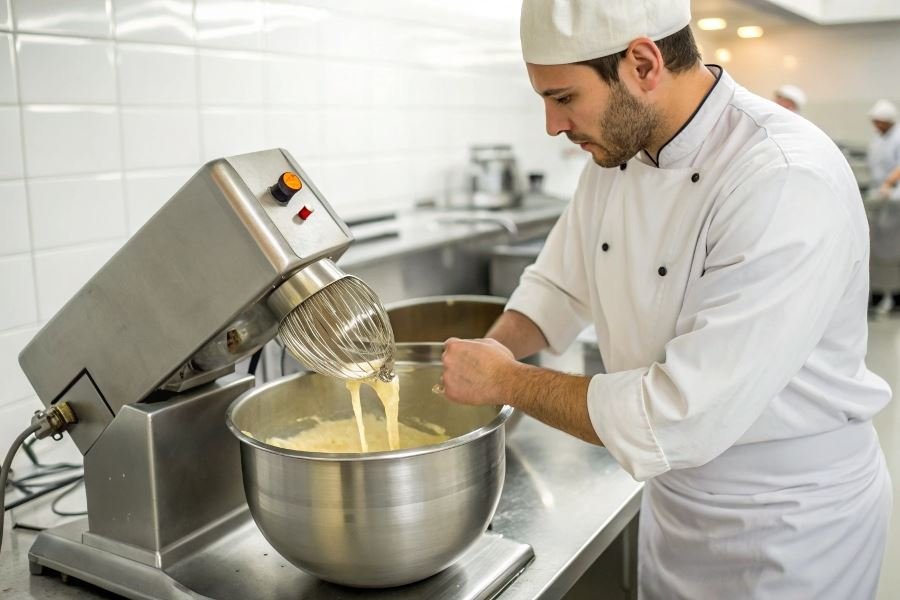
Behind every smooth chocolate ganache, velvety salad dressing, and creamy cosmetic lotion stands an unsung hero: the industrial mixer. These powerhouse machines represent the critical intersection where culinary art meets precision engineering, transforming disparate ingredients into cohesive, stable products that maintain their integrity from production line to consumer.
The backbone of consistency
Industrial mixers don’t just blend—they transform ingredients through precisely controlled mechanical forces. When Heinz launched their iconic ketchup in 1876, consistency between batches was a constant challenge. Today’s mixing technology ensures that whether you’re in Seattle or Miami, your favorite sauce tastes identical bottle after bottle, year after year.
Navigating mixing challenges
Creating the perfect sauce or cream presents formidable technical hurdles:
- Emulsification stability: Preventing oil and water separation over time
- Particle suspension: Maintaining even distribution of herbs, spices, and solids
- Texture development: Achieving the precise viscosity and mouthfeel that defines premium products
- Scale consistency: Ensuring laboratory perfection translates to production quantities
Selection criteria that matter
Choosing the right industrial mixer isn’t about finding the most expensive equipment—it’s about matching technology to specific product requirements. The difference between a planetary mixer and a high-shear homogenizer can mean the difference between product success and failure. Factors like ingredient sensitivity, viscosity changes during processing, and production volume requirements must drive equipment selection decisions.
When selecting mixing technology, manufacturers must balance technical performance with practical considerations like energy efficiency, cleaning requirements, and maintenance accessibility—all while meeting increasingly demanding consumer expectations for product quality and consistency.
Technical Specifications That Make or Break Your Mixer
When selecting industrial mixers for sauces and creams, the technical specifications aren’t just numbers on a spec sheet—they’re the difference between silky-smooth chocolate ganache and a lumpy disaster. The industrial food processing sector demands equipment that delivers consistency, efficiency, and reliability, especially when dealing with viscous products like sauces and creams that require precise handling.
Understanding the features of selection for industrial mixers for sauces and creams requires diving deep into the technical aspects that affect performance. The right mixer doesn’t just blend ingredients—it transforms them with mathematical precision while meeting strict industry standards. Let’s examine the critical specifications that should guide your investment decision.
Capacity That Matches Your Production Needs
The mixing capacity directly impacts your production efficiency and output quality. Consider:
- Batch size requirements: Most industrial mixers range from 50 to 5,000 liters
- Working volume vs. total volume: Effective capacity is typically 70-80% of total volume
- Headspace requirements: Creams may expand during mixing, requiring 25-30% additional space
When selecting capacity, think beyond current needs. A Hobart mixer sized perfectly for today might become a bottleneck tomorrow as your production scales.
Oversizing isn’t always the answer—larger mixers consume more energy and may create dead zones with insufficient product to engage mixing elements properly.
Power and Efficiency Metrics
| Power Rating | Typical Applications | Energy Consumption |
|---|---|---|
| 1-5 HP | Light sauces, dressings | 0.75-3.7 kW/h |
| 5-20 HP | Medium-viscosity creams | 3.7-15 kW/h |
| 20-50 HP | Heavy batters, thick creams | 15-37 kW/h |
Energy efficiency isn’t just about operating costs—it affects product quality too. Modern mixers from manufacturers like Alfa Laval incorporate variable frequency drives that adjust power consumption based on load, saving up to 30% on energy while delivering more consistent results.
Construction Materials and Sanitation
Food-grade materials aren’t optional—they’re essential. The industry standard is 316L stainless steel for product-contact surfaces, offering:
- Corrosion resistance against acidic sauces and cleaning chemicals
- Non-reactive surfaces that won’t alter flavor profiles
- Durability under high-temperature cleaning protocols
Surface finish matters tremendously. A mixer with an electropolished finish (Ra value <0.8μm) from SPX Flow will resist bacterial adhesion and clean more thoroughly than one with a rougher finish.
The welding quality on your mixer isn’t just about durability—it’s about eliminating microscopic crevices where bacteria could hide, potentially compromising entire production batches.
Speed Control and Mixing Precision
The difference between a premium sauce and an average one often comes down to mixing precision:
- Variable speed ranges: Professional mixers offer 5-150 RPM for gentle folding to high-shear mixing
- Torque consistency: Maintains speed under varying loads
- Programmable profiles: Modern systems from Silverson allow multi-stage mixing programs with precise timing
Advanced mixers incorporate dual-direction capabilities, allowing the mixing head to reverse direction mid-cycle—critical for achieving the perfect emulsion in cream-based products.
The precision of your mixer’s speed control directly affects product consistency, texture development, and ingredient incorporation. For delicate creams, look for systems with at least ±1 RPM accuracy at low speeds to ensure batch-to-batch consistency that customers will notice and appreciate.
Top 3 Industrial Mixers That Revolutionize Sauce Production
High-viscosity mixers for thick formulations
When production demands call for handling thick, resistant materials, high-viscosity industrial mixers become your operation’s backbone. These powerhouses are specifically engineered to maintain performance even when confronting the most challenging creams and sauces.
The Silverson Ultramix stands out with its impressive 30 horsepower motor and specialized impeller design that creates both vertical and horizontal flow patterns. This dual-action movement prevents “dead spots” in your mixture—a critical factor when working with products like caramel sauces or cream cheese bases that can easily develop inconsistencies.
Key performance indicators for high-viscosity mixers include:
- Torque ratings exceeding 10,000 in-lbs
- Variable speed drives (typically 50-1200 RPM)
- Reinforced shaft designs with specialized seals
- Heat dissipation systems to prevent product degradation
The Breddo LDTW series deserves mention for its innovative bottom-entry design, which excels with products reaching viscosities up to 100,000 centipoise—approximately the consistency of cold honey. Its jacketed vessel design allows precise temperature control during mixing, critical for maintaining the structural integrity of thick dairy-based products.
Versatile multi-purpose industrial mixers
For operations requiring flexibility across product lines, versatile multi-purpose mixers deliver exceptional adaptability without sacrificing performance.
The true value of these systems lies in their modular design philosophy, allowing operators to reconfigure components based on specific batch requirements.
| Mixer Type | Viscosity Range | Batch Size Capacity | Interchangeable Parts |
|---|---|---|---|
| Admix Rotosolver | 1-50,000 cP | 5-500 gallons | 4 impeller options |
| SPX Flow Lightnin | 1-100,000 cP | 10-1,000 gallons | 6 impeller options |
| Ross VersaMix | 1-2,000,000 cP | 25-4,000 gallons | 8 impeller options |
The multi-purpose category shines with innovations like the Ross VersaMix, featuring triple-shaft technology that combines high-shear dispersers, three-wing anchors, and high-speed rotors in a single unit. This configuration allows operators to transition from water-thin vinaigrettes to mayonnaise-thick emulsions without changing equipment.
Specialized emulsion mixers for stability
When product stability and texture uniformity become paramount concerns, specialized emulsion mixers deliver unmatched performance through precision engineering.
The IKA Magic Lab represents the gold standard with its ability to create droplet sizes as small as 1 micron—essential for preventing separation in oil-in-water emulsions like salad dressings and cream-based sauces. Its inline rotor-stator design creates intense shear forces that break down particles while maintaining consistent circulation.
Critical factors for emulsion stability include:
- Tip speeds exceeding 5,000 feet per minute
- Precision-machined tolerances between rotors and stators (often <0.005″)
- Controlled turbulence patterns that prevent coalescence
- Vacuum capabilities to eliminate air incorporation
The Quadro Ytron deserves recognition for its Z-blade configuration that creates both vertical and horizontal mixing patterns simultaneously. This unique approach ensures homogeneous distribution of emulsifiers and stabilizers throughout the product matrix, extending shelf life and maintaining mouthfeel consistency from first production to final consumption.
When selecting an emulsion mixer, prioritize systems with programmable recipe management that can reproduce exact processing parameters batch after batch—the difference between consistent quality and unpredictable results.
Discover essential features for selecting industrial mixers that deliver perfect consistency in sauces and creams. Compare top models based on capacity, power efficiency, and specialized mixing capabilities for your food production needs.
Discover essential features for selecting industrial mixers that deliver perfect consistency in sauces and creams. Compare top models based on capacity, power efficiency, and specialized mixing capabilities for your food production needs.